What this code means
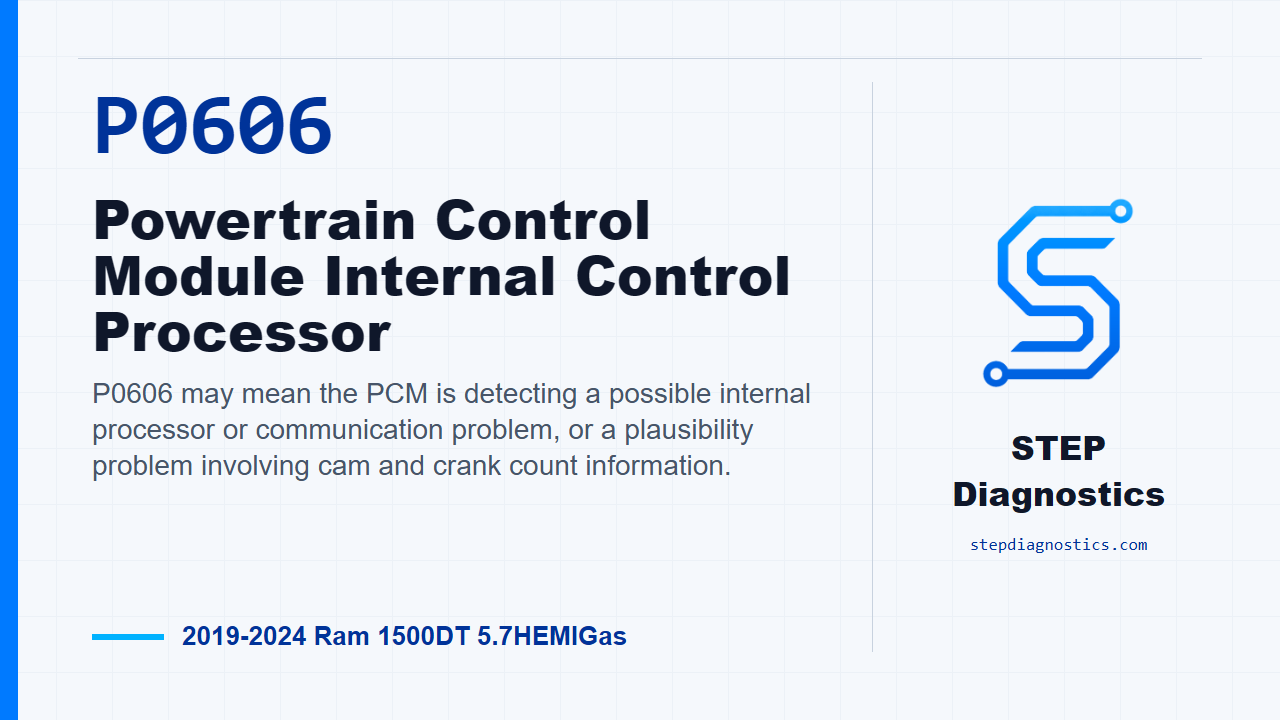
P0606 may mean the PCM is detecting a possible internal processor or communication problem, or a plausibility problem involving cam and crank count information.
What the vehicle may do
- The MIL may illuminate.
- The ETC light may flash.
- Throttle input and vehicle speed may be limited.
Possible fault areas
- Possible PCM internal control issue.
- Possible cam or crank signal-related issue.
- Possible low system voltage concern.
- Possible PCM or related connector and terminal condition.
Diagnostic path
Code overview
On this Ram 1500 with the 5.7 Hemi, P0606 points to a possible internal processor problem in the Powertrain Control Module. In plain language, the PCM is seeing something it does not like inside its own control logic, or in the way the cam and crank count information is lining up. The truck may turn on the MIL, the ETC light may flash, and throttle input or vehicle speed may be limited. Before condemning anything, treat this like a controlled diagnostic: start with the basic system checks, capture the data, and make the code prove itself.
Confirm the code returns
Start by scanning every module, not just the PCM. Record the DTCs on the repair order, and save the vehicle scan report with the related recorded data. Then erase all DTCs. Turn the ignition off for a minimum of 10.0 seconds, turn the ignition back on, and operate the vehicle under the same type of conditions that set the code. Since this monitor runs with the engine running, use the captured data and the set conditions to make the retest meaningful. After that, read the DTCs again. If P0606 does not return, treat it as an intermittent condition and do not force a hard-part conclusion.
Check for codes that change the path
If P0606 does return, look back at the recorded codes before going deeper. If there are active or pending cam sensor, crank sensor, or low system voltage codes, diagnose those first. Those faults can affect the logic this code is watching, so do not skip past them. If those code groups are not active or pending, continue with the P0606 path.
Inspect PCM and related connections
Next, handle the connection side carefully. Perform any applicable service bulletins first. Disconnect the PCM harness connectors, any related in-line connectors if equipped, and the related component connectors. Inspect the harness connectors, component connectors, and male and female terminals for poor installation, damaged locks, corrosion, water intrusion, weather seal damage, bent terminals, heat damage from a poor connection, terminals pushed back in the cavity, spread terminals, and weak terminal tension. Repair any condition you find. Then reconnect the PCM connectors, in-line connectors if equipped, and related component connectors, making sure they are fully seated and the locks are fully engaged.
Retest after connection repair
After the connector inspection and any needed repair, erase the DTCs again. Test drive or operate the truck under the monitored and set conditions, then read the DTCs. If P0606 does not return, the wiring or poor connection problem has been repaired. Keep that separate from the final verification step: now verify the repair and confirm the code stays gone.
If the code still returns
If P0606 returns after the code has been confirmed, the related code groups have been handled, and the PCM and related connections have been inspected and corrected, the diagnostic path calls for replacing and programming the Powertrain Control Module. After that, verify the repair and confirm the code stays gone.
Takeaway
The key with P0606 is not to jump straight to the PCM. Confirm the code, rule out cam, crank, and low-voltage code paths, inspect the PCM and related connections thoroughly, then make the final call based on whether the code returns. For more diagnostic training, visit stepdiagnostics.com.
Final check
P0606 often needs a disciplined confirmation path before making a PCM decision.
For more guided automotive diagnostics, visit STEP Diagnostics.