Quick answer
The evaporative-emissions (EVAP) system stores gasoline vapor in a charcoal canister, meters it into the engine through the purge circuit, and lets the powertrain control module (PCM) check whether the vapor path can create and retain the expected state. On the exact application reviewed for this overview, the Evaporative System Integrity Monitor (ESIM) switch provides the PCM's primary leak-test evidence. P0440 means the system did not establish the required test state; P0455 means it established vacuum but lost it too quickly. Neither code identifies a failed part by itself.
Applicability and service-information boundary
This overview applies to the 2019-2024 Ram 1500DT 5.7 HEMI Gas configuration. Authorized vehicle records confirm Ram 1500 Truck 4WD applications with the 5.7-liter eTorque MHEV powertrain at the 2019 and 2024 endpoints. Detailed EVAP operation and diagnostic evidence for this overview was verified on the exact 2024 application.
Fuel-filler design, vapor plumbing, calibration, component location, electrical circuits, scan-tool routines, monitor conditions, test pressures, and repair procedures can change by year and equipment. Confirm the VIN and emissions configuration, and use current service information for the exact truck whenever a test requires a value, connector, command, tool, lifting point, power-down step, or component-removal procedure.
What the EVAP system does
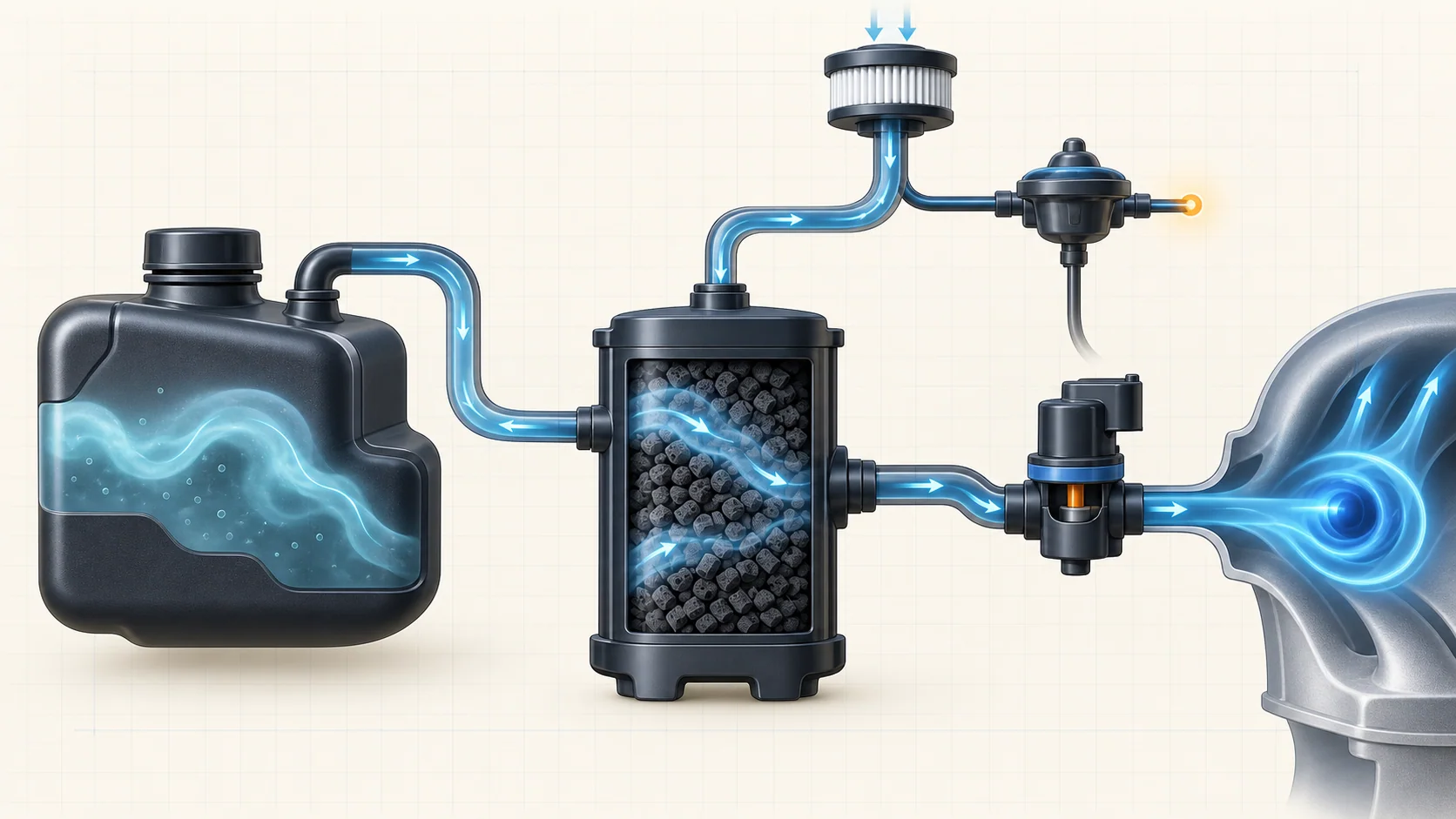
Gasoline produces vapor whenever it is stored and heated. The EVAP system prevents that vapor from being released directly to the atmosphere. Vapor moves from the fuel tank through dedicated plumbing to the charcoal canister, where activated carbon stores hydrocarbons until the engine can consume them.
When operating conditions are suitable, the PCM controls the purge solenoid so intake vacuum draws fresh air through the canister. That air carries stored fuel vapor into the intake, where it is burned. Purge must therefore be controlled: too little flow prevents normal canister clearing, while uncontrolled flow can act like an unwanted fuel-vapor or vacuum input.
The system also needs a controlled fresh-air path, reliable seals, and a way to judge whether the vapor circuit is closed. The ESIM combines pressure- and vacuum-responsive functions with an electrical switch. The PCM uses the switch state to determine whether the system reaches and retains the condition required by its leak monitor.
The main functional sections
- Fuel tank and filler path: Contains liquid fuel while routing vapor through the intended valves, seals, filler components, and vapor plumbing.
- Charcoal canister: Temporarily stores fuel vapor instead of venting it outside.
- Fresh-air filter and vent path: Allows filtered air to replace the vapor drawn out during purge. A restriction here can create abnormal vacuum and misleading evidence.
- Purge solenoid and intake connection: Meter stored vapor into the engine when commanded. The circuit, valve seal, vacuum source, and actual flow are separate things to prove.
- ESIM switch and relief functions: Provide the PCM with system-integrity evidence while also allowing the system to manage normal pressure and vacuum changes.
- Fuel-tank-pressure sensor: Gives the technician useful pressure-trend information and supports directed testing. In the exact strategy reviewed here, it is not the PCM's primary leak pass/fail input.
- PCM diagnostics: Coordinate purge, evaluate ESIM state, check prerequisite conditions, store failure records, and decide when an EVAP monitor has passed or failed.
How this system checks for leaks
A sealed fuel-vapor space naturally changes pressure as fuel and air warm or cool. The monitoring strategy uses those natural changes and controlled purge vacuum to learn whether the system behaves like a closed volume. Because temperature can create or erase pressure quickly, the same physical leak can be obvious in one condition and difficult to reproduce in another.
During an applicable intrusive check, commanded purge creates vacuum in the vapor system. If the ESIM switch never changes to the expected state, the controller cannot conclude that the required vacuum was established. If the switch closes and then opens too soon after purge stops, the system is losing the stored vacuum faster than expected.
That distinction matters. Failure to create vacuum can come from a very large opening, but it can also come from weak purge vacuum, a valve that never opens, a blocked tube, an ESIM switch or circuit fault, or an installation problem. Failure to hold vacuum after it was created points more directly toward leakage, but the leak can still be in plumbing, a seal, the canister, the ESIM, the purge valve, or the tank/filler area.
What P0440 and P0455 are telling you
| DTC | Monitor result | What the technician needs to prove |
|---|---|---|
| P0440 | General EVAP system failure: the required test state was not established | Whether the system has a gross opening, insufficient purge/vacuum, a restriction, an ESIM switch/circuit or installation problem, or another condition that prevents valid test evidence |
| P0455 | Large-leak behavior: vacuum was established but decayed too quickly | Whether vapor plumbing, filler/tank seals, canister, ESIM sealing, or a purge valve that leaks when closed is allowing the system to lose vacuum |
The labels overlap because both codes belong to the same integrity strategy. Do not translate P0440 into “replace the ESIM” or P0455 into “replace the fuel cap.” First identify what the monitor failed to accomplish, then test the system branch that could explain that result.
What the driver or technician may notice
The malfunction indicator lamp may be the only obvious symptom. The truck can drive normally because a sealing fault may not affect combustion during most operation. Depending on the cause, the driver or technician may also notice fuel-vapor odor, difficult refueling, a monitor that remains incomplete, a code that returns only after an overnight soak, or rough running after refueling when purge is uncontrolled.
Fuel odor is a safety clue, not proof of location. Stop diagnosis and correct any liquid-fuel leak before continuing EVAP testing.
Common failure categories
An opening in the sealed vapor path
A filler seal, capless sealing unit, hose, formed tube, tank connection, pump-module seal, canister housing, or service connection can leak. Impact damage, rubbing, dirt on a sealing surface, and recently disturbed plumbing deserve attention.
Purge flow or vacuum-source failure
The purge solenoid may fail to open, respond electrically without flowing, lack a usable intake-vacuum source, or have a restricted line. These faults can prevent P0440's required state even when the rest of the system is sealed.
Purge valve leaking when commanded closed
An internally leaking purge valve can create vacuum at the wrong time or let a sealed system lose its state. Separate electrical command, mechanical sealing, and actual flow before replacing the valve.
Restricted vent, filter, canister, or vapor tube
A blocked fresh-air path can create excessive vacuum or slow pressure equalization. A pinched purge or canister line can prevent the expected response. Hard refueling can support a restriction direction, but it does not identify the restricted component.
ESIM installation, mechanical, switch, or circuit problem
The ESIM must be installed correctly, its relief functions must move, and its electrical switch state must reach the PCM. A switch that is stuck, an open ground or signal path, terminal damage, or incorrect mounting can imitate a sealing or purge fault.
Operating-condition or intermittent problem
Fuel level, ambient and fuel temperature, recent refueling, heat soak, engine-off time, and a marginal seal can change the result. A rapid shop-temperature transition can make a valid test difficult to interpret. Preserve monitor evidence before disturbing the system.
A practical system-first diagnostic strategy
Step 1: Confirm the truck and preserve evidence
Verify the VIN, model year, 5.7-liter eTorque configuration, emissions label, and current service information. Save the full module scan, DTC status, freeze-frame or failure records, readiness state, fuel level, temperature context, recent refueling history, and recent repair history before clearing anything.
Step 2: Classify the failed behavior
Decide whether the evidence says the system could not create the required state, created it but could not hold it, or never met the conditions needed to run a valid monitor. This prevents a general EVAP code from being treated as a parts list.
Step 3: Resolve related electrical and control faults first
Address purge-circuit, ESIM-circuit, reference-voltage, pressure-sensor, power, ground, or other prerequisite codes in the order specified for the truck. A leak test cannot validate a switch signal that the PCM cannot receive.
Step 4: Inspect the complete vapor path
Inspect the filler seal, tank-area connections, canister, ESIM, fresh-air filter, purge plumbing, intake connection, wiring, and anything recently disturbed. Look for liquid fuel, impact damage, rubbed or pinched tubing, disconnected fittings, contamination, and incorrect routing.
Step 5: Observe purge, ESIM, and pressure trends together
Use the exact current data list and procedure. Confirm that purge command, available vacuum, ESIM state, and tank-pressure trend tell one coherent story. Pressure data can help reveal whether the physical system moved even though the ESIM switch did not, but it does not replace the switch in the reviewed leak-decision strategy.
Step 6: Separate sealing from flow and restriction
Use the approved directed test to prove whether the closed system leaks. Separately prove that purge can create the required response and that the vent path is not restricted. A successful smoke check does not prove purge flow, and a purge command does not prove the system is sealed.
Step 7: Isolate the leaking or nonresponsive section
If leakage is confirmed, divide the system only as the current procedure permits so the tank/filler side can be distinguished from the canister/fresh-air/purge side. Test components only after the system evidence points to that branch.
Step 8: Match the repair to the proven cause
Repair the damaged seal or vapor line, restore a restricted path, correct wiring or terminals, service an incorrectly installed component, or replace a valve, sensor, canister, or ESIM only when its directed test fails. PCM replacement belongs at the end of a completed diagnostic path.
Step 9: Recreate the monitor and verify
Restore every connection, complete required resets or routines, and reproduce the applicable temperature, fuel-level, soak, purge, and operating conditions. Confirm that the system reaches and retains the expected state, the relevant monitor completes, and no pending or confirmed code returns. A cleared lamp with an incomplete EVAP monitor is not a verified repair.
Safety before testing
Gasoline vapor is flammable. Work in a ventilated area away from flames, sparks, hot tools, and other ignition sources. Wear eye protection, contain any fuel release, and follow the current procedure before opening a fuel or vapor connection. If liquid fuel is present, stop and correct that leak first.
Use only EVAP test equipment approved for the procedure. Never apply oxygen, unrestricted shop air, or an improvised smoke source directly to the system. An approved leak machine may use regulated shop air as its supply only when connected and operated exactly as specified. Excess pressure can damage the tank, valves, canister, or sensors and can create a fire hazard.
If the truck must be raised, use approved lift points and supports; never rely on a jack alone. Keep leads, clothing, and tools clear of fans, belts, exhaust components, and other hot or rotating parts during running tests.
The verified applications include eTorque stop/start hardware. Before underhood or electrical work, place the truck in the safe service state required by current information and confirm the engine cannot restart unexpectedly. Follow the exact battery and power-down procedure before disconnecting related sensors or controller circuits.
Final takeaway
The EVAP system is a controlled vapor circuit, not a collection of parts to replace from a code name. The tank and canister store vapor, the vent path admits clean air, the purge circuit moves vapor into the engine, and the ESIM gives the PCM evidence about system integrity. P0440 says the required test state was not established. P0455 says vacuum was established but escaped too quickly.
Preserve the failure conditions, confirm code priority, inspect the full path, compare purge command with ESIM and pressure behavior, prove sealing separately from flow, isolate the responsible section, and rerun the correct monitor after repair. The linked STEP guides provide model-specific educational paths; current service information for the exact truck controls specifications, tools, component access, and final verification.