
Mechanic Guides
Automotive Oscilloscope vs Multimeter: Choose the Measurement Before the Tool
Choose a meter or waveform capture by the question you need to answer, then document the setup and limits before drawing a repair conclusion.
Published · 5 min read
Quick answer
Use a multimeter for the appropriate numeric measurement. Use an oscilloscope when signal shape or timing is the question. Neither instrument proves a component is faulty without a valid setup, applicable reference and repeatable evidence.
A technician should be able to finish this sentence before reaching for a tool: “I need to measure ___ under ___ conditions so I can decide ___.” That sentence is more useful than a rule that one instrument is always better.
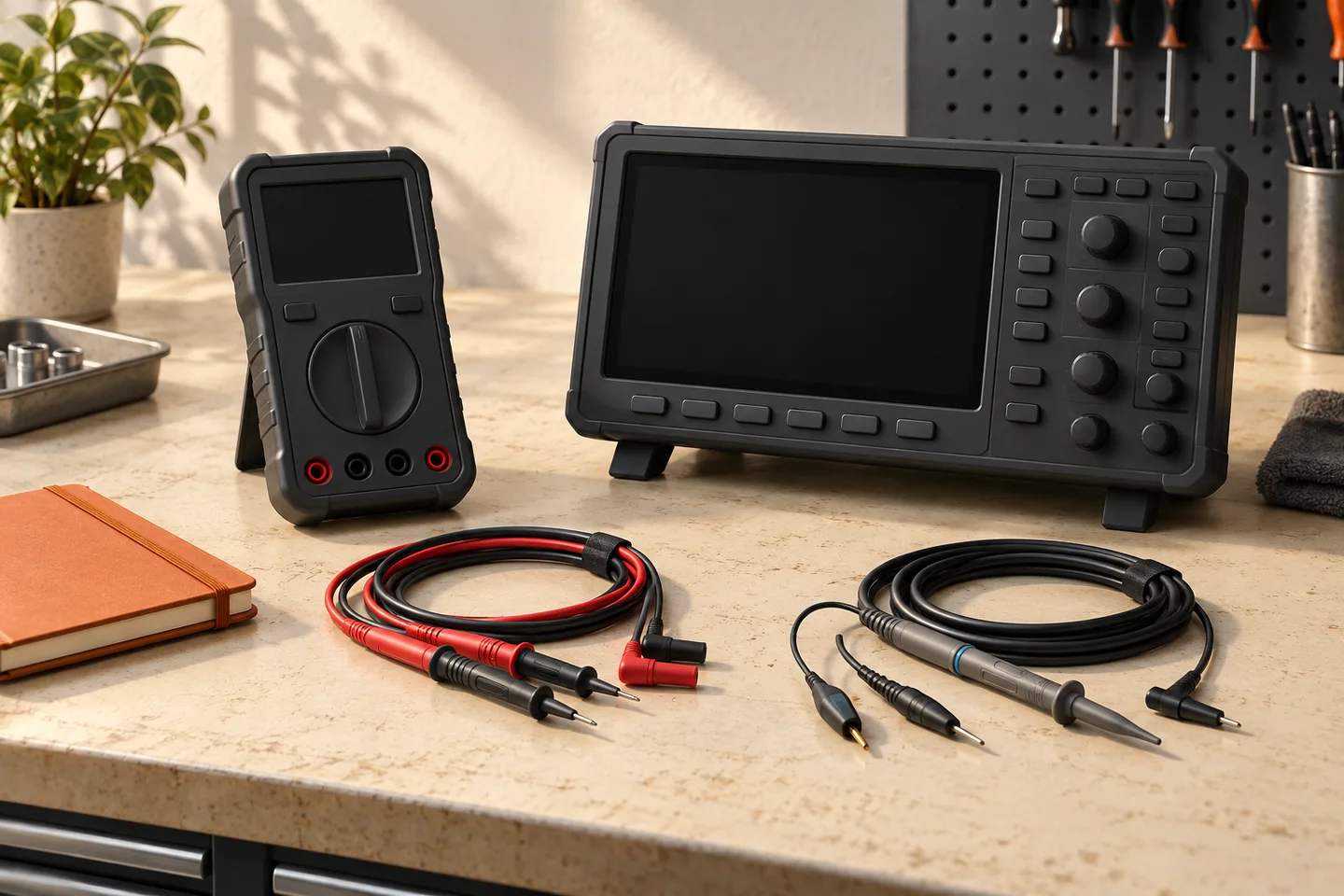
A multimeter reports electrical quantities as numeric readings. An oscilloscope displays how a signal behaves over time. Some instruments combine these functions, and some meters include logging, min/max or duty-cycle modes. Choose a function that can answer the question, then check its specifications and permitted connection method.
Start with the decision, not the screen
Write down what the next result would change in the diagnostic plan. If either possible result would lead to the same action, reconsider whether that measurement is useful yet.
For a steady-condition voltage check, a suitable meter may supply the required evidence. For a question about pulse shape, a brief disturbance or the relationship between signals, a suitable scope capture may be more informative. These are starting points, not substitutes for the vehicle test procedure.
Before either test, confirm the circuit and connector viewpoint. A sophisticated display cannot correct an incorrectly identified test point.
Specify what the meter result means
A numeric result needs a mode, units, reference point and operating condition. Record those beside the value. If using a special capture function, also record the instrument function and its documented limitations.
Do not turn a stable display into the statement “the signal never changed.” That conclusion requires evidence that the measurement method could detect the event of interest. Equally, do not assume every meter is incapable of recording changes: capabilities depend on the instrument and mode.
Keep method selection separate from instrument selection. For example, voltage-drop and resistance tests answer different questions even when the same meter can perform both.
Specify what the scope capture must show
Define the event before making a recording: which signal, under which operating condition, and what relationship or change matters? Then use the applicable procedure and instrument documentation to establish the connection and capture settings.
A saved waveform should travel with its channel descriptions, reference connections, probe details, scale and time settings. Without that context, a coworker may see an unusual-looking trace but be unable to determine what it represents.
A trace is evidence from a measurement setup, not a component verdict. Preserve the original capture and separate observations from interpretation. If the setup is uncertain, mark the result inconclusive and correct the setup before using it to authorize a repair.
Use a three-line comparison record
For each candidate method, write three short entries:
- Question: What exact uncertainty will this measurement reduce?
- Evidence: What result will be saved, with which units and test conditions?
- Limit: What could remain unresolved even if the result looks normal?
This makes tool choice reviewable without creating a brand comparison or a shopping list. It also helps the next technician understand why a second test was needed.
Fictional example: the first test answers only part of the question
An imagined shop is investigating a reported momentary hesitation. A technician documents a steady-condition voltage reading at a permitted test point. The value matches the applicable reference for that condition, but the hesitation did not occur during the check.
The next question is whether the relevant signal changes during the symptom. The technician plans an appropriate capture and saves the setup with the result. The first reading remains valid for its recorded condition; it is not stretched into proof that the intermittent concern is absent.
This is a documentation example, not a diagnosis or a prescribed connection for a particular vehicle. Use the intermittent-fault workflow when planning how to reproduce and record the concern.
Stop when the connection or limits are unclear
Follow current vehicle and instrument instructions for ratings, reference connections, adapters and permitted circuit states. Do not assume that a scope connection is interchangeable with a meter connection. Restraint, ignition and high-voltage systems require their own precautions and qualified procedures; this comparison supplies none of their test points or limits.
Keep the measurement question, original evidence and remaining uncertainty together in the diagnostic report. If that workflow fits your shop, request STEP early access and share what your team needs to document.