
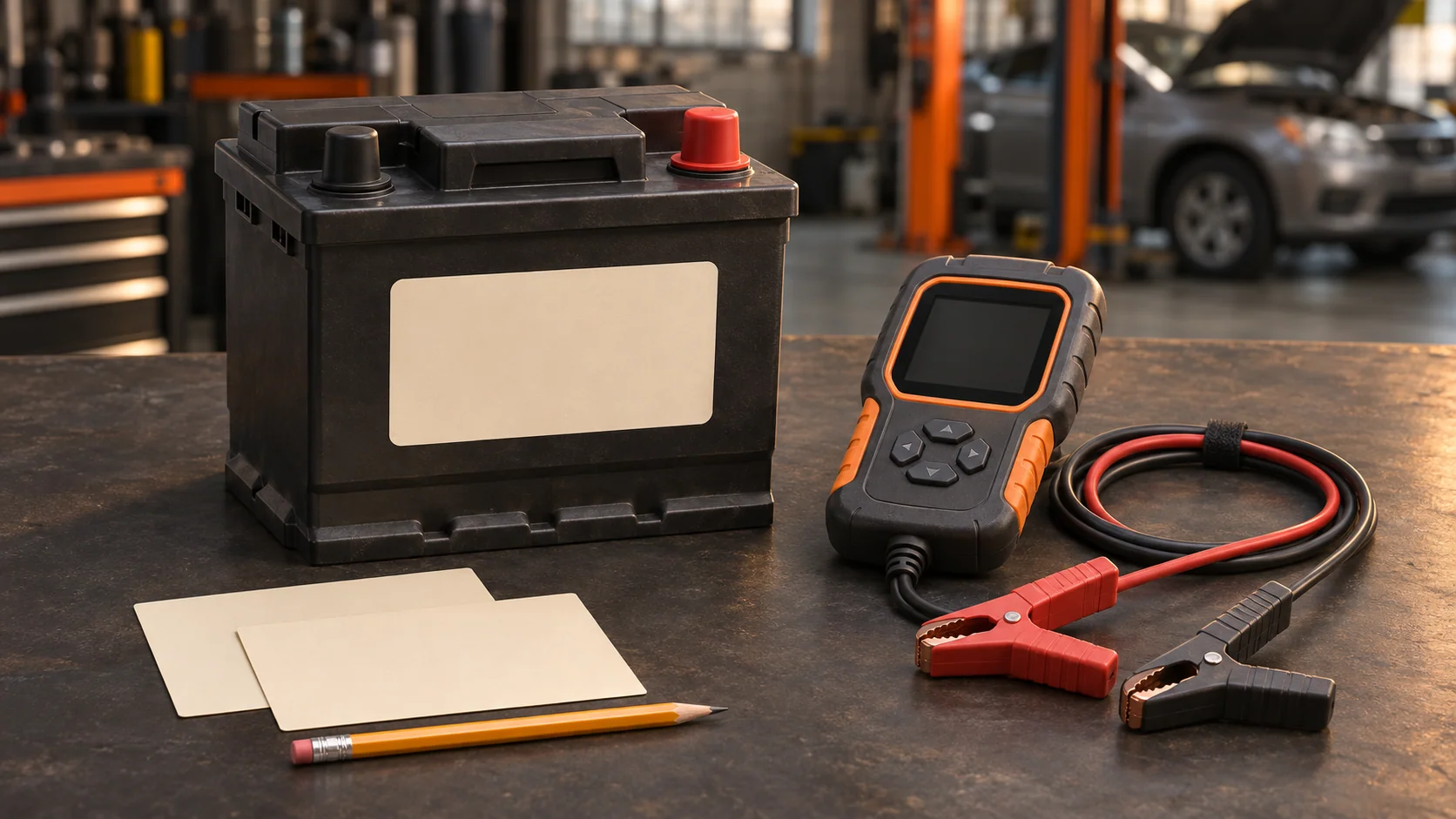
The tester asks for a rating standard, then a number. A hurried technician recognizes the number on the battery but accepts the menu's previous standard. The resulting report may look complete while the shop cannot show that the inputs matched the battery label.
For a conventional 12-volt lead-acid starting battery, treat the standard and its value as a pair. This guide helps check that pair before testing and document a correction afterward. It does not select a replacement battery or provide a high-voltage battery procedure.
Copy the standard with the value
The Midtronics MDX-500 manual directs the operator to choose the rating standard and rating from the battery label. If that information is unreadable, it directs the operator to the battery manufacturer. Battery type is a separate selection.
Before continuing, record the battery identity and capture the relevant label information. Transcribe the value with its printed standard, then compare it with both fields displayed by the tester. Preserve the source rather than recording only what someone remembers entering.
For an invented label reading 600 A EN, the setup question is whether the tool has been correctly configured for that EN rating and value. Entering 600 under DIN does not preserve the label's meaning merely because the digits match. This is a documentation example, not a battery specification, conversion or predicted test result.
Check what this tester means by CCA
A familiar abbreviation does not eliminate the manual check. The MDX-650P standard table describes its CCA selection as SAE cold-cranking amps and lists SAE, EN and DIN choices. It also distinguishes CA and MCA, associated with 32 F, from CCA at 0 F. A CA number should not silently become a CCA entry.
Use those definitions as an example of reading the actual tool's instructions. Menu options can depend on the application and instrument. If the label and available selections do not match clearly, preserve the uncertainty and obtain the correct battery data or manufacturer guidance. Do not select the nearest-looking abbreviation to get past the screen.
The CPX-900 EU manual even lists EN and EN2 separately. Its setup distinguishes battery units, numeric rating and battery type. Record the exact option used, including a suffix, rather than shortening every choice to EN in the repair order.
Handle missing or multiple ratings explicitly
If a label lists more than one standard, retain each published pair. Use the pair required by the applicable test procedure and supported by the tester. Do not take the number beside one standard and the menu choice from another.
An unreadable label is an information gap. Identify the actual battery and seek applicable product information; the vehicle's expected battery rating does not by itself identify the battery presently installed. Record where the replacement information came from and why it applies.
This workflow supplies no universal SAE-to-EN-to-DIN conversion. If a tool or applicable procedure provides an authorized mapping, retain that reference and its conditions. Without one, leave the unresolved input visible. A larger displayed rating under another standard does not by itself prove a stronger battery or a false label.
Preserve the first report when correcting an input
If a saved test used the wrong standard or an uncertain rating, keep that original report and annotate the issue. Save it before starting another test: the MDX-500 manual notes that a new test overwrites the previous result on that family. Other tools have their own retention behavior.
Use the original downloadable record to separate four things:
- Battery identity and the label or applicable product-data reference.
- Published standard/value pairs and the pair the procedure requires.
- Actual tester model, selected mode, battery type, standard and entered value.
- Original result, identified input problem, corrected setup and separately saved repeat result.
Keep preparation, connection location and required temperature information with the test. Follow the applicable instructions for any repeat; do not claim that correcting an entry alone establishes battery condition. Preserve prompts such as charge and retest rather than reducing every result to pass or fail.
The CCA, Ah and reserve-capacity guide addresses different rating quantities. The conductance versus load-test guide and surface-charge guide cover separate method and preparation questions. Attach the input record to the shop report.
STEP is inviting repair shops into Early Access. Share how your team keeps test settings, original results and unresolved questions together during a handoff.