
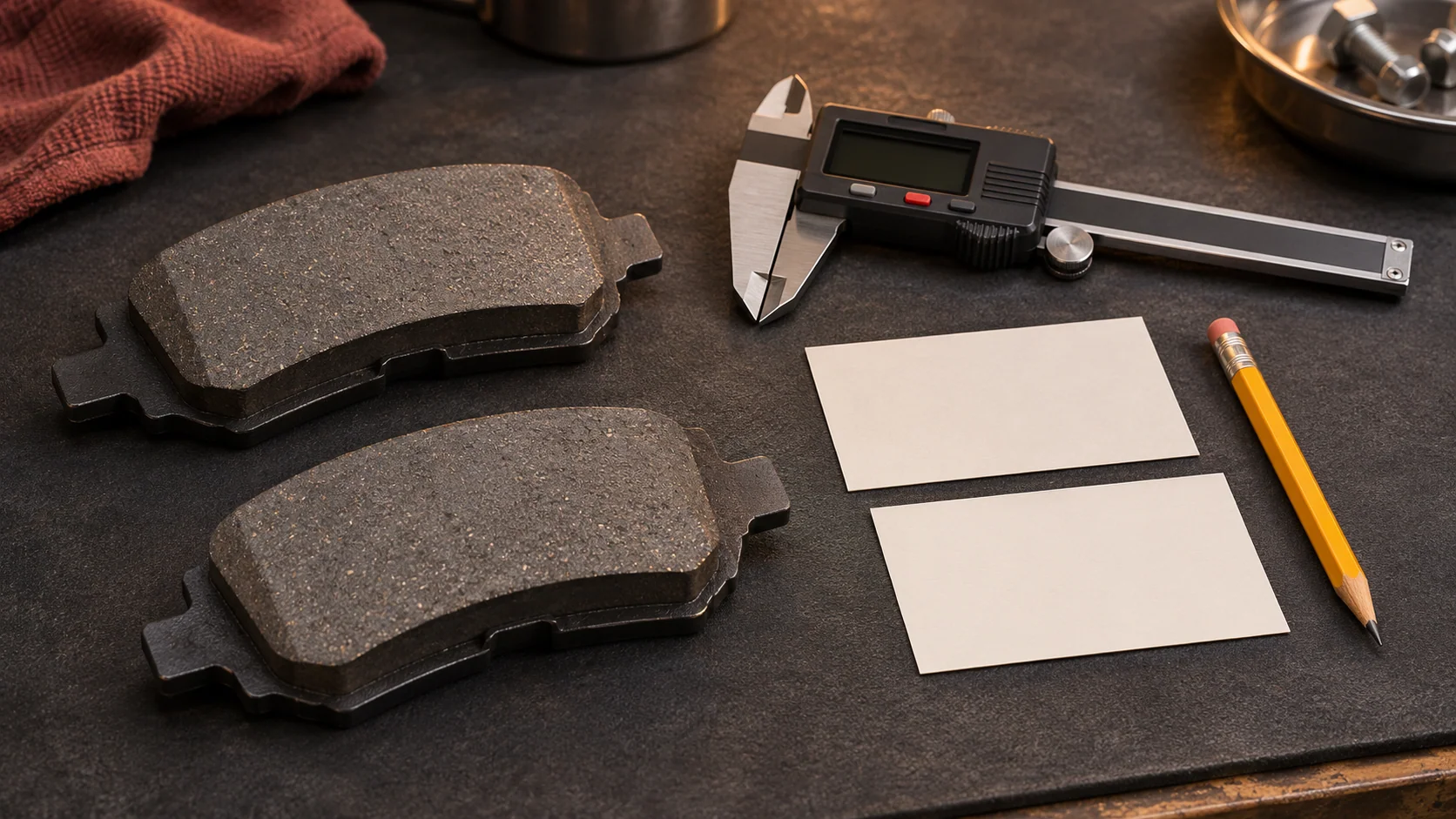
Define which difference you found
“Uneven pads” can describe several different observations. One pad may vary from end to end, vary across its radial height, or have a different overall thickness from its partner. Those descriptions lead to different comparison records.
Start with a location map: wheel position, inner or outer pad, installed orientation and the points to be compared. Label the map before the pads are moved or mixed. Use the application's terminology for leading and trailing positions when it is known; otherwise preserve an unambiguous sketch instead of guessing the direction.
Check the design and the applicable instructions
Ferodo's Brake Pad Trouble Tracers, in the Tapered Pads section, notes that some vehicles use pads tapered by design. Its fitting guidance also distinguishes pads assigned to particular positions. A visible slope or a different pad shape therefore needs an application check.
Obtain current instructions for the actual vehicle, brake configuration and installed pad. Record the measurement definition, locations, method and applicable acceptance limits. If the required specification or pad identification is missing, mark it unresolved. Do not substitute a racing-pad limit, another vehicle's bulletin or a shop-wide taper allowance.
Before accessing the brakes, follow the vehicle's support, parking-brake and brake-service procedures, including the applicable dust precautions. This guide supplies a recording method; it does not replace those procedures or authorize a vehicle's return to service.
Make a pad-position measurement record
Use the tool and access method required by the applicable instructions. Record whether the specified thickness concerns friction material alone or another defined dimension. A value that includes a backing plate cannot be compared directly with a friction-material-only limit.
- Assign each pad an ID tied to its original installed position.
- Mark comparable measurement points on the sketch, avoiding ambiguity about ends and radial positions.
- Record each actual value, units, tool and measurement definition.
- Note chamfers, grooves, damaged areas or inaccessible points that affect the available measurement.
- Follow the specified locations rather than moving a point to obtain a more favorable number.
When the required points cannot be measured in place, follow the applicable access or removal procedure. Leave an unavailable measurement blank and explain why. A photograph can preserve orientation and appearance, but it does not replace a required thickness measurement.
Compare the pattern without losing the locations
Keep the raw readings alongside any difference you calculate. In a fictional recording example, point A on one pad reads 7.2 mm and comparable point B reads 6.4 mm. Their difference is 0.8 mm. That arithmetic describes two locations on that pad; it supplies no acceptance limit and proves no cause.
Record a comparison between inner and outer pads separately. Comparing the thick end of one pad with an unspecified point on the other loses the distinction the inspection needs. If the design already has a taper, the current dimensions alone also do not establish how much uneven wear developed in service.
Choose the next inspection from evidence
Ferodo identifies caliper distortion, sticking slides and excessive clearance among possible contributors to abnormal taper. Treat those as inspection paths to evaluate under the applicable procedure.
An application-specific counterexample shows why automatic parts attribution is weak: Acura's B23070A Version 2 ServiceNews article, August 2023, describes uneven front pad wear on the 2022 MDX and states that examined calipers were not the cause. That finding is limited to the bulletin's stated application; it is not a repair instruction for another vehicle.
The handoff should name the observed pattern, the applicable requirement, any inspection actually completed and the next unresolved check. Preserve separate rotor runout and thickness-variation records when those measurements are required. Pad measurements do not stand in for rotor results.
Keep the observation with the decision
Use the pad location and thickness worksheet to retain the map and comparison. Record the source-backed disposition separately from the measurement.
The same distinction between observed evidence and a proposed cause matters when your shop handles electrical and network diagnosis. Request STEP access to discuss that diagnostic workflow and availability. This guide does not claim STEP provides brake inspection, repair approval or vehicle-specific brake coverage.