What this code means
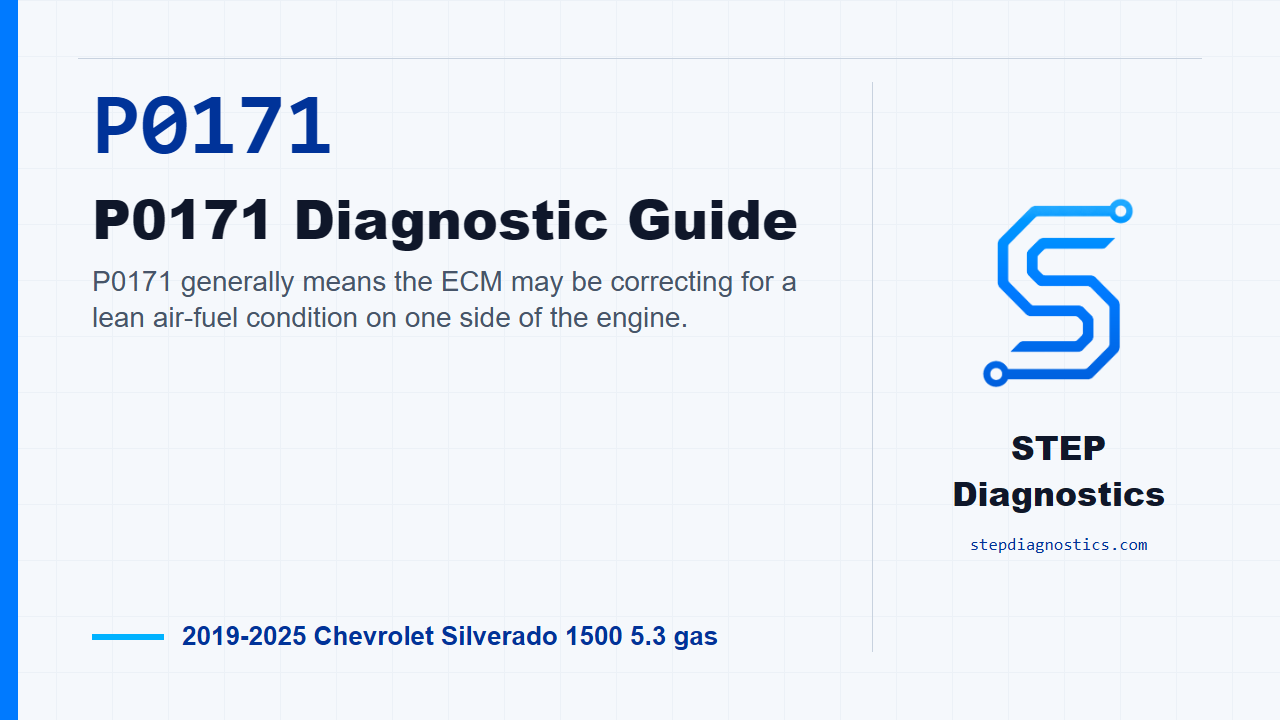
P0171 generally means the ECM may be correcting for a lean air-fuel condition on one side of the engine.
What the vehicle may do
- The vehicle may turn on the check engine light.
- It may idle rough, hesitate, or feel weak under some conditions.
- It can also appear to run normally while the code is stored.
Possible fault areas
- Possible unmetered air or intake leakage
- Possible fuel delivery concern
- Possible sensor input issue
- Possible exhaust, EVAP, or PCV influence
- Possible engine mechanical condition
Diagnostic path
Open and diagnostic frame
On this Silverado with the 5.3 gas engine, P0171 means the ECM is seeing a possible lean fuel-control condition on one side of the engine. The driver may notice a check engine light, rough idle, hesitation, or it may run normally and only store the code. Broadly, this can involve possible unmetered air, fuel delivery issues, sensor input problems, exhaust or EVAP influence, PCV issues, or an engine mechanical condition. Treat it like a fuel-control diagnosis, not a parts call. Start with the basic system checks, follow a structured diagnostic approach, and keep aftermarket devices in mind if they may be affecting system operation.
Pre-check related systems before chasing P0171
With the ignition on and the vehicle in service mode, first make sure there are no related codes set for the oxygen sensor, intake air temperature, MAP, intake air sensing, fuel tank pressure, purge, fuel injector, throttle body, or misfire systems. If one of those related codes is present, check what it means first. If none of those are set, reproduce the operating conditions for the monitor, or use the captured conditions from when the fault stored, and see whether P0171 comes back. If it does not reset, the check is all OK at that point. If it does reset, move into testing.
Understand when the monitor is meaningful
Do not over-read fuel trim before the system is in the right operating state. Fuel control needs to be in Closed Loop, and once the monitor gates are met, the monitor runs continuously. For this monitor gate, the operating window includes Barometric Pressure = Greater than 70 kPa (10 PSI), Engine Coolant Temperature = −20 to 150°C (−7 to 302°F), Engine Speed = 400 to 6,600 RPM, Fuel level = Greater than 10%, IAT Sensor = −20 to 150°C (−7 to 302°F), MAF Sensor = 1 to 510 g/s, and Manifold Absolute Pressure = 5 to 255 kPa (.725 to 37 PSI). For P0171, the lean correction limit has been exceeded after the running conditions are met, for greater than 3 min. In plain terms, the ECM has been adding enough fuel for long enough that it no longer considers the mixture correction normal.
MAP sanity check before fuel-trim testing
Begin testing with the ignition on and the vehicle in service mode. Check the scan tool MAP Sensor value against the Altitude Versus Barometric Pressure range. That value has to be within the specified range before you keep going. If it is not in range, move into the MAP sensor code path first rather than forcing a fuel-trim diagnosis. If it is in range, turn the ignition and vehicle off and continue. That table value is a required pass-fail point; if you cannot confirm the correct specified range, pause and get that range before deciding.
Check the throttle body mechanically
Next, inspect the throttle body blade condition. You are looking for anything that would hold it away from normal operation: binding or sticking on open or close movement, coking, debris, dirt, ice, visible damage, being open with the engine off, or moving open and closed without spring pressure. If a condition is found, repair as necessary. If the blade checks out, start the engine and let it idle at normal operating temperature.
Use long-term fuel trim to choose the path
At idle and normal operating temperature, look at Long Term Fuel Trim. The ideal fuel trim values are around 0%. A positive fuel trim value means the ECM is adding fuel to compensate for a lean condition. A negative fuel trim value means the ECM is reducing fuel to compensate for a rich condition. The normal check point here is Long Term Fuel Trim = −10 to 10%.
If long-term trim is high
If Long Term Fuel Trim is greater than 10%, shut the ignition and vehicle off and inspect the lean-side possibilities. Look for a cracked EVAP canister, a missing air cleaner element, exhaust leaks, missing exhaust components, or restriction, contaminated or poor-quality fuel, restricted injectors, low fuel pressure, not enough fuel in the tank, a loose or damaged intake air duct, intake manifold leakage, MAF measuring-element contamination or water intrusion, PCV connection, leakage, or restriction issues, and vacuum hose routing, kinks, leaks, or restrictions. If one of those conditions is found, repair or replace as necessary. If none are found, stop the fuel-trim path and continue with engine mechanical symptom diagnosis.
If long-term trim is low
If Long Term Fuel Trim is less than −10%, shut the ignition and vehicle off and inspect the rich-side possibilities. Check for a dirty, restricted, or water-saturated air cleaner element, EVAP system fuel saturation, missing components, or visible damage, exhaust or catalyst leakage, missing parts, restriction, heat discoloration, or visible damage, contaminated or poor-quality fuel, leaking injectors, high fuel pressure, a collapsed or damaged intake air duct, MAF measuring-element contamination, and a PCV system saturated with fuel. If one of those conditions is found, repair or replace as necessary. If none are found, pause this path and continue with engine mechanical symptom diagnosis.
If trim is in range, reproduce and verify
If Long Term Fuel Trim is between -10 and 10%, drive or operate the vehicle under the monitor conditions again, or match the captured conditions from when the fault stored. Then verify that P0171 does not set. If it sets again, go back to the related-code verification at the start of the diagnostic path and avoid jumping ahead. If it does not set, the result is all OK.
Repair verification and close
After completing any repair, verify the repair and confirm the code stays gone. Then perform the Fuel Trim Reset function. The takeaway is simple: for P0171, prove the related inputs are clean, confirm MAP makes sense for the vehicle conditions, check the throttle body, and let long-term fuel trim point you toward a lean, rich, or mechanical path. For more diagnostic training, visit stepdiagnostics.com.
Final check
P0171 is often best approached as a fuel-control diagnosis where scan data and basic checks guide the next step.
For more guided automotive diagnostics, visit STEP Diagnostics.