What this code means
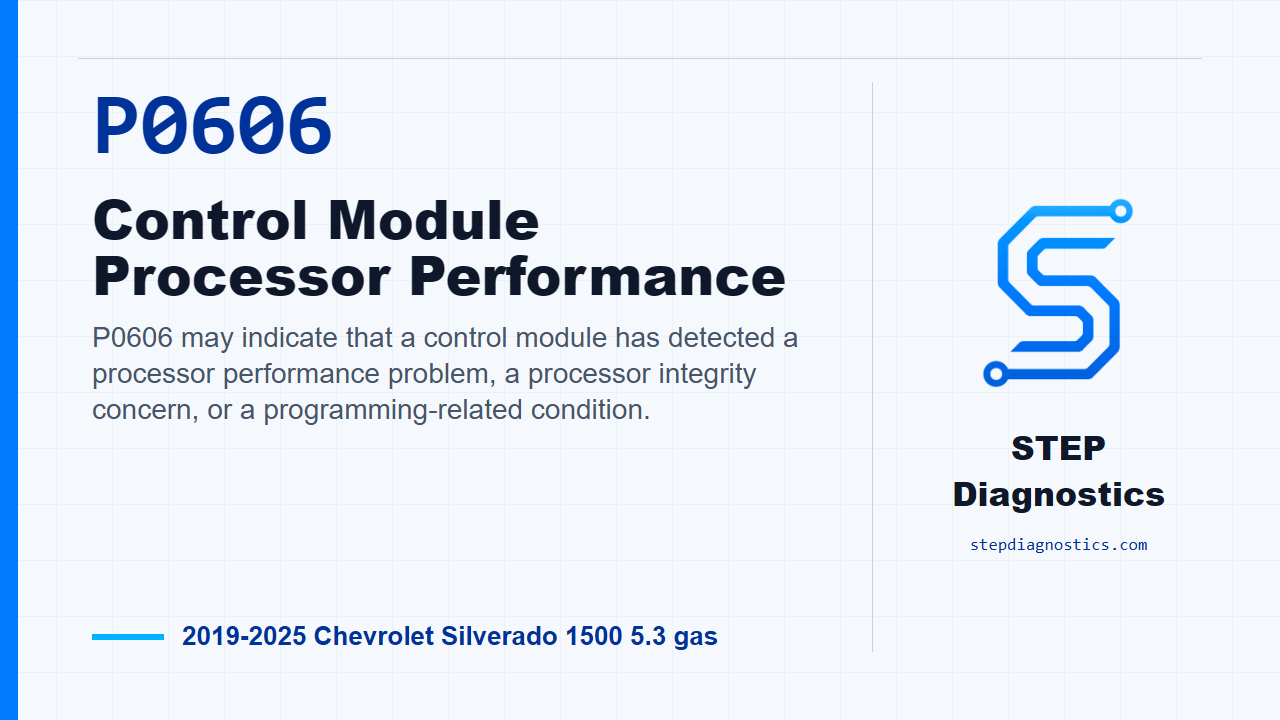
P0606 may indicate that a control module has detected a processor performance problem, a processor integrity concern, or a programming-related condition.
What the vehicle may do
- The vehicle may limit some transmission-related control strategies.
- Shift behavior, torque management, TCC operation, and start-stop behavior can be affected depending on equipment.
- The code may return quickly when the module sees the same processor or programming concern again.
Possible fault areas
- Possible control module programming or setup issue.
- Possible loose, damaged, defective, or poor connection at the K71 Transmission Control Module connector.
- Possible internal control module fault.
Diagnostic path
Open on what P0606 means here
Today we’re focused on P0606, Control Module Processor Performance, on a Silverado 1500 with the 5.3 gas engine. In plain language, the module may be seeing a processor integrity problem, or it may be dealing with a programming or setup issue. The truck can respond by limiting some transmission-related strategies, so shift behavior, torque control, TCC control, and start-stop operation may be affected depending on equipment. Keep the fault areas broad at the start: programming and setup, connector condition at the K71 Transmission Control Module, and a possible internal module problem.
Understand the monitor before testing
Before testing, understand when this monitor is allowed to run. Battery voltage has to be greater than 11 V, ignition has to be on greater than 5 s, and ignition voltage has to be greater than 11 V. Once those gates are met, the check runs continuously. The code sets when the control module reports an internal malfunction or is not programmed.
Start with the basic path
Start with the basic system checks, then keep the diagnosis structured. With the ignition on and the vehicle in service mode, look for the programming-related companion fault first. If that fault is present, handle the required programming and setup for the K71 Transmission Control Module before going any farther. After programming and setup, verify the code does not reset. If it comes back after that programming and setup path, replace the K71 Transmission Control Module. If it does not come back, there is no further action on that branch.
If programming is not the issue, inspect the connector path
If the programming-related fault is not set, turn the ignition, vehicle, and all vehicle systems off. Disconnect the electrical connector at the K71 Transmission Control Module. Now inspect that connection for anything defective, loose, poorly connected, or visibly damaged. If you find a condition there, repair or replace as necessary. If the connector checks clean, reconnect it and continue.
Clear, cycle, and see if P0606 returns
With the connector back in place, turn the ignition on with the vehicle in service mode and clear the DTCs. Then turn the ignition, vehicle, and all vehicle systems off. Bring the ignition back on again with the vehicle in service mode. Now verify P0606, along with the related internal processor group, is not set. If P0606 is set at this point, replace the K71 Transmission Control Module. If it is not set, this path indicates no further action.
Verify the repair
Keep repair verification separate from the testing branch. After the repair is complete, verify the repair and confirm the code stays gone. If the transmission control component or system was serviced, complete the transmission service fast learn. The takeaway is simple: for P0606, do not jump past programming status or the TCM connector check. Follow the sequence, then make the replacement call only if the code returns where this path says it should not. For more diagnostic training, visit stepdiagnostics.com.
Final check
P0606 is often approached cautiously because programming status, connector condition, and a possible module concern may all be part of the fault area.
For more guided automotive diagnostics, visit STEP Diagnostics.