What this code means
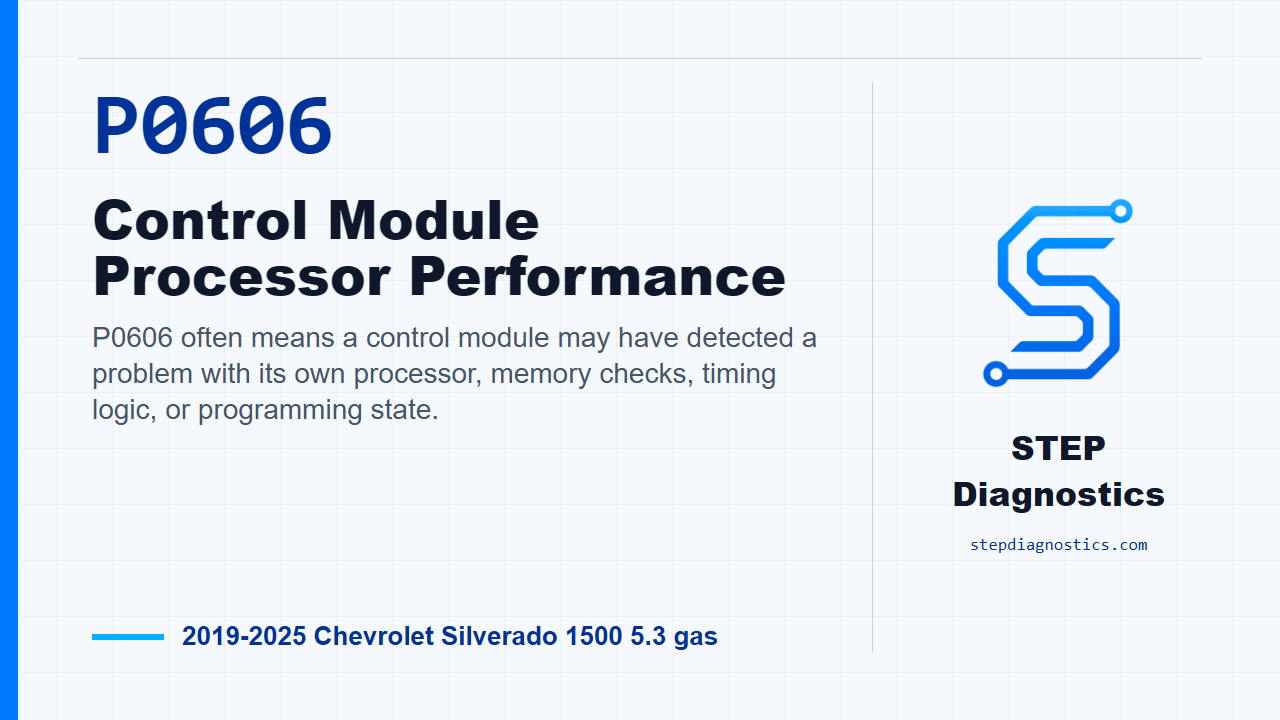
P0606 often means a control module may have detected a problem with its own processor, memory checks, timing logic, or programming state.
What the vehicle may do
- The vehicle may set warning indicators.
- An affected system can have limited or disabled operation.
- The code may be current or may only be stored in history.
Possible fault areas
- Possible internal control module integrity concern.
- Possible incomplete programming or setup concern.
- Possible related module fault context that may need to be understood before making a module decision.
Diagnostic path
Open on the fault logic
On this Silverado 1500 with the 5.3 gas engine, P0606 is a control module processor performance code. In plain language, the module may be failing one of its own internal checks, such as memory read and write ability, timing logic, or it may have a possible programming issue. The truck can set warning indicators, may limit an affected system, or may show very little driver complaint depending on when the fault is current. For this code path, the broad fault areas are internal module integrity and programming status, not external wiring or sensor circuits.
Understand when the monitor runs
Before testing, treat this as a module self-check performance fault. The monitor runs with the ignition ON or the vehicle in service mode, and system voltage has to be greater than 9.5 V. The code sets when the control module detects an internal malfunction or incomplete programming. It is handled as a type A DTC for both setting and clearing behavior.
Run the diagnostic path in order
Start with the basic system checks, then follow a structured diagnostic approach so you do not jump straight to a module call without checking the vehicle-wide context. With the ignition ON or the vehicle in service mode, check whether related module processor faults are also current. Do not read the whole related-code list out loud here; the point is simple: if other codes in that group are present, check what they mean first and follow that path before condemning the module from this test.
Make the module decision carefully
If none of the related module processor faults are set, and P0606 is current, this diagnostic path supports replacing the K160 Brake System Control Module. But there is an important stop point: if P0606 is stored only in history and is not retrieved as a current DTC, do not replace the control module based on that history code alone.
Verify after the repair
After the repair is completed, keep verification separate from the diagnostic decision. Verify the repair and confirm the code stays gone under the operating conditions that allow the monitor to run. The takeaway is: P0606 is an internal processor performance path, so confirm it is current, make sure related module faults are not steering the diagnosis somewhere else, and do not replace a module for a history-only code. For more diagnostic training, visit stepdiagnostics.com.
Final check
Treat P0606 as an internal control-module performance code, confirm whether it is current, and avoid a module decision when it is history-only.
For more guided automotive diagnostics, visit STEP Diagnostics.