What this code means
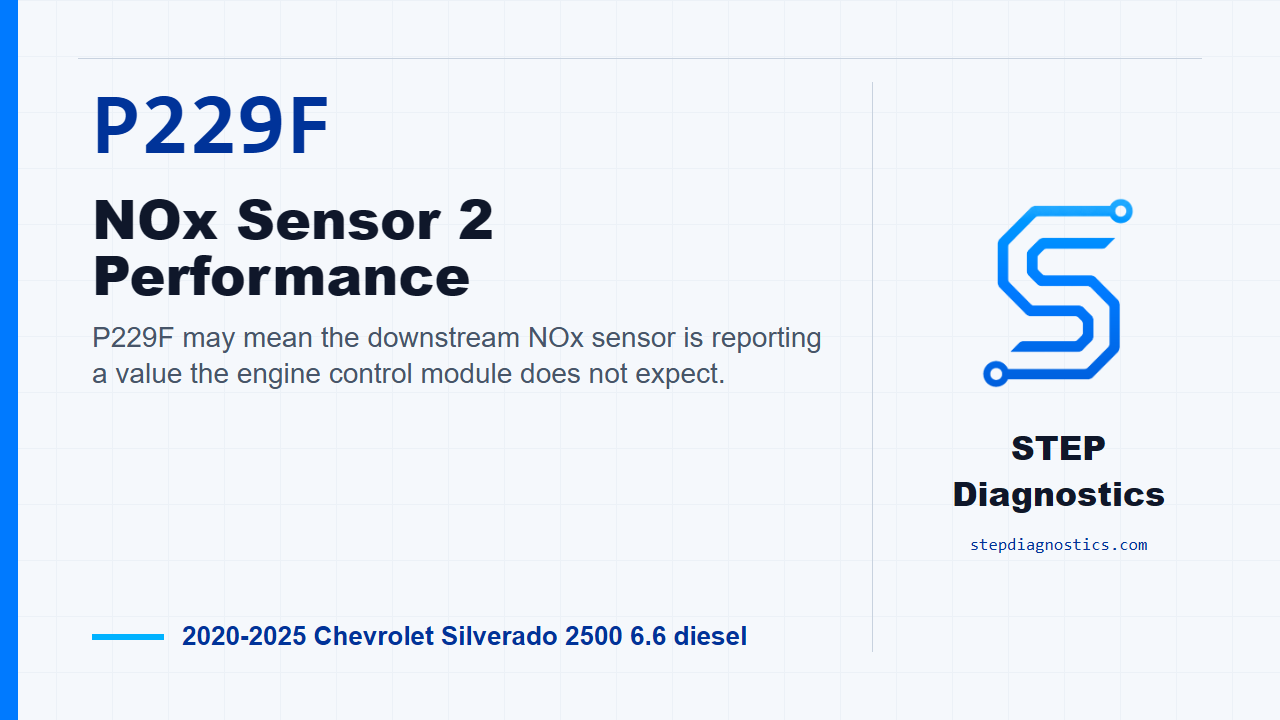
P229F may mean the downstream NOx sensor is reporting a value the engine control module does not expect.
What the vehicle may do
- The vehicle may display an emissions or exhaust fluid warning message.
- The aftertreatment system may need a service bay test after diagnosis or repair.
- The code can return if the monitored conditions are reproduced and the sensor reading remains out of range.
Possible fault areas
- Possible NOx Sensor 2 performance concern.
- Possible sensor operating-condition concern, such as supply, heater readiness, or related communication status.
- Possible induction leak, exhaust leak, missing exhaust component, modified exhaust component, or turbocharger-related condition.
- Possible related engine or aftertreatment input fault affecting NOx interpretation.
Diagnostic path
Code focus
For this episode, we’re focused on P229F, NOx Sensor 2 Performance, on a 2020 to 2025 Chevrolet Silverado 2500 with the 6.6 diesel. In plain language, this code means the engine control module is seeing NOx Sensor 2 reporting outside the range it expects. The truck may show a Service Emission System or Service Exhaust Fluid System message, and the fault can involve the NOx sensor itself, its operating conditions, possible induction or exhaust leaks, turbo or exhaust changes, or other engine and aftertreatment inputs that make the NOx reading unreliable. The NOx sensor reports wide-band lambda, digital lambda, and NOx concentration, and the engine control module uses that information to manage the propulsion and aftertreatment strategy.
Monitor logic
Before testing, understand when the monitor is allowed to run. For P229F, the engine is running, the related communication and component faults are not present, NOx Sensor 2 heater mode is allowed, ignition voltage is Greater than 11 V, and NOx Sensor 2 supply voltage is Greater than 10.8 V. Once those gates are met, the monitor runs continuously. The code sets when NOx Sensor 2 is not within a calibrated range for greater than 2 s.
Start with the checks that can mislead the NOx result
Start with the basic system checks before using this diagnostic path, and follow a structured diagnostic approach as you work through it. Put the ignition on with the vehicle in service mode. Before condemning NOx Sensor 2, make sure there are no other faults tied to the supporting inputs and systems, like air temperature, pressure, engine speed, vehicle speed, exhaust temperature, DPF differential pressure, upstream NOx sensing, EGR, fuel injection, or aftertreatment fuel injection. If other related codes are present, check what they mean first. If they are not present, move on and make sure the induction system is not leaking, and that the exhaust system and turbocharger are not leaking, missing components, or modified. If one of those conditions is found, repair or replace as necessary before continuing.
Reproduce the fault
Next, reproduce the operating conditions for the monitor. Drive the vehicle within the conditions that run the DTC, or duplicate the captured conditions from the stored data. Then verify whether P229F sets again. If the code does not reset, this path is considered OK at that point. If P229F does reset after the related-code and leak checks have passed, this procedure calls for replacing B195B Nitrogen Oxides Sensor 2.
Run the aftertreatment service bay test
After replacing NOx Sensor 2 when the procedure has led you there, run the Reductant System Malfunction Warning Service Bay Test with the scan tool. The test needs to pass. If it does not pass, do not guess; move into the appropriate reductant-system diagnostic path and recheck the earlier direction of the diagnosis. If the test passes, that part of the repair path is OK.
Final verification and message handling
Keep final verification separate from the service bay test. Once the repair work is complete, verify the repair and confirm the code stays gone. There is one additional step only when the driver information message shows Service Emission System or Service Exhaust Fluid System: run the Reductant System Tamper Warning Service Bay Test. When that procedure applies, it clears the driver information message for the applicable system. The takeaway is simple: on P229F, rule out related input faults and air or exhaust leaks first, reproduce the monitor conditions, and only replace NOx Sensor 2 when the diagnostic path gets you there. For more diagnostic training, visit stepdiagnostics.com.
Final check
P229F often needs a clean prerequisite check first, then a controlled attempt to reproduce the code before deciding the downstream NOx sensor is the repair target.
For more guided automotive diagnostics, visit STEP Diagnostics.