What this code means
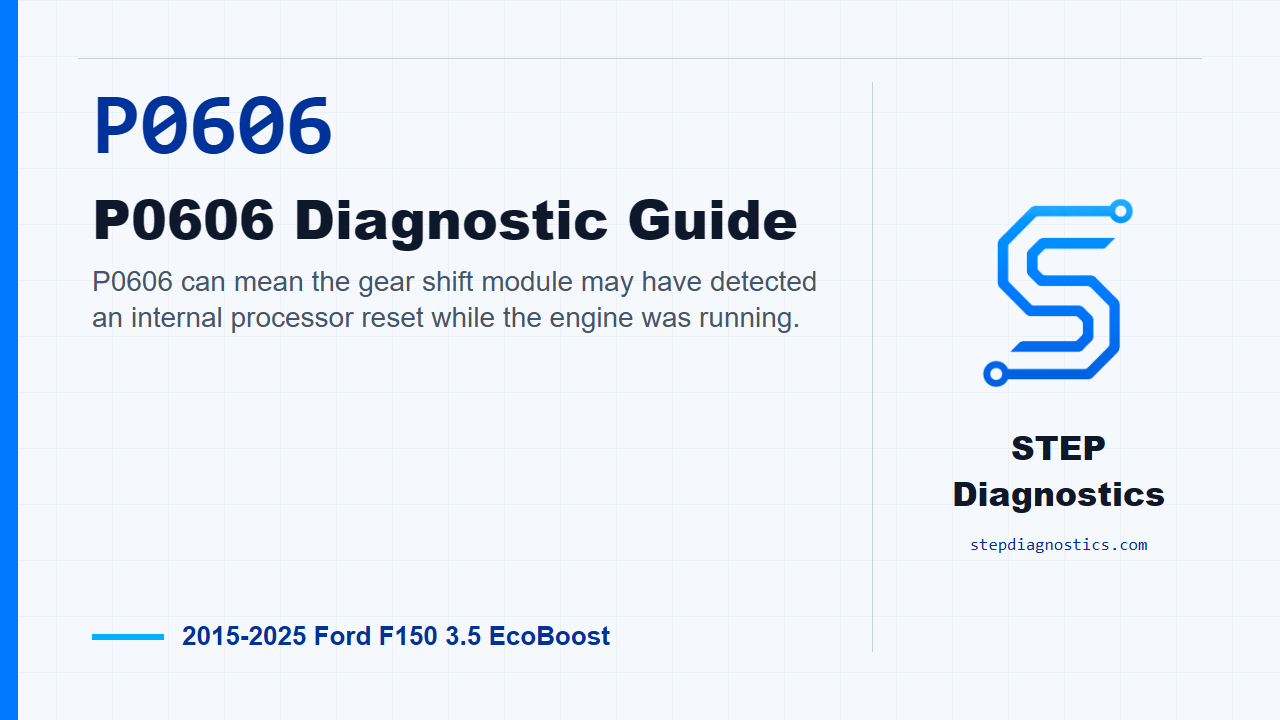
P0606 can mean the gear shift module may have detected an internal processor reset while the engine was running.
What the vehicle may do
- The vehicle may show shift-control complaints.
- Warning messages may appear.
- The concern can be intermittent.
Possible fault areas
- Battery or charging system condition may be involved.
- GSM calibration may be involved.
- The GSM itself may be involved.
Diagnostic path
Opening context
On this F-150 with the 3.5 EcoBoost and 10R80 external shift controls, P0606 is a GSM processor fault. In plain language, the gear shift module may have seen an unintended reset while the engine was running. The truck may have shift-control complaints, warning messages, or an intermittent concern, but this code can also be tied to power supply stability, charging system condition, module calibration, or the GSM itself. Treat this as a technician-level diagnostic path: keep the basics tight, use the scan tool, and do not jump straight to a module until the power and programming checks are handled.
Start with the basic system checks
Start by verifying the customer concern. Operate the vehicle and try to duplicate the condition before you get deep into testing. Then do a visual inspection for obvious mechanical or electrical damage. If you find an obvious cause that matches the complaint, correct it if possible before moving on. If nothing is visually evident, pull all GSM codes. If P0606 is the code you are working, move into the GSM internal module diagnostic path. If there are no codes, do not force a code-based path; verify the symptom and continue with symptom-based diagnosis.
Confirm battery condition first
The first real check is battery condition. Make sure the battery is fully charged before continuing. If needed, connect a battery charger so the vehicle has steady battery voltage while you are testing. If the battery is not fully charged, charge it or install a new battery as necessary before continuing the P0606 path. If the battery is fully charged, move on to the scan-tool code check in the GSM.
Check GSM continuous memory codes
With the ignition on, retrieve all continuous memory codes from the GSM. At this point, you are specifically watching for battery voltage-related GSM codes P0562 or P0563. If either one is present, resolve those codes first. That matters because unstable power can make an internal-module code misleading. If those voltage codes are not present, continue to the calibration step.
Program the GSM and retest
Next, keep the ignition on, clear all GSM codes, and program the GSM with the latest calibration. After programming, road test the vehicle. Then turn the ignition off, turn it back on, and run the GSM self-test with the scan tool. This separates a calibration-related fault from a fault that is still active after the module has been updated and exercised.
Make the final call
After the latest calibration, road test, key cycle, and GSM self-test, look at what comes back. If P0606, or the same GSM internal-module fault group, is present again in the GSM, install a new GSM. If that internal-module fault group is not present, the fault is not present at this time, and it may have been caused by a module programming error. The takeaway is simple: verify the concern, prove battery condition, rule out GSM voltage codes, update the calibration, and only then make the module call based on the post-test result. For more diagnostic training, visit stepdiagnostics.com.
Final check
P0606 is often approached by proving stable power, checking related voltage faults, updating calibration, and confirming whether the internal module fault returns.
For more guided automotive diagnostics, visit STEP Diagnostics.