What this code means
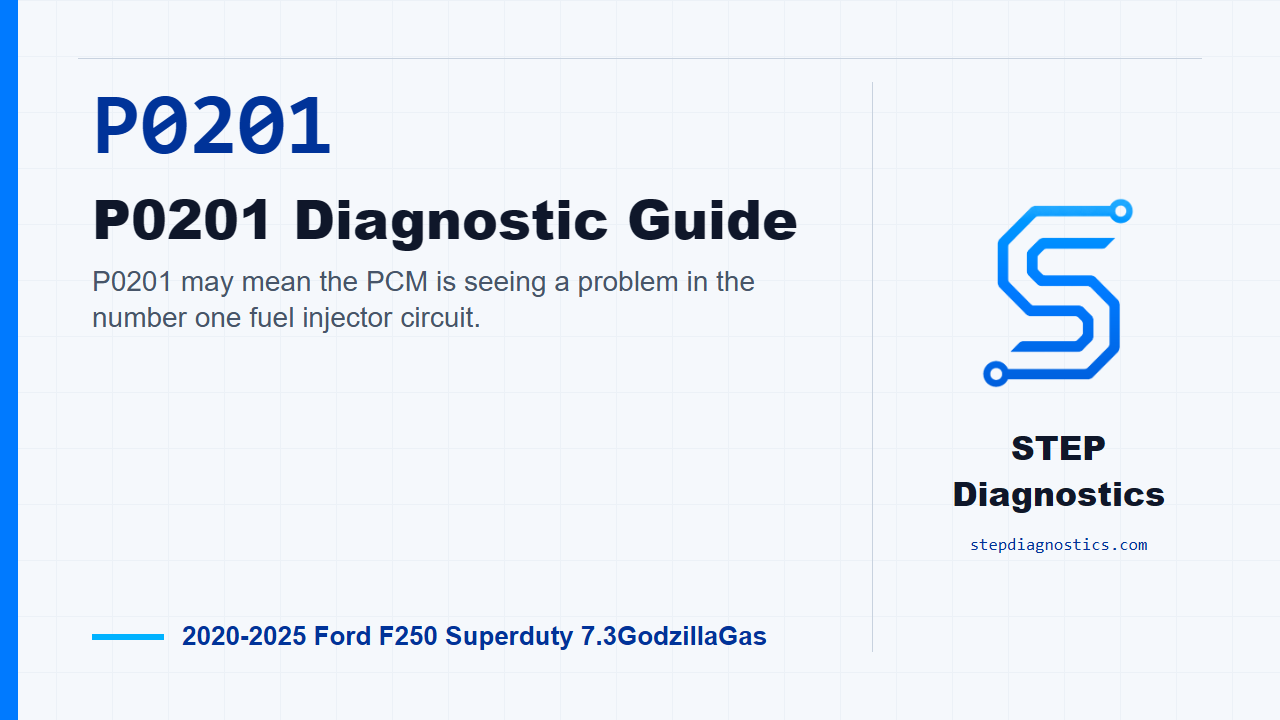
P0201 may mean the PCM is seeing a problem in the number one fuel injector circuit.
What the vehicle may do
- The vehicle may run rough.
- The engine may misfire.
- The truck may have reduced power.
- The check engine light can be on.
Possible fault areas
- Possible injector power feed concern.
- Possible injector control circuit concern.
- Possible fuel injector concern.
- Possible fuel injector relay concern.
- Possible connector or harness concern.
- Possible PCM concern.
Diagnostic path
Opening context
On this 2020 to 2025 F-250 with the 7.3 gas engine, P0201 may point to a problem in the number one fuel injector circuit. The truck may run rough, misfire, lack power, or set a check engine light, depending on how the circuit is failing. Broadly, the possible fault areas can include the injector power feed, the injector control circuit, the injector itself, a fuel injector relay concern, connector issues, or the PCM. The diagnostic path here is electrical: prove the feed, prove the control wire, check the injector resistance, then verify the driver can pulse the circuit.
Start with the code check
Start with the basic code check. For this episode, we are focused on P0201. If the injector circuit code is present, continue into the injector circuit pinpoint path. If you are working from a symptom but the injector circuit code is not present, this same path can still be used when the symptom points you there. If it does not fit the symptom or the code set, pause and recheck the earlier diagnostic path instead of guessing.
Check for other PCM codes first
Next, check whether any other PCM codes are present. On some vehicles, these injector circuit codes may show up along with PCM fuel-system-related codes. If those are present, handle the fuel-system-related PCM codes first. If there are no other PCM codes driving the direction, move on to the injector circuit checks.
Check injector power feed
Now check the VPWR feed to the suspect injector. Key off, disconnect only the suspect injector harness connector, then key on and measure the injector voltage at the correct injector connector feed pin for the suspect cylinder. On some vehicles, that voltage is only there while the fuel pump relay is energized, so make the measurement within 2 seconds of the ignition ON. You are looking for voltage greater than 10.5 V. If it is greater than 10.5 V, the power feed is good enough to keep testing. If it is not, repair the open in that feed circuit, clear the PCM codes, and repeat the self-test.
Check the injector control circuit for an open
With the ignition off, disconnect the PCM connector and check the injector control circuit from the suspect injector connector back to the PCM. For P0201, that is the injector connector control pin to its matching PCM pin. The resistance needs to be less than 5 Ω. If it is less than 5 Ω, continue. If it is not, repair the open circuit, clear the PCM codes, and repeat the self-test.
Check the control circuit for a short to ground
Next, check that same injector control circuit for a short to ground. Measure resistance from the suspect injector control circuit to the correct ground-side test point. The reading should be greater than 10000 Ω. If it is greater than 10000 Ω, continue. If it is not, repair the short circuit, clear the PCM codes, and repeat the self-test.
Check the control circuit for a short to voltage
Then check the injector control circuit for a short to voltage. Turn the ignition on and measure voltage on the suspect injector control circuit using the correct matching test points. If any voltage is present, repair the short circuit, clear the PCM codes, and repeat the self-test. If no voltage is present, move on to checking the injector itself.
Check injector resistance
With the ignition off, measure resistance across the suspect fuel injector, between the two injector connector pins. The injector resistance should be between 11 Ω - 18 Ω. If it is in that range, keep going. If it is not between 11 Ω - 18 Ω, install a new fuel injector, reset the keep alive memory, and repeat the self-test.
Check whether the circuit is being pulsed
Reconnect the PCM connector, turn the ignition on, and connect a non-powered test lamp across the suspect injector connector pins. Start the engine and watch the lamp. If the test lamp blinks, the circuit is being pulsed, so move on to an intermittent harness check. If the test lamp does not blink, go to the PCM connector and PCM operation check.
Wiggle test the injector harness
Reconnect the injector, start the engine, and bring it to normal operating temperature. Monitor the injector fault PID for the suspect cylinder, then wiggle, shake, and bend small sections of the harness while working from the injector back toward the PCM. If the injector value fluctuates in and out of range, isolate the area that reacts and repair as necessary. Then clear the PCM codes and repeat the self-test. If the concern cannot be duplicated or identified, pause and recheck the earlier diagnostic path rather than forcing a conclusion.
PCM connector and PCM operation check
If the injector circuit does not pulse during the test lamp check, inspect PCM connector operation next. Disconnect all PCM connectors and look for pushed-out pins and corrosion. Reconnect all PCM connectors and make sure they seat correctly, then verify whether the concern is still present. If it is still present after that connector check, install a new Powertrain Control Module using the required programming process. If the concern is gone, the system is operating correctly at that time, and the issue may have been caused by a loose or corroded connector.
Verification and takeaway
Keep verification separate from the testing. After any circuit repair, injector replacement, connector correction, or PCM replacement, clear the PCM codes and repeat the self-test. The takeaway on P0201 is simple: do not jump straight to the injector. Prove power, prove the control wire, check for shorts, measure injector resistance, verify pulse, and only then move toward intermittent wiring or PCM checks. For more diagnostic training, visit stepdiagnostics.com.
Final check
P0201 is often best approached as an electrical circuit diagnosis before considering component replacement.
For more guided automotive diagnostics, visit STEP Diagnostics.