What this code means
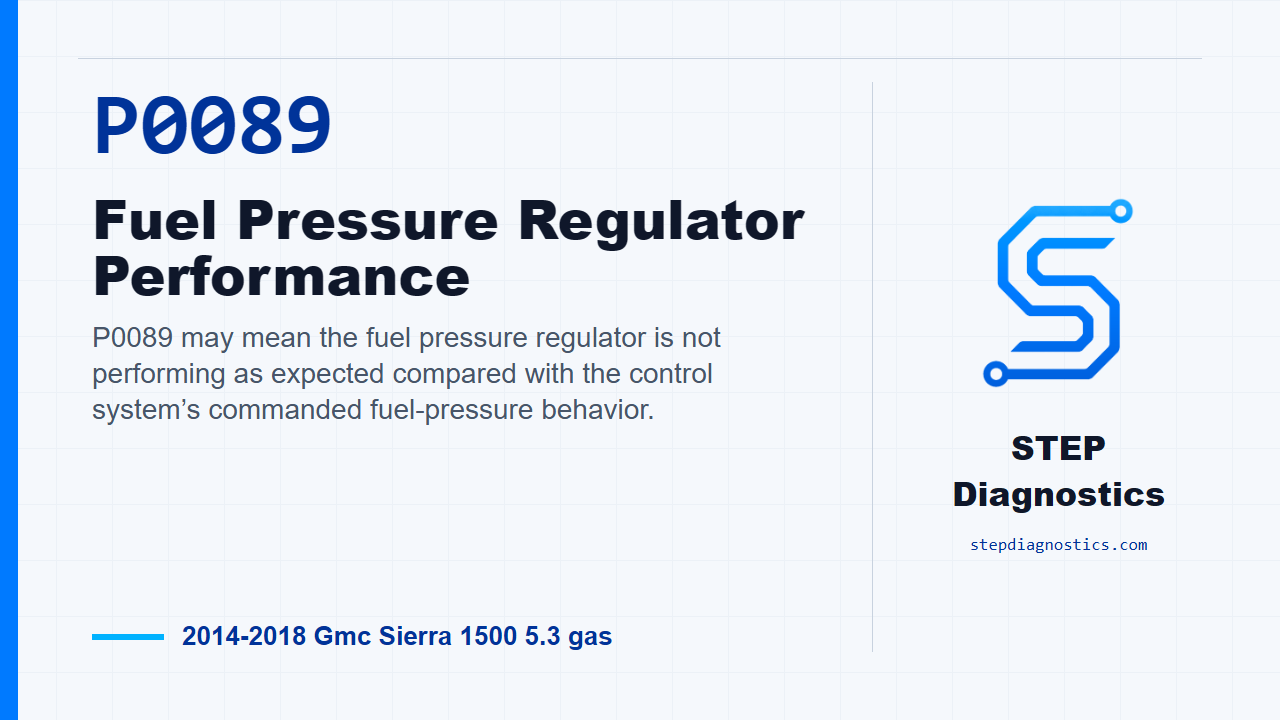
P0089 may mean the fuel pressure regulator is not performing as expected compared with the control system’s commanded fuel-pressure behavior.
What the vehicle may do
- The vehicle may crank longer than normal.
- The engine may run rough or hesitate.
- The vehicle may feel low on power.
- The check engine light can be on.
Possible fault areas
- Possible fuel supply or fuel quality concern.
- Possible high-pressure fuel pump or regulator control concern.
- Possible fuel rail pressure feedback concern.
- Possible injector leakage or restriction concern.
- Possible mechanical drive or cam-related concern.
Diagnostic path
Opening context
Today we’re focused on P0089 on a 2014 to 2018 GMC Sierra 1500 with the 5.3 gas engine. In plain language, this code points to fuel pressure regulator performance. The truck may crank longer, run rough, feel low on power, or turn the check engine light on. Broadly, this can involve fuel supply, high-pressure fuel control, rail pressure feedback, injector leakage or restriction, fuel quality, or a mechanical drive issue for the high-pressure pump. Treat related fuel, pressure, sensor, and timing codes as context, but keep this diagnosis centered on P0089.
Start with basic checks and monitor logic
Before chasing the regulator, start with the basic system checks and follow a structured diagnostic approach. P0089 is a command-versus-result type of fault: the controller is looking at whether the fuel pressure regulator position stays in its expected operating window. The control side matters too: the output circuit is switched to 12 V to activate the component. For this code, the setting condition is the Q18 fuel pressure regulator not within 0 to 240° for greater than 10 s.
Running-condition gates
Don’t treat the code as valid until the monitor has had the right chance to run. The gate for this fault includes the engine running, BARO greater than 70 kPa (10.2 PSI), fuel temperature −10 to 100°C (14 to 212°F), IAT greater than −10°C (14°F), ignition voltage greater than 11 V, and the low pressure side of the fuel system greater than 275 kPa (40 PSI). After those gates are met, the monitor runs continuously for greater than 10 s. Let the visual card carry the details, but use those gates to decide whether you really reproduced the fault.
Initial verification
For the verification, turn the ignition on with the vehicle in service mode. If other relevant codes are present, check what they mean first instead of forcing the P0089 path. If they are not present, start the engine and let it idle. On the scan tool, verify Fuel Rail Pressure Sensor 1 is 1.9 to 5.0 MPa (276 to 725 PSI). If it is outside that range, move into circuit and system testing. If it is in range, clear the codes and continue with the road-test portion.
Road test and repeat check
Now accelerate the vehicle with wide open throttle, only under safe conditions and while obeying traffic laws. Don’t do anything that risks vehicle control. After that, check whether any code in this fault group reset. If one did, go to circuit and system testing. If none reset, reproduce the operating conditions for the DTC, or reproduce the captured conditions from the vehicle data, and verify P0089 does not set.
Circuit and system testing
If verification sends you into testing, shut the vehicle off. Check for the real-world faults that can make rail pressure control look wrong: a binding or sticking camshaft position actuator, a leaking or restricted fuel rail, contaminated or poor-quality fuel, a leaking or restricted fuel feed pipe, a binding or stuck fuel pressure regulator, a high-pressure fuel pump that is binding, sticking, loose, or a fuel injector that is leaking or restricted. If one of those conditions is found, correct that condition. If none are found, remove the G18 high pressure fuel pump and inspect the camshaft lobes for wear or visible damage. If the camshaft lobe condition exists, the diagnostic path supports camshaft replacement. If the cam lobes check out, test or replace the G18 high pressure fuel pump as directed by the next checks.
High-pressure pump component test
For the component test, turn the ignition, vehicle, and all vehicle systems off, then disconnect the G18 high pressure fuel pump electrical connector. The pump temperature matters here: it should be 19 to 21°C (66 to 70°F) while testing. Measure resistance between control terminal 1 and control terminal 2. A square-top G18 high pressure fuel pump should read 0.58 to 0.7 Ω. A round-top G18 high pressure fuel pump should read 1.0 to 2.0 Ω. If the resistance is not in the specified range, the path supports replacing the G18 high pressure fuel pump.
Terminal-to-housing check
If the pump resistance is within range, test for infinite resistance between each terminal of the component and the pump housing. If resistance is less than infinite, the path supports replacing the G18 high pressure fuel pump. If the test shows infinite resistance, the component test result is all okay, so pause, recheck the earlier diagnostic path, and avoid guessing.
Verification and takeaway
After the repair is completed, verify the repair and confirm the code stays gone. The short version: prove the monitor conditions first, verify rail pressure at idle, load the system safely, then separate fuel-system restrictions or leakage from high-pressure pump drive and pump electrical faults. For more diagnostic training, visit stepdiagnostics.com.
Final check
P0089 is often best approached by proving the operating conditions, checking fuel pressure behavior, then testing the mechanical and electrical sides of the high-pressure fuel system without guessing.
For more guided automotive diagnostics, visit STEP Diagnostics.