Applicability basis: Verified vehicle records confirm a Sierra 1500 4WD with a 5.3-liter V8 at both the 2014 and 2018 endpoints. The detailed internal sources were collected for a 2018 Sierra 1500 4WD V8-5.3L, so exact commands, thresholds, component identifiers, locations, fuel-fill design, and service steps must come from service information for the truck being repaired.
What the EVAP system does
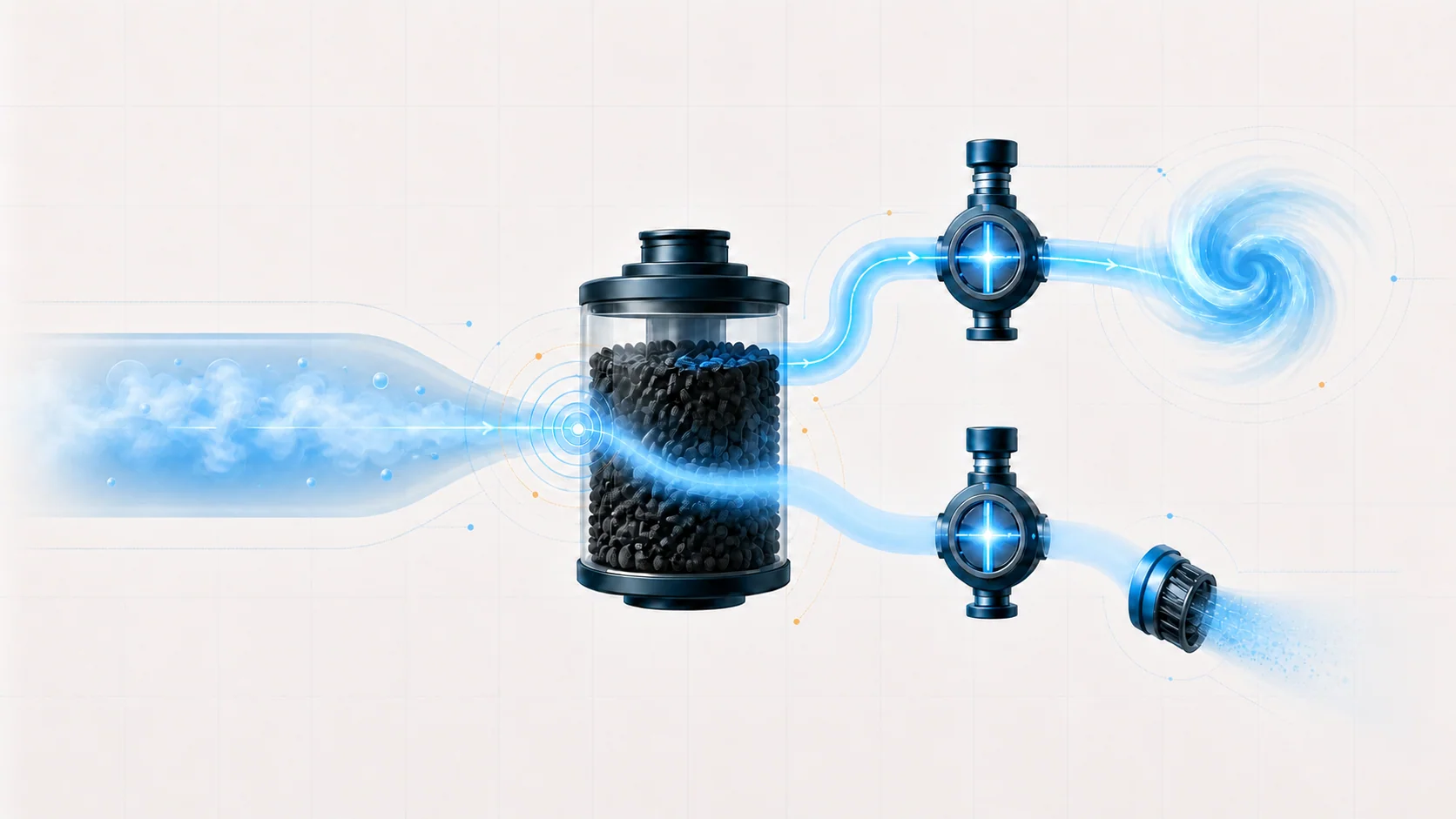
The evaporative emission control system, usually called EVAP, keeps gasoline vapor from venting directly into the atmosphere. Vapor produced in the fuel tank is routed to a charcoal canister, stored there, and later drawn into the engine to be burned when operating conditions allow.
The system has to perform three connected jobs:
- contain vapor while the truck is parked or purge is not allowed;
- meter stored vapor into the intake without upsetting engine operation;
- open and seal the fresh-air side so the system can purge normally and test itself for leaks or restrictions.
The engine control module judges those jobs by commanding the purge and vent paths and watching fuel tank pressure (FTP) feedback. A DTC therefore reports behavior that failed a monitor. It does not, by itself, identify the failed part.
The main EVAP components on this Sierra
Confirm the exact layout and fuel-fill design in service information for the truck in front of you. At a system level, diagnosis revolves around these parts:
- Fuel tank and filler assembly: The tank, filler interface, valves, seals, and vapor connections are part of the sealed vapor boundary.
- EVAP canister: Activated carbon stores fuel vapor until the control system can purge it.
- Purge solenoid valve and purge path: The normally closed purge valve meters vapor from the canister toward the intake when commanded.
- Vent solenoid valve, vent filter, and fresh-air path: The vent side admits filtered air during normal purge operation. In the exact 2018 source strategy, the vent valve is normally open and closes during certain EVAP tests.
- Fuel tank pressure sensor: The FTP sensor reports pressure or vacuum relative to atmospheric pressure. The controller uses its response to judge sealing, purge flow, and venting.
- Hoses, pipes, quick-connects, wiring, and connectors: A mechanical leak or restriction can resemble a valve-control problem, while an electrical fault can prevent a mechanically sound valve from moving.
These components form one system. Replacing a familiar purge or vent valve without proving the failed behavior can leave the original problem untouched.
How storage, purge, venting, and self-testing work together
When purge is allowed, the controller opens the purge path in a controlled manner. Intake vacuum draws stored vapor out of the charcoal canister, while the vent side supplies fresh air through the canister. Vapor and air then enter the engine and are burned during combustion.
To test the system, the controller changes the normal valve states and watches FTP response. For a large-leak check, the EVAP boundary must seal and the purge path must create the expected vacuum. A large opening, a valve that does not seal, or a purge path that cannot create flow can all prevent that response.
For a vent-performance check, the controller evaluates whether the system can release vacuum when the vent path should be open. A blocked filter, restricted hose, contaminated canister path, or vent valve that cannot reach the expected state can keep the tank under too much vacuum.
For a non-purge check, the controller commands purge off and watches for vacuum that should not be developing. If vacuum appears anyway, unwanted flow through the purge path is one possibility.
The exact 2018 strategy also uses an engine-off natural-vacuum test for small-leak detection. After shutdown, fuel-tank temperature and vapor pressure change as the vehicle cools. The controller observes the resulting FTP pattern and compares it with the response expected from a sealed system. Because this monitor runs after key-off under specific conditions, an intermittent P0442 may not reproduce during a short shop visit.
What the related DTCs are telling you
These four STEP guides represent different EVAP failure categories:
| DTC | Diagnostic category | What it directs you to prove |
|---|---|---|
| P0442 | Small leak detected | Whether the sealed vapor boundary loses pressure or vacuum slowly enough to fail the small-leak monitor |
| P0446 | Vent-system performance | Whether the fresh-air path, vent filter, canister, hoses, vent valve, and FTP feedback let the system vent as expected |
| P0455 | Large leak or inability to create the expected vacuum | Whether the vapor boundary seals and whether the purge path can create the response the monitor expects |
| P0496 | Flow during non-purge | Whether purge flow or tank vacuum is present when the purge path should be closed |
The categories should not begin with the same parts decision. P0442 and P0455 focus on different leak behavior, P0446 focuses on venting and restriction, and P0496 focuses on unwanted purge flow. Every category still depends on believable FTP feedback.
What the driver or technician may notice
Many EVAP faults illuminate the malfunction indicator lamp without causing an obvious drivability complaint. Depending on the failure, the driver or technician may also encounter:
- a fuel-vapor odor when vapor is escaping externally;
- an emissions readiness monitor that remains incomplete;
- an intermittent code that appears only under particular fuel-level, temperature, soak, or operating conditions;
- a refueling complaint when the vent path cannot move air normally;
- rough starting or other driveability symptoms when purge flow occurs at the wrong time.
These are clues, not component tests. A truck that drives normally can still have a vapor leak, restricted vent, leaking purge valve, misleading FTP signal, or electrical control fault.
Safety before testing
Gasoline vapor is flammable. Work in a well-ventilated area, eliminate ignition sources, wear the required personal protective equipment, and follow the applicable fuel and EVAP pipe precautions. Stop if liquid fuel is leaking.
Use only the test equipment and clean, dry, regulated low-pressure gas source specified by the applicable service procedure. Do not substitute shop air or any other pressurized source, even if it is regulated, and do not exceed the specified test pressure or vacuum. Excess pressure can damage EVAP components or the fuel tank and can also produce misleading results. Support the truck correctly before working underneath it, and follow the exact procedure for disconnecting vapor or fuel fittings.
Common failure categories
1. The vapor boundary cannot seal
A loose or damaged fuel-fill seal is only one possible leak point. Filler sealing surfaces, hoses, pipes, quick-connects, valve seats, canister connections, tank-module seals, and the tank itself can all be part of the vapor boundary.
P0442 and P0455 describe different leak-test outcomes, but neither tells you where the opening is. P0455 also does not always separate a true external leak from a purge path that cannot create the required vacuum. Inspect first, then use the applicable leak-test procedure to divide those possibilities.
2. The vent path is restricted or cannot open
Dust, dirt, mud, ice, hose damage, a restricted filter, canister contamination, or a vent valve problem can restrict fresh-air flow. When purge creates vacuum faster than the vent path can relieve it, FTP response can move beyond the expected pattern.
P0446 is a system-performance code. It does not automatically condemn the vent solenoid. Prove that the physical path is open, the valve can achieve its commanded state, and the pressure signal represents the condition actually present.
3. Purge flow occurs when it should not
A purge valve that does not seal, an incorrect hose connection, damaged plumbing, or an abnormal pressure signal can make the system appear to draw vacuum during a non-purge event. P0496 should be treated as an unwanted-flow diagnosis, not as automatic authorization to replace the purge valve.
The useful question is whether the purge path is physically sealed when commanded off and whether FTP data responds consistently with that known state.
4. FTP feedback is not trustworthy
The controller cannot correctly judge sealing, purge, or vent behavior without believable pressure feedback. Before interpreting a vacuum response, check for related pressure-sensor DTCs and compare the sensor baseline and direction of change with the applicable procedure.
An unexpected scan value does not prove the sensor itself is bad. A restricted path, trapped pressure, leaking valve, wiring problem, or test connection that changes the system can also affect the reading.
5. Electrical control does not match mechanical condition
The purge and vent valves depend on power, control, terminals, and sound wiring. A valve can pass a mechanical sealing check yet fail to move when commanded, or it can operate correctly while a wiring fault creates a separate circuit code.
If related valve-circuit or FTP-circuit DTCs are present, diagnose those first according to service-information priority. Do not use a performance-code path to bypass a known electrical fault.
A practical diagnostic strategy
Step 1: Confirm the exact truck and preserve evidence
Verify model year, engine, drivetrain, fuel-fill design, and tank configuration. Record confirmed, pending, and history DTCs plus freeze-frame or failure-record data before clearing anything. EVAP monitors depend on operating conditions, and the captured conditions may explain why the fault is difficult to reproduce.
Step 2: Diagnose related circuit and sensor codes first
Check for purge-valve, vent-valve, FTP-sensor, fuel-level, temperature, voltage, or other prerequisite DTCs identified by the applicable procedure. A performance test is useful only when its commands and feedback signals are dependable.
Step 3: Classify the code before connecting test equipment
Use the DTC family to choose the first question:
- P0442: Is there a small opening that the after-shutdown monitor can detect?
- P0455: Can the system seal and can the purge path create vacuum?
- P0446: Can the vent path flow and return the system toward atmosphere?
- P0496: Is vacuum developing while purge should be closed?
This classification prevents a smoke test from becoming the automatic first response to every EVAP code.
Step 4: Inspect the relevant path
Check recently disturbed connections, the fuel-fill sealing interface, accessible hoses and pipes, valve connectors, and the vent filter or air inlet. Look for loose or incorrect connections, kinks, abrasion, contamination, liquid fuel, and visible damage. Environmental debris around the vent path deserves attention on a vent-performance fault, but it still has to be proven.
Step 5: Validate FTP response
Use the applicable scan data and procedure to confirm that the FTP signal has a plausible atmospheric baseline and moves in the expected direction when the system is exposed to a known pressure, vacuum, or vented condition. Do not interpret sealing or flow until the feedback is trustworthy.
Step 6: Command the system and isolate the failed section
Use a bidirectional scan tool that supports the required GM EVAP functions for the exact truck. Compare commanded purge and vent states with FTP response. Then divide the system into logical sections: filler and tank, canister and vent, purge plumbing and valve, or sensor feedback.
For leak testing, calibrate and connect the approved EVAP tester exactly as the service procedure requires. Use smoke only after the system is placed in the correct state and the test result calls for leak location. A visible smoke exit identifies an opening; absence of visible smoke does not prove that purge, vent, FTP feedback, and monitor logic are all correct.
Step 7: Repair only the proven fault
The repair may involve restoring a hose or connection, cleaning or replacing a restricted vent component, replacing a valve that failed its sealing or command test, correcting a circuit, repairing a filler or tank seal, or servicing the canister. Follow the exact removal, installation, and sealing procedure for the confirmed component.
Step 8: Verify the repair under valid conditions
Reassemble the entire vapor path, clear codes only after preserving the evidence, and perform the applicable diagnostic repair verification. Confirm commanded valve behavior and FTP response, then verify that the relevant DTC does not return when its monitor is able to run.
A cleared code with an incomplete monitor is not a verified repair. Confirm readiness or the manufacturer-specified verification result before closing the job.
Avoid the EVAP parts cannon
The same purge valve, vent valve, canister, hoses, and FTP sensor appear across several code paths, but the failed behavior is different. A vent valve may be blocked, electrically inoperative, leaking, or completely healthy while debris elsewhere restricts the path. A purge valve may fail to seal, fail to open, or be blamed for pressure data that is not trustworthy.
Make each test answer one question:
- Is the fault present now?
- Is the vapor boundary sealed?
- Can the purge path create controlled flow?
- Can the vent path admit fresh air?
- Does the purge valve seal when commanded off?
- Does FTP feedback match a known system state?
- Does the circuit support the commanded valve position?
Once the failed section is proven, use the linked STEP guide for model-specific educational context and the applicable service information for exact commands, specifications, connector details, and repair verification.
Final takeaway
On the 2014-2018 GMC Sierra 1500 5.3 Gas, the EVAP system stores fuel vapor, meters it into the engine, controls fresh-air flow, and checks its own sealing and pressure response. P0442, P0446, P0455, and P0496 describe different failed behaviors; none guarantees a failed component.
Preserve the evidence, classify the code, inspect the relevant path, validate FTP feedback, command the system, and isolate the fault before replacing parts. That sequence turns a broad EVAP complaint into a small set of testable sections.