What this code means
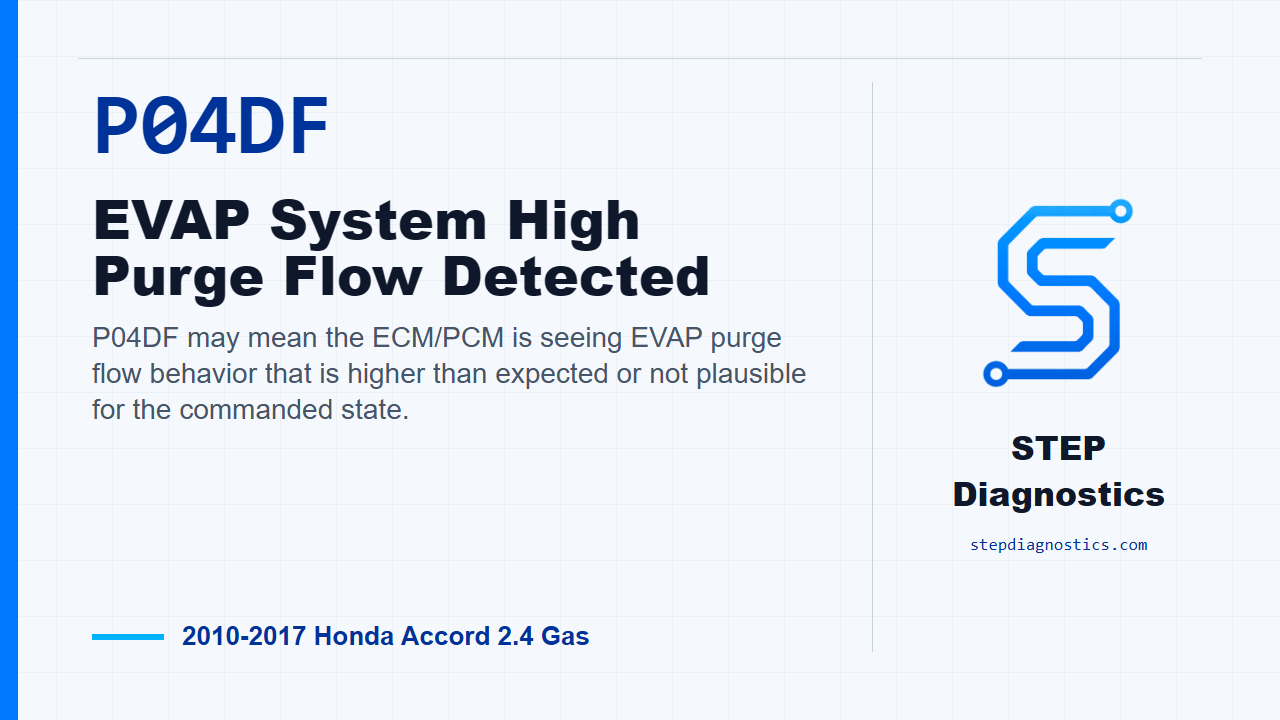
P04DF may mean the ECM/PCM is seeing EVAP purge flow behavior that is higher than expected or not plausible for the commanded state.
What the vehicle may do
- The vehicle may turn on the check engine light.
- The vehicle can often drive normally while the EVAP fault is present.
- EVAP-related readiness monitors may not complete until the fault is corrected.
Possible fault areas
- Possible EVAP purge control issue.
- Possible EVAP vent control issue.
- Possible FTP sensor feedback or circuit issue.
- Possible loose terminals, poor connections, or intermittent wiring concerns.
Diagnostic path
Open and diagnostic mindset
On this 2010 through 2017 Honda Accord with the 2.4 gas engine, P04DF points to an EVAP system high purge flow condition. In plain terms, the ECM/PCM may be seeing purge flow behavior that does not match what it expects. The vehicle may have a check engine light, and it can often still drive normally while the EVAP fault is present. The fault area may involve EVAP purge control, vent control, FTP sensor feedback, wiring or connector issues, or an intermittent condition. Start with the basic system checks, and if another code prevents this EVAP test from completing, check what that code means first before chasing P04DF.
Verify the problem first
Begin by turning the ignition switch to ON (II), or pressing the engine start/stop button to select ON mode. Clear the DTC with the HDS. Then, with the HDS, select the EVAP test and run the function test. This is the first split in the diagnosis: if the result is OK, treat it as an intermittent failure and the system is OK at this time. In that case, look closely for poor connections or loose terminals at the FTP sensor, the EVAP canister purge, the EVAP canister vent shut valve, and the PCM. If captured operating data is available for this DTC, try to reproduce the same conditions instead of guessing. If the result is not OK, continue into the EVAP canister purge valve open-stuck check.
Check whether the purge valve is stuck open
For the purge valve open-stuck check, disconnect the vacuum hose, which is the purge line, from the EVAP canister purge valve in the engine compartment. Connect a vacuum gauge and a vacuum pump/gauge to that hose. Use thread seal tape on the vacuum gauge threads when connecting the gauge to the tube joint adapter. Because this test depends on a sealed setup, do not judge the result until the hose, gauge, and pump/gauge connections are correct and sealed.
Interpret the vacuum hold result
Apply about 2 kPa (0.6 inHg, 15 mmHg) of vacuum to the purge valve. The decision is simple: does it hold vacuum? If it does hold vacuum, replace the EVAP canister vent shut valve. If it does not hold vacuum, replace the EVAP canister purge valve.
Verify after the repair
After the repair, keep verification separate from the component test. Confirm P04DF stays gone under the conditions that originally exposed the fault before calling it fixed. The takeaway is to prove the purge flow fault first, then let the vacuum hold result decide whether the vent shut valve or purge valve is the next move. For more diagnostic training, visit stepdiagnostics.com.
Final check
For P04DF, confirm the fault with the EVAP function test first, then use the purge valve vacuum hold check to guide the next repair decision.
For more guided automotive diagnostics, visit STEP Diagnostics.