What this code means
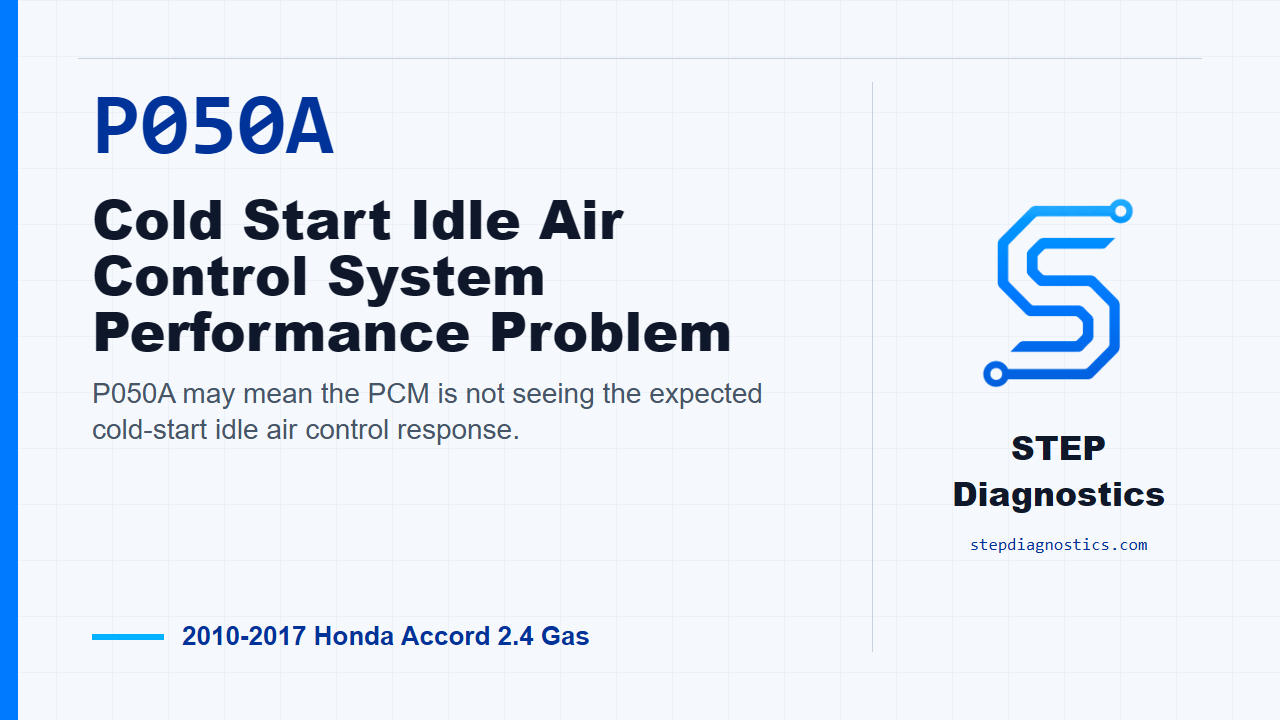
P050A may mean the PCM is not seeing the expected cold-start idle air control response.
What the vehicle may do
- The vehicle may have a rough or unstable idle after a cold start.
- The idle can feel slow to settle when the engine is cold.
- The malfunction indicator may be on with the code stored.
Possible fault areas
- Possible intake air duct or air cleaner housing connection or blockage issues.
- Possible dirty or restricted air cleaner element.
- Possible throttle control or throttle bore condition.
- Possible MAF sensor or IAT sensor input concern.
- Possible poor connections or loose terminals at the throttle, MAF sensor/IAT sensor, or PCM.
Diagnostic path
Opening context
On this Accord, P050A points to a cold start idle air control system performance problem. In plain terms, the PCM may not be seeing the airflow and idle response it expects right after a cold start. The driver may notice a rough cold idle, an unstable idle, or a cold-start idle that just does not settle normally. The broad fault areas can include the intake air path, the air cleaner assembly, the throttle control side, and the MAF and IAT inputs. Before getting deep into testing, save the captured operating data and any snapshot information, then start with the basic system checks.
Initial code check
Start by turning the ignition ON, or selecting ON mode, and check Pending and Confirmed codes with the HDS. If other codes are present besides P050A, check what they mean first. If P050A is the only code you are chasing, move into the air intake checks.
Air inlet inspection
First, inspect the intake air duct for a poor connection or a blockage. If the duct is not OK, reconnect or repair it, then verify the repair. If the duct checks out, inspect the air cleaner housing the same way, looking for a poor connection or blockage. If the housing is not OK, replace the air cleaner housing, then verify the repair. If that is OK, check the air cleaner element for dirt or debris. A dirty element gets replaced, then the repair is verified. If the element is not dirty, continue with reproducing the code conditions.
Duplicate the failure under the monitor gate
To verify the problem, let the engine cool until ECT SENSOR 1 is 122 °F (50 °C) or less. Clear the code with the HDS, start the engine, and let it idle for 10 seconds or more. Then monitor the OBD STATUS for P050A in the HDS. If it shows FAILED, you have duplicated the failure and can continue testing. If it shows PASSED, treat it as an intermittent at this time and check for poor connections or loose terminals at the throttle, the MAF sensor and IAT sensor, and the PCM. If it shows EXECUTING, keep it idling until a result appears. If it shows OUT OF CONDITION, pause, recheck the earlier diagnostic path and the operating conditions, and avoid guessing.
Throttle body functional check
Once the failure is duplicated, run the ETCS test from the HDS inspection menu. You are checking whether the throttle actuator control valve is normal. If it is normal, keep going. If it is not normal, replace the throttle body, then verify the repair.
MAF sensor performance check
Next, check MAF sensor performance. Start the engine and hold it at 3,000 rpm without load, with an automatic in P or N, or a manual in neutral, until the radiator fan comes on. Then let it idle. After that, hold the engine at 2,500 rpm for 30 seconds and watch the MAF sensor value with the HDS. For an automatic, the threshold shown is 6.5-9.1 g/s. For a manual, the threshold shown is 5.5-7.7 g/s. If the current condition matches the malfunction threshold, the MAF sensor is considered OK for this path and you move to the IAT check. If it does not match, replace the MAF sensor/IAT sensor, then verify the repair.
IAT sensor and throttle bore decision
For the IAT check, turn the ignition OFF, or select OFF mode, and allow the engine to cool to ambient temperature. Note the ambient temperature. Then turn the ignition ON, or select ON mode, and quickly read IAT SENSOR in the HDS data list. Compare the IAT value to ambient temperature. If the IAT SENSOR value differs 5.4 °F (3 °C) or more from ambient, replace the MAF sensor/IAT sensor, then verify the repair. If it does not differ 5.4 °F (3 °C) or more, the IAT sensor is OK for this path. At that point, inspect the throttle bore for dirt, carbon, or damage. If dirt or carbon is present, clean the throttle body, then verify the repair. If the throttle bore is damaged, replace the throttle body, then verify the repair.
Verify the repair
Keep repair verification separate from the testing. Turn the ignition OFF, or select OFF mode, reconnect all connectors, then turn the ignition ON, or select ON mode. Reset the PCM with the HDS and do the PCM idle learn procedure. Let the engine cool until ECT SENSOR 1 is 122 °F (50 °C) or less. Start the engine and let it idle for 10 seconds or more while monitoring the OBD STATUS for P050A. If the HDS shows PASSED, the troubleshooting is complete. If it shows FAILED, go back to the beginning and recheck. If it shows EXECUTING, keep idling until a result appears. If it shows OUT OF CONDITION, meet the test condition and check OBD STATUS again.
Closing takeaway
The key with P050A is to prove the cold-start failure first, then work through the air path, throttle control, MAF performance, IAT comparison, and final verification in order. For more diagnostic training, visit stepdiagnostics.com.
Final check
Diagnose P050A in order: confirm the cold-start monitor result, check the air path, test throttle control, evaluate MAF and IAT data, then verify the repair under the same cold-start conditions.
For more guided automotive diagnostics, visit STEP Diagnostics.