What this code means
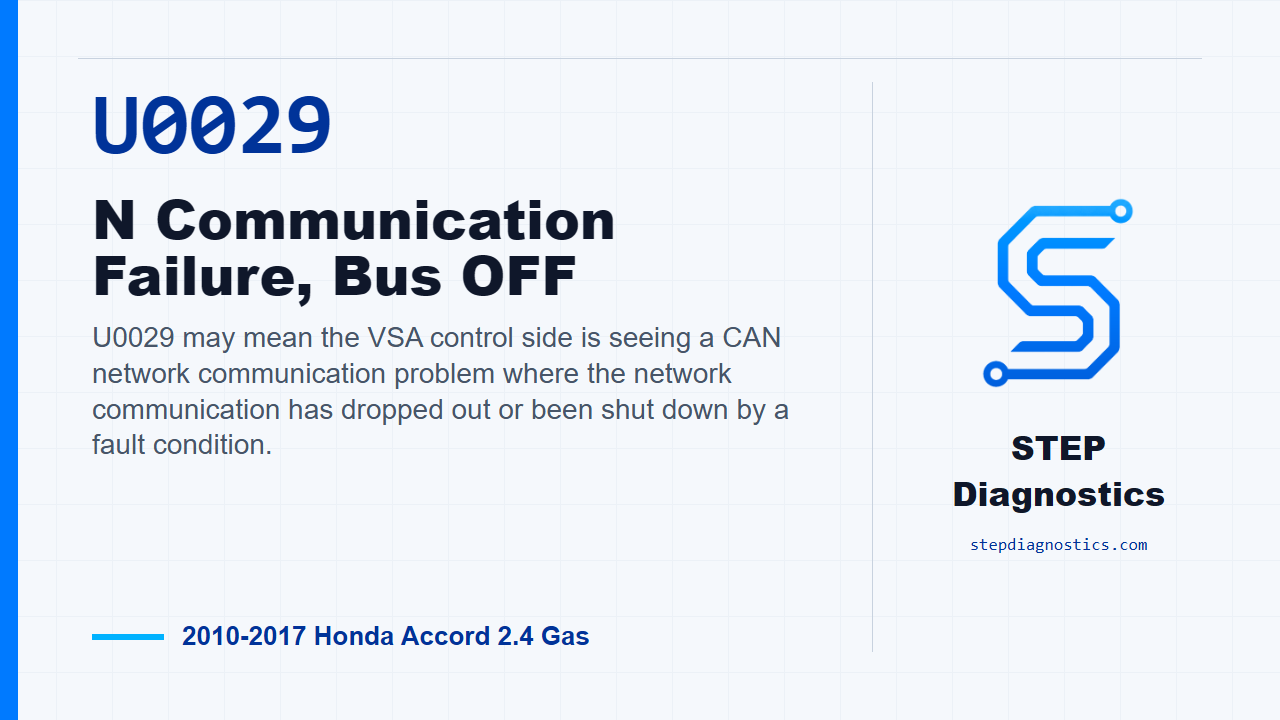
U0029 may mean the VSA control side is seeing a CAN network communication problem where the network communication has dropped out or been shut down by a fault condition.
What the vehicle may do
- The vehicle may show stability control, brake, or related warning indicators.
- Scan tool communication or module data may be affected.
- The concern may be intermittent if the code does not return during verification.
Possible fault areas
- Possible CAN network wiring concern between the PCM and VSA modulator-control unit.
- Possible loose terminal or poor connection at the VSA modulator-control unit connector.
- Possible VSA modulator-control unit software issue.
- Possible VSA modulator-control unit fault if the directed checks lead there.
Diagnostic path
Opening context
On this 2010 to 2017 Honda Accord with the 2.4 gas engine, U0029 points to a CAN communication failure, with the VSA control side seeing a bus-off type problem. In plain terms, the VSA modulator-control unit may not be communicating on the network the way it should. The driver may see stability or brake-related warning lamps, and scan tool communication or module data may be affected. Broadly, this can involve network wiring, connector condition, module software, or the VSA modulator-control unit itself. Before chasing U0029, if PGM-FI codes are present, handle those first. Also start with the basic system checks so you are not diagnosing a network code on top of a basic power, ground, scan tool, or vehicle setup issue.
Verify the problem first
Start by verifying the fault. Turn the vehicle to the ON mode, clear the code with the HDS, then turn the vehicle to the OFF, LOCK mode. Start the engine, wait 2 seconds or more, and check for codes again with the HDS. If U0029-00 comes right back, the failure is duplicated and you move into the circuit check. If U0029-00 does not return, treat it as an intermittent failure. At that point, the system is OK right now, and if captured data is available, try to reproduce the same conditions that were present when the code stored.
Check the F-CAN lines for an open
With the fault duplicated, check the F-CAN_H and F-CAN_L circuits between the VSA modulator-control unit and the PCM. Turn the vehicle to the OFF, LOCK mode. Jump the SCS line with the HDS and wait more than 1 minute. Then disconnect the VSA modulator-control unit 38P connector and PCM connector A, 51P. Now check continuity on the two network circuits. For the first circuit, check between VSA modulator-control unit 38P connector No. 38 and, on the L4 engine, PCM connector A, 51P, No. 2. For the V6 engine, that PCM point is connector A, 51P, No. 9. For the second circuit, check between VSA modulator-control unit 38P connector No. 26 and, on the L4 engine, PCM connector A, 51P, No. 1. For the V6 engine, that PCM point is connector A, 51P, No. 10. If continuity is present, the F-CAN_H and F-CAN_L wires are OK and you continue to the VSA unit software check. If continuity is not present, repair the open in the wire between the PCM and the VSA modulator-control unit.
Check VSA unit software and connector condition
After the wiring continuity check passes, reconnect the VSA modulator-control unit 38P connector and PCM connector A, 51P. Check the VSA modulator-control unit software, and update it if it does not have the latest software. Then turn the vehicle to the OFF, LOCK mode, start the engine, wait 2 seconds or more, and check again for U0029-00 with the HDS. If U0029-00 is still indicated, check for loose terminals and poor connections at the VSA modulator-control unit 38P connector. If the VSA modulator-control unit was updated and the symptom or indication is still present, replace the VSA modulator-control unit.
Verify the repair
Keep verification separate from the circuit testing. After the repair path is complete, check the vehicle again with the HDS. If U0029-00 is not indicated, troubleshooting for this code is complete. If other codes are present, check what they mean first and follow the diagnostic path for those codes. The takeaway is simple: prove the code returns, prove the CAN wires are not open, then handle VSA software, connector condition, and the VSA unit only as the test path leads you there. For more diagnostic training, visit stepdiagnostics.com.
Final check
This diagnosis is built around confirming the code, checking the F-CAN wiring for an open, then addressing VSA software, connector condition, and the VSA unit only when the earlier checks support that
For more guided automotive diagnostics, visit STEP Diagnostics.