What this code means
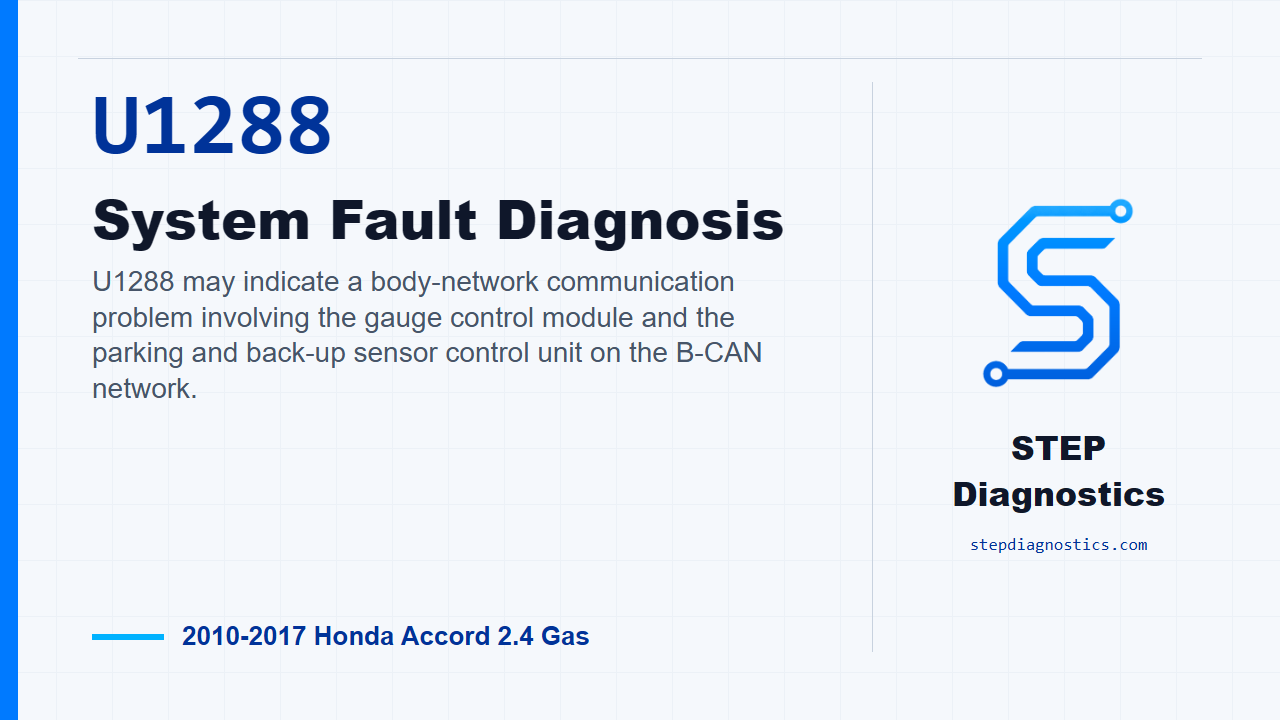
U1288 may indicate a body-network communication problem involving the gauge control module and the parking and back-up sensor control unit on the B-CAN network.
What the vehicle may do
- Parking assist or back-up sensor functions may act abnormally.
- Warning or status information may not display normally.
- The vehicle may store the code without an obvious driver complaint.
Possible fault areas
- Possible ignition feed or fuse issue to the parking and back-up sensor control unit.
- Possible ground circuit or ground connection issue.
- Possible connector or terminal concern.
- Possible B-CAN wiring issue between the parking and back-up sensor control unit and the gauge control module.
Diagnostic path
What U1288 is pointing us toward
On this 2010 to 2017 Honda Accord with the 2.4 gas engine, U1288 is a body-network communication fault seen through the gauge control module. In plain terms, the car may not be seeing the parking and back-up sensor control unit the way it should on the B-CAN network. The vehicle may have parking assist or back-up sensor functions that act up, warning information that does not display normally, or it may simply store the code with no obvious driver complaint. The likely areas to keep in mind are ignition power to the module, module grounds, fuse feed, connectors, and the B-CAN wiring between the parking and back-up sensor control unit and the gauge control module. If other body-network codes are present, check what they mean first so you do not chase this one in isolation.
First, prove the code is current
Start by clearing the codes with the HDS. Turn the vehicle OFF, then back ON, wait for at least 6 seconds, and check for codes again. If U1288 comes right back, continue with the network and power checks. If it does not return, treat it as an intermittent for now. At that point, the system is OK at this time, and the best move is to look for loose terminals, poor connector fit, or a connection that is being disturbed by movement.
See if the parking sensor module is being detected
Next, use the HDS body electrical menu to look at the B-CAN connected control units. Check the parking sensor module status. If the module shows DETECT, the scan tool is seeing it on the network, so skip ahead to the B-CAN line check for that path. If it does not show DETECT, stay with the basics first and check its power and ground feed before condemning the network wiring.
Check the fuse and ignition feed
If the parking sensor module is not detected, check fuse No. B5, rated at 7.5 A, in the under-dash fuse and relay box. If the fuse is not OK, replace the fuse. If it blows again, repair the short to ground in the No. B5 fuse circuit. If the fuse is OK, move to the IG1 METER feed. Turn the vehicle OFF, disconnect the parking and back-up sensor control unit 24P connector, turn the vehicle ON, and measure voltage from terminal No. 1, the BRN wire, to body ground. You are looking for battery voltage. If battery voltage is present, keep going. If it is not present, repair the open or high resistance in that wire.
Check the module grounds
With the parking and back-up sensor control unit 24P connector still disconnected, turn the vehicle OFF and check the ground circuits. Check continuity from terminal No. 12, the BLK wire, to body ground, and also from terminal No. 9, the BLK wire, to body ground. If both ground paths have continuity, the ground wires are OK and the next check is the B-CAN wiring. If continuity is missing, repair the open or high resistance in the ground wire, or the poor ground at G603.
B-CAN check when the module was not detected
If power and ground checked out after the module was not detected, turn the vehicle OFF and disconnect gauge control module connector A, the 32P connector. With both the gauge control module connector and the parking and back-up sensor control unit 24P connector disconnected, check continuity on the B-CAN_H circuit from the parking and back-up sensor control unit terminal No. 22, the PNK wire, to gauge control module connector A terminal No. 30, also PNK. If that circuit has continuity, the fault area is an open or poor connection in the B-CAN_L wire between the parking and back-up sensor control unit and the gauge control module. If it does not have continuity, the fault area is an open or poor connection in the B-CAN_H wire between those two modules.
B-CAN check when the module was detected, then confirm the result
If the parking sensor module did show DETECT earlier, the path still comes back to the B-CAN line check. Turn the vehicle OFF, disconnect gauge control module connector A, the 32P connector, and disconnect the parking and back-up sensor control unit 24P connector. Check continuity on the B-CAN_H circuit from terminal No. 22, PNK, at the parking and back-up sensor control unit to terminal No. 30, PNK, at gauge control module connector A. If continuity is present, the fault area is an open or poor connection in the B-CAN_L wire between the two modules. If continuity is not present, the fault area is an open or poor connection in the B-CAN_H wire. After the repair, use the same clear-and-recheck routine to verify the repair and confirm the code stays gone. The takeaway is simple: prove U1288 is current, confirm whether the parking sensor module is being seen, then work power, ground, and B-CAN wiring in order. For more diagnostic training, visit stepdiagnostics.com.
Final check
U1288 is best approached by confirming the code, checking whether the parking sensor module is detected, then testing power, ground, and B-CAN wiring in order.
For more guided automotive diagnostics, visit STEP Diagnostics.