What this code means
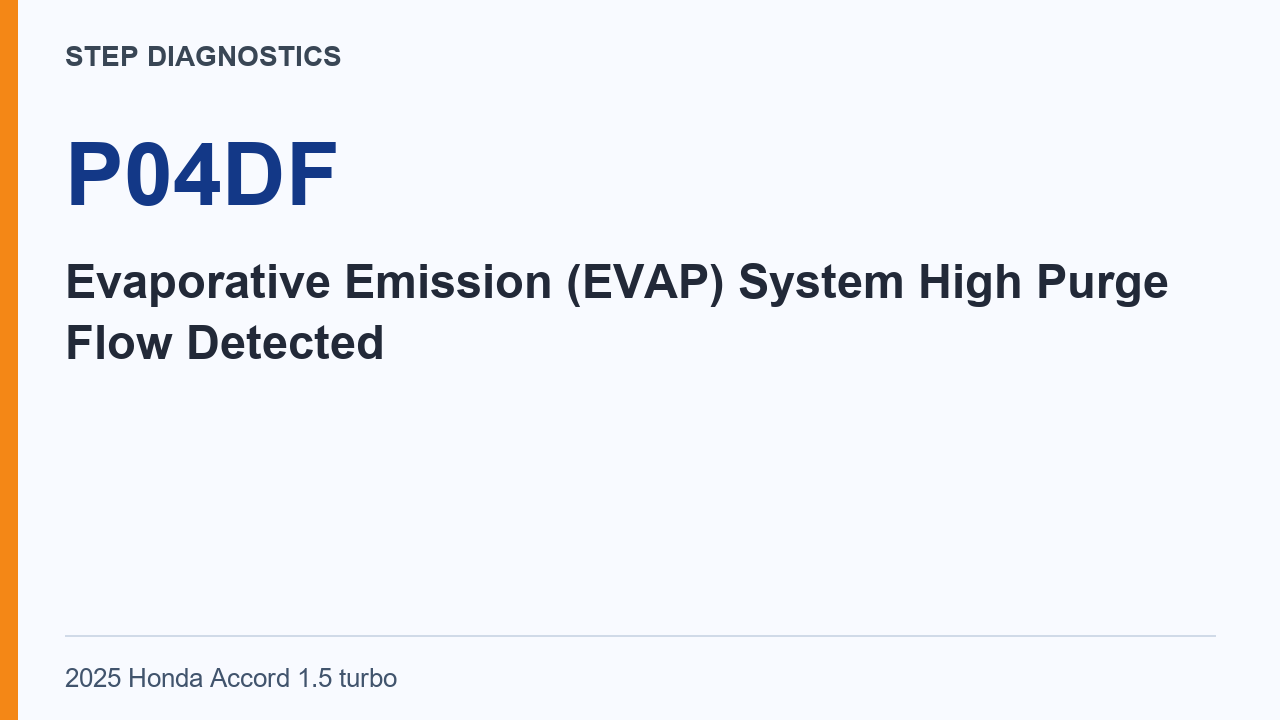
P04DF can indicate high purge flow in the EVAP system.
P04DF concerns high purge flow in the EVAP system. In the described monitored condition, the PCM watches the FTP reading after the engine stops. A fluctuation from negative pressure to atmospheric pressure leads to the stored code.
The procedure then combines an HDS function check with several purge-valve and non-return-valve inspections. These use pressure or vacuum under different command conditions. The result is a pattern of hold and not-hold observations, rather than a single general judgment that the valve is open or closed.
What the vehicle may do
- The FTP sensor value may fluctuate after the engine stops.
Possible fault areas
- Possible fault areas include the EVAP canister purge valve and its integrated non-return valves.
- The EVAP canister vent shut valve can also be a fault area.
The HDS function test first checks whether the failure is duplicated. The valve inspections then use the removed purge valve with its connector still connected and the stated pump/gauge. The equipment range is part of the listed tool description; the individual inspection results are the pressure-hold or vacuum-hold criteria given below.
Read each of those criteria with its HDS command and pressure-or-vacuum setup. The leakage check also has the stated prerequisite that the close-stuck inspection result is within specification. That prerequisite connects the checks instead of making them interchangeable alternatives.
Diagnostic path
Understand the stored condition
P04DF means Evaporative Emission (EVAP) System High Purge Flow Detected. In everyday terms, purge flow in the EVAP system is high. After the engine stops, the PCM watches the FTP sensor value. If that value fluctuates from negative pressure to atmospheric pressure, the PCM stores this code.
Before the checks
It marks the scope of the inspection.
Check whether the failure repeats
Turn the vehicle to the ON mode. On the HDS, use PGM-FI > Function Test > EVAP TEST > FUNCTION TEST. Check the result. If it is not OK, the failure is duplicated. For the commanded valve checks, the HDS path is PGM-FI > Function Test > EVAP TEST > SINGLE SOLENOID > PCS(CPV) ON. PGM-FI > Data List is also listed as an available HDS function.
Check whether the purge valve is stuck open
For these valve checks, the purge valve must be removed, but its connector must stay connected. Use a Vacuum Pump/Gauge, 0-30 inHg, Snap-on YA4000B or equivalent, commercially available. Use it to apply pressure or vacuum to the valve port in the following checks. An asterisk marks an inspection required for this troubleshooting. Apply pressure to one side port as shown for this inspection to check whether the purge valve is stuck open. The pressure should hold.
Check whether the purge valve is stuck closed
Select the HDS [PCS(CPV) ON] to check whether the purge valve is stuck closed. Then apply pressure to one side port as shown for this inspection. With this command selected, the pressure should not hold.
The open-stuck and closed-stuck checks have different expected pressure behavior. In the first check, pressure should hold. With the specified PCS(CPV) ON command selected for the closed-stuck check, pressure should not hold. The command condition is therefore part of the meaning of the observation.
The following leakage and non-return checks use vacuum and have their own expected behavior. Keep the pressure checks and vacuum checks distinct so that a correct observation in one setup is not applied to another setup with a different criterion.
Check for leakage and a non-return valve stuck open
Before this check, complete the EVAP Canister Purge Valve Close Stuck Inspection. Confirm that its result is within specification before you continue. Select the HDS [PCS(CPV) ON] to check for a purge valve leak and a non-return valve stuck open. Then apply vacuum to one side port as shown for this inspection. The vacuum should hold.
Check non-return valve A
Select the HDS [PCS(CPV) ON] for the Non-Return Valve A Close Stuck (Intake Manifold Side) check. Then apply vacuum to one side port as shown for this inspection. The vacuum should not hold.
Check non-return valve B
Select the HDS [PCS(CPV) ON] for the Non-Return Valve B Close Stuck (Turbocharger Side) check. Then apply vacuum to one side port as shown for this inspection. The vacuum should not hold.
What the results mean
Compare each inspection result with its specification. Every inspection must be within specification for the overall result to be normal. If the overall result is abnormal, there is a problem with the purge valve. If all results are normal, there is a problem with the EVAP canister vent shut valve.
The procedure requires every inspection to be within specification for the overall result to be normal. An abnormal overall result points to the purge valve. If all results are normal, the procedure points to the EVAP canister vent shut valve.
This final decision depends on the combined set of results. A single passing observation does not supply the complete all-results-normal condition. The individual command, pressure and vacuum setups explain what contributes to that overall conclusion.
Final check
The combined valve inspection results can identify whether the problem is with the purge valve or the vent shut valve.
The final finding should retain the HDS function result and the individual hold/not-hold observations. The overall normal condition is the combination specified by the procedure. Use that combined result for the purge-valve or vent-shut-valve conclusion, preserving the prerequisite between the close-stuck and leakage checks.