What this code means
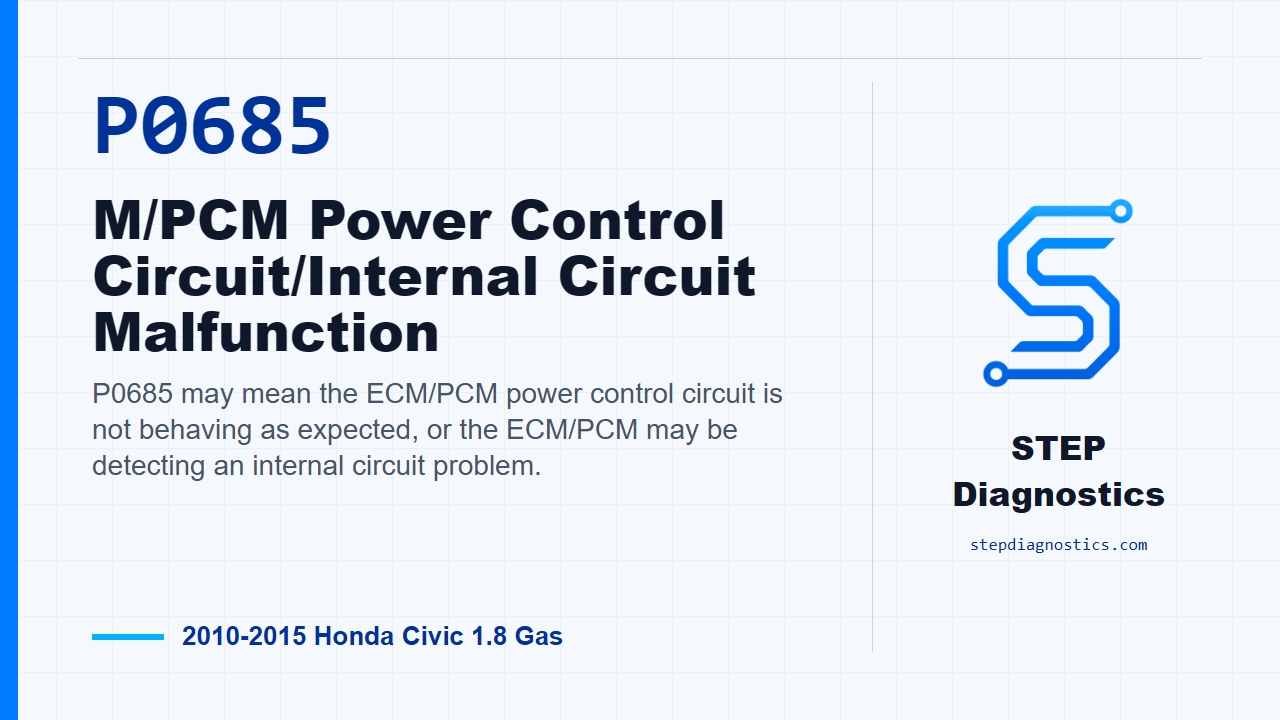
P0685 may mean the ECM/PCM power control circuit is not behaving as expected, or the ECM/PCM may be detecting an internal circuit problem.
What the vehicle may do
- The vehicle may have intermittent starting or running symptoms.
- The code may return after a key cycle.
- The issue can be intermittent and may not duplicate immediately.
Possible fault areas
- Possible main relay or main fuse concerns.
- Possible poor connections or loose terminals between the ECM/PCM and the under-hood fuse and relay box.
- Possible ECM/PCM ground, battery cable, or battery-related concerns.
- Possible ECM/PCM software or control-unit concern.
Diagnostic path
Open and frame the code
On this 2010 to 2015 Honda Civic with the 1.8 gas engine, P0685 points to a problem in the ECM/PCM power control circuit or an internal circuit fault. In plain terms, the computer may not be seeing power control behave the way it expects. The vehicle may have intermittent starting or running symptoms, or the code may come back after a key cycle. Broadly, this can involve the main relay or fuse side, battery and ground connections, wiring or terminal fit between the ECM/PCM and the under-hood fuse and relay box, or the ECM/PCM itself. Before going after the control unit, slow down and prove whether the fault is repeatable.
Before troubleshooting
Before clearing anything, save the freeze data and any on-board snapshot, then do your normal basic checks. Also, if this code clears and does not return, or it has been stored intermittently, check for loose terminals at the IGP line connectors before condemning the ECM/PCM.
Problem verification
Start by turning the ignition switch to ON (II). Clear the DTC with the HDS. Then start the engine and let it idle for 30 seconds. Turn the ignition switch to LOCK (0), then turn it back to ON (II). Now check Pending or Confirmed DTCs with the HDS and see whether P0685 is indicated.
If the fault duplicates
If P0685 is indicated during that check, the failure has been duplicated. At that point, update the ECM/PCM if it does not have the latest software, or substitute a known-good ECM/PCM, then move into repair verification. Keep this separate from the initial problem verification so you know whether the code was truly repeatable before any control-unit action was taken.
If the fault does not duplicate
If P0685 is not indicated, treat it as an intermittent failure. Check the PGM-FI main relay 1 and the PGM-FI main fuse, then look for poor connections or loose terminals between the ECM/PCM and the under-hood fuse and relay box. Also check ECM/PCM grounds, battery cable connections, and the battery condition. The point here is to find a power, ground, or terminal-fit issue before replacing expensive electronics.
Repair verification
For repair verification, start the engine and let it idle for 30 seconds. Turn the ignition switch to LOCK (0), then turn it back to ON (II). Check Pending or Confirmed DTCs with the HDS again and see whether P0685 is indicated.
Verification results
If P0685 is still indicated and the ECM/PCM was updated, substitute a known-good ECM/PCM and recheck. If the ECM/PCM had already been substituted, go back to the beginning of the diagnostic path and prove the fault again instead of guessing. If P0685 is not indicated, troubleshooting is complete. If a known-good ECM/PCM was substituted, replace the original ECM/PCM. If other Pending or Confirmed DTCs are present, check what those codes mean next.
Takeaway
The key with P0685 is to separate a repeatable ECM/PCM power-control fault from an intermittent power, ground, fuse, relay, or terminal problem. Prove the code, handle the ECM/PCM software or known-good substitution only when the fault duplicates, then verify that P0685 stays gone. For more diagnostic training, visit stepdiagnostics.com.
Final check
P0685 is best handled by proving whether the fault repeats, checking intermittent power and ground connection areas when it does not, and keeping repair verification separate from the initial problem-
For more guided automotive diagnostics, visit STEP Diagnostics.