What this code means
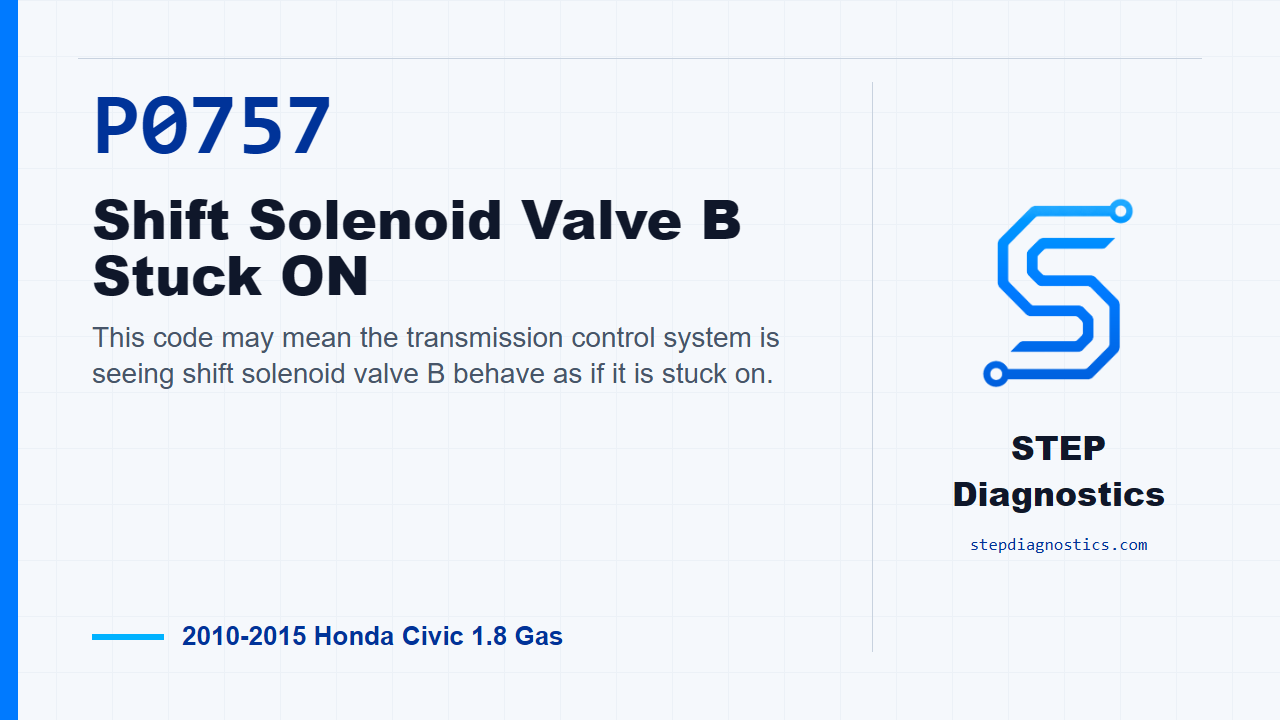
This code may mean the transmission control system is seeing shift solenoid valve B behave as if it is stuck on.
What the vehicle may do
- The vehicle may have shift complaints.
- The code can return after the transmission is driven through its operating range.
- The transmission may need a road test to show whether the fault is active or intermittent.
Possible fault areas
- Possible ATF contamination or internal clutch material.
- Possible shift solenoid valve B operation concern.
- Possible hydraulic or mechanical concern around shift valve B or the transmission.
Diagnostic path
Open and frame the fault
On this L4-1.8L (R18Z1) Civic, P0757 is shift solenoid valve B stuck ON. In plain language, the transmission control system may be seeing shift solenoid valve B behave like it is staying applied when it should not. The vehicle may have shift complaints, and the code can come back after the transmission is driven through its range. The broad areas to think about are possible fluid contamination or clutch material, possible shift solenoid B operation, and a possible hydraulic or mechanical problem around shift valve B. Before testing, save the freeze data and any onboard snapshot with the HDS, then start with the basic system checks so you are working from a clean picture.
Check the ATF first
Start with the ATF check. Warm the engine to normal operating temperature, meaning the radiator fan comes on. Confirm the transmission is filled to the proper level, and check for fluid leaks. Then drain the ATF through a strainer and inspect what the strainer catches. If you find metal debris or excessive clutch material, the path calls for replacing the transmission, then verifying the repair. If the strainer does not show metal debris or excessive clutch material, replace the ATF and move on to the solenoid operation check.
Command shift solenoid valve B
Next, check shift solenoid valve B operation with the HDS. Turn the ignition switch to ON (II), clear the DTC, then command shift solenoid valve B with the scan tool. You are listening for a clicking sound. If the click is heard, shift solenoid valve B is OK for this part of the test, so continue to the drive check. If no clicking sound is heard, replace shift solenoid valve B, then verify the repair.
Duplicate the fault on the road
Now try to duplicate the problem. Test-drive the vehicle with the shift lever in D, and let the transmission shift through all five gears. While driving, monitor the OBD STATUS for P0757 with the HDS. If the HDS shows FAILED, the failure is duplicated. At that point, the path identifies faulty shift valve B and calls for replacing the servo body, shift valve B, or the transmission, then verifying the repair. If the HDS shows PASSED, treat it as an intermittent failure, and the system is OK at this time. If it shows NOT COMPLETED, test-drive again.
Verify the repair and confirm the code stays gone
Keep final verification separate from the testing. Turn the ignition switch to ON (II), clear the DTC with the HDS, then test-drive again with the shift lever in D and let the transmission shift through all five gears. Monitor the OBD STATUS for P0757 with the HDS. If the HDS shows PASSED, troubleshooting for this code is complete. After that, check for any other pending or confirmed codes, and if any are present, handle those diagnostic paths as needed. If the HDS shows FAILED, go back to the solenoid operation check and recheck the path. If it shows NOT COMPLETED, reproduce the operating conditions and check OBD STATUS again.
Takeaway
The key on P0757 is to prove whether the issue is debris and internal damage, a solenoid that will not click when commanded, or a fault that only shows up during the drive check. Work the path in order, verify it cleanly, and do not skip the final OBD status result. For more diagnostic training, visit stepdiagnostics.com.
Final check
This diagnosis often depends on checking fluid condition first, then proving solenoid operation, then confirming the code status on a controlled drive.
For more guided automotive diagnostics, visit STEP Diagnostics.