What this code means
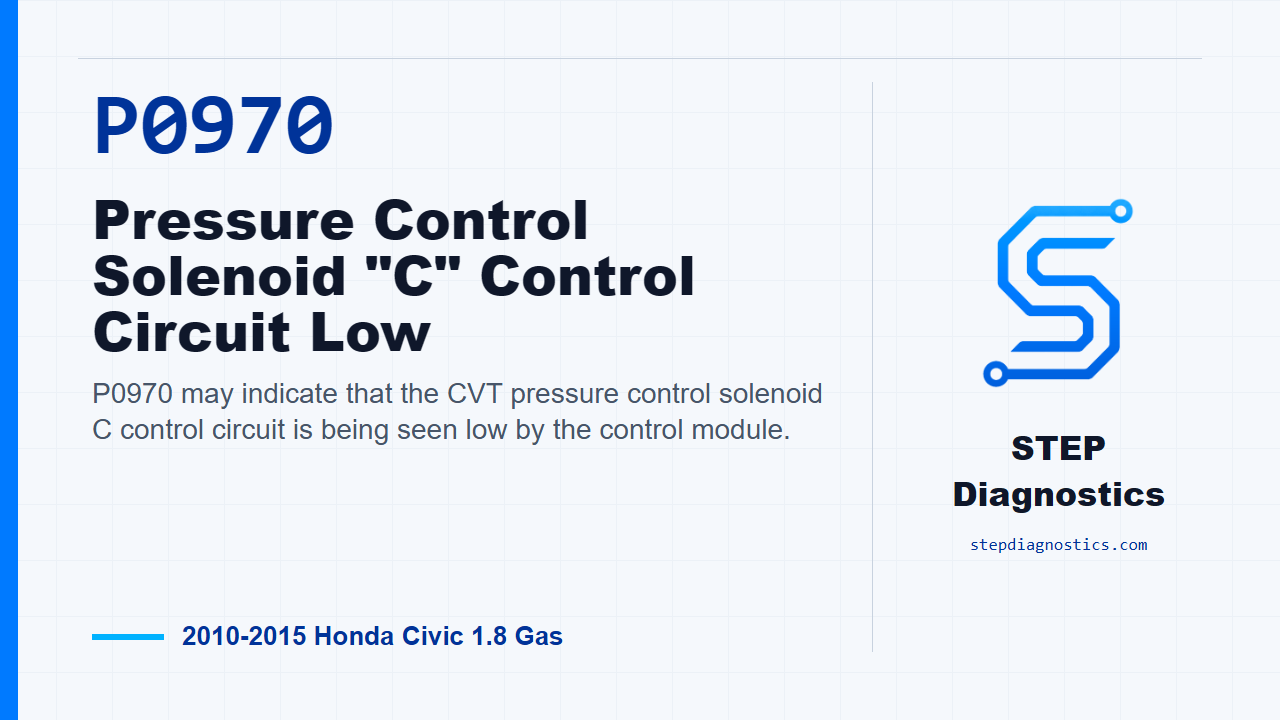
P0970 may indicate that the CVT pressure control solenoid C control circuit is being seen low by the control module.
What the vehicle may do
- The vehicle may turn on a warning light or store a transmission-related fault.
- The CVT can sometimes feel abnormal, delayed, or limited depending on how the control module responds.
Possible fault areas
- Possible areas can include the CPCLS control line, related connectors or harnessing, the solenoid wire harness, the CVT pressure control solenoid circuit, PCM software status, or a
- confirmed control module issue after the circuit checks.
Diagnostic path
Set up the diagnosis
On this Civic CVT, P0970 means the pressure control solenoid C control circuit may be reading low on the CPCLS control line. In plain language, the PCM may not be seeing the electrical side of that solenoid control the way it expects. The vehicle may have a transmission warning, a stored CVT fault, or an abnormal drive feel, but this code path stays focused on the electrical control circuit. This is not a mechanical transmission diagnosis. Before chasing the circuit, start with the basic system checks, make sure the vehicle and HDS setup are clean, and then work the fault in order.
Verify P0970 first
Start by proving the code is active. Turn the ignition switch to ON (II), or use the engine start/stop button to select ON mode. Clear the DTC with the HDS. Start the engine, wait for at least 1 second, then check for pending or confirmed DTCs with the HDS. If P0970 comes back, the failure is duplicated and you move into the solenoid and circuit checks. If P0970 does not come back, treat it as an intermittent failure. The system is OK at that moment. If captured data is recorded for this code, try to duplicate the same operating conditions instead of guessing.
Separate the solenoid path from the wiring path
Next, test the CVT clutch pressure control solenoid valve. This step decides where the diagnostic path goes next. If the solenoid valve works properly, continue to the CPCLS line continuity check. If it does not work properly, go directly to the solenoid resistance check.
Check the CPCLS line for an open
For the CPCLS line check, turn the ignition switch to LOCK (0), or select OFF mode with the engine start/stop button. Jump the SCS line with the HDS. Disconnect the solenoid wire harness 8P connector on the engine wire harness side, and disconnect PCM connector B, the 51P connector. Then check continuity on the CPCLS circuit between solenoid wire harness 8P connector No. 7, RED/BLK, and PCM connector B, 51P, No. 6, RED/BLK. If there is continuity, the CPCLS wire is OK. At that point, update the PCM if it does not have the latest software, or substitute a known-good PCM, then recheck. If P0970 goes away after the PCM was updated, that completes this path. If P0970 goes away with a known-good PCM substituted, replace the original PCM. If there is no continuity, repair the open in the CPCLS wire between the solenoid wire harness and the PCM.
Check solenoid resistance when the solenoid path fails
If the earlier solenoid test did not pass, remove the solenoid wire harness and measure resistance at the CVT clutch pressure control solenoid valve. The ignition is still in LOCK (0), or OFF mode. Disconnect the CVT clutch pressure control solenoid valve 2P connector and the solenoid wire harness 8P connector on the valve body side. Measure between the solenoid valve 2P connector No. 1 and No. 2 on the CPC+ and CPC- circuit. The expected reading is 4.9-6.6 Ω. If the reading is in that range, the solenoid checks OK, so replace the solenoid wire harness. If the reading is not in that range, the CVT clutch pressure control solenoid valve is faulty, so replace the valve body.
Verify and close
Keep verification separate from the circuit testing. After the PCM update or PCM substitution path, recheck for P0970 as directed. The practical takeaway is simple: prove the code first, decide whether the solenoid path or CPCLS wiring path is failing, and do not turn this into a mechanical CVT diagnosis. For more diagnostic training, visit stepdiagnostics.com.
Final check
P0970 is best approached as an electrical control-circuit diagnosis, with mechanical transmission faults kept out of the main path.
For more guided automotive diagnostics, visit STEP Diagnostics.