What this code means
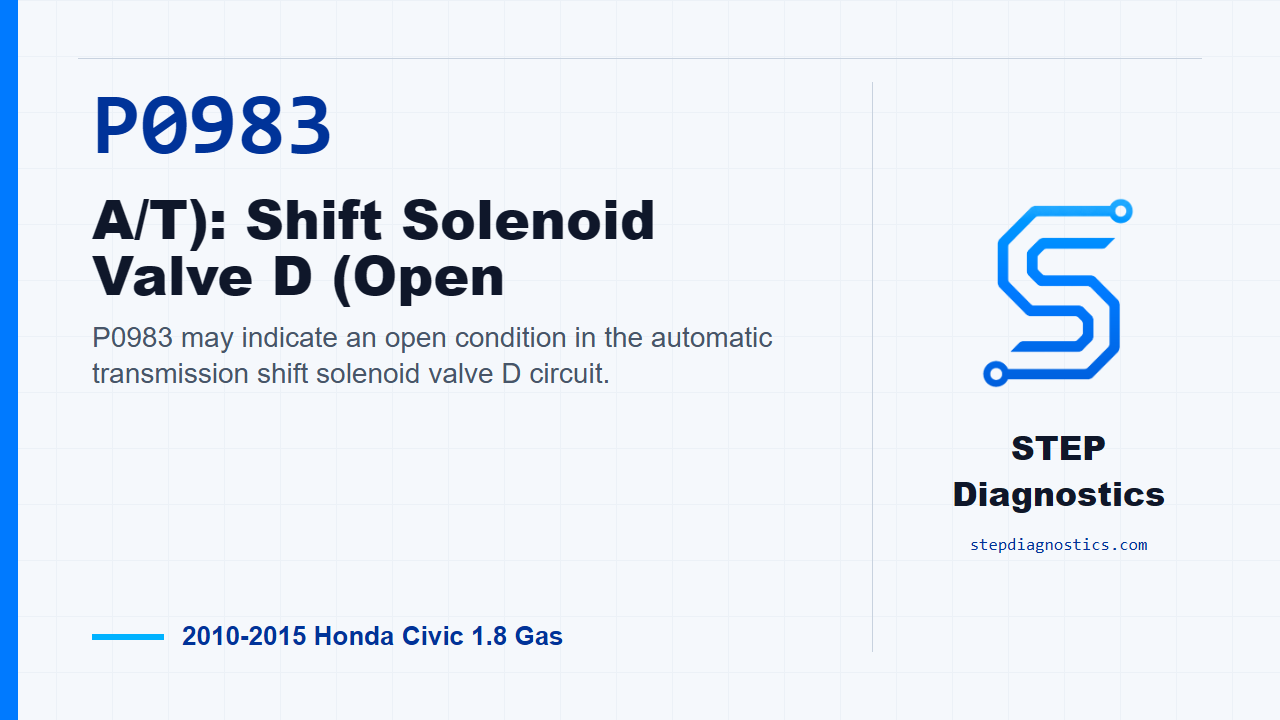
P0983 may indicate an open condition in the automatic transmission shift solenoid valve D circuit.
What the vehicle may do
- The vehicle may have shift quality complaints.
- The transmission control system may command limited or abnormal shifting behavior.
- The concern can be intermittent if the circuit or terminals only lose contact under certain conditions.
Possible fault areas
- Possible electrical fault areas can include shift solenoid valve D, related wiring, connector or terminal fit, the shift solenoid wire harness, and the PCM side of the circuit.
Diagnostic path
Opening context
On this 2010 to 2015 Honda Civic with the 1.8 gas engine, P0983 points to an open condition in the automatic transmission shift solenoid valve D circuit. The vehicle may have shift quality complaints or transmission control issues, but the important thing here is that this code is treated as an electrical circuit problem. It can involve the solenoid, the solenoid wiring, connector or terminal issues, the harness between the transmission and PCM, or the PCM side of the circuit. Before you start testing, save the freeze data and any on-board snapshot with the HDS, and start with the basic system checks. Also keep in mind: this one is not caused by a mechanical problem inside the transmission.
Verify whether the fault is present
Start by turning the ignition switch to ON (II), then clear the DTC with the HDS. Start the engine, press the brake pedal, shift to N, and wait for at least 1 second. Now check Pending or Confirmed DTCs with the HDS. If P0983 comes right back, the failure is duplicated, so move into circuit testing at the solenoid D resistance check. If P0983 is not indicated, keep going with the commanded solenoid check.
Command the solenoid and listen
Next, use the HDS Miscellaneous Test Menu and command Shift Solenoid Valve D. Listen for the solenoid click. If you hear the click, the solenoid is responding during that command, so continue by trying to duplicate the fault on the road. If you do not hear the click, go directly into the resistance and circuit checks.
Try to duplicate the code under operating conditions
If the solenoid clicked during the command test, test-drive the vehicle in 3rd gear with the shift lever in D for at least 1 second. Watch the OBD STATUS for P0983 in the HDS DTC menu. If the status shows FAILED, the failure is duplicated, and you move into the resistance check. If it shows PASSED, treat it as an intermittent at this time: the system is OK right now, so check closely for poor connections or loose terminals between shift solenoid valve D and the PCM. If the status shows NOT COMPLETED, run the drive check again under the required conditions.
Check solenoid D resistance from the PCM side
For the resistance check, turn the ignition switch to LOCK (0), jump the SCS line with the HDS, and disconnect PCM connector B, the 49P connector. Measure resistance on the SH_D circuit between PCM connector B No. 32, the GRN/RED wire, and body ground. The expected reading is 13.8-17.1 Ω. If the circuit measures 13.8-17.1 Ω, shift solenoid valve D checks OK from this test point. At that point, update the PCM if it does not have the latest software, or substitute a known-good PCM, then move to repair verification. If the resistance is not 13.8-17.1 Ω, continue with the open-wire check on the SH_D line.
Check the SH_D wire for an open
With the ignition still at LOCK (0), disconnect the shift solenoid wire harness 8P connector, and keep PCM connector B disconnected. Check continuity on the SH_D wire between shift solenoid wire harness 8P connector No. 5, the GRN/RED wire, and PCM connector B No. 32, also GRN/RED. If there is continuity, the SH_D wire is OK, and you continue into the solenoid wire harness check. If there is no continuity, repair the open in the SH_D wire between the shift solenoid wire harness and the PCM, then verify the repair.
Check the solenoid wire harness
If the SH_D wire to the PCM checks good, remove the shift solenoid wire harness. Check continuity between the shift solenoid wire harness 7P connector No. 4, the YEL wire, and shift solenoid valve D 1P connector No. 1, also YEL. If there is continuity, the shift solenoid wire harness is OK, and the diagnostic path supports replacing shift solenoid valve D. If there is no continuity, replace the shift solenoid wire harness. After either repair, go to verification.
Verify the repair
For repair verification, reconnect all connectors. Turn the ignition switch to ON (II), clear the DTC with the HDS, then start the engine with the shift lever in P and wait for at least 1 second. Press the brake pedal, shift to N, and wait for at least 1 second. Monitor OBD STATUS for P0983 in the HDS DTC menu. If the status shows PASSED, troubleshooting is complete. If a known-good PCM was substituted, replace the original PCM. Then check for any other Pending or Confirmed DTCs, and if any are present, handle those separately. If the status shows FAILED, go back to the beginning and recheck the diagnostic path. If the PCM was updated, substitute a known-good PCM and check OBD STATUS again. If the status shows NOT COMPLETED, meet the test condition and check OBD STATUS again.
Takeaway
The key with P0983 is to stay on the electrical path: prove whether the fault is present, command the solenoid, measure the circuit from the PCM side, then separate the PCM-to-harness wiring from the solenoid-side harness and the solenoid itself. For more diagnostic training, visit stepdiagnostics.com.
Final check
P0983 is approached as an electrical circuit diagnosis, not as a mechanical transmission failure.
For more guided automotive diagnostics, visit STEP Diagnostics.