What this code means
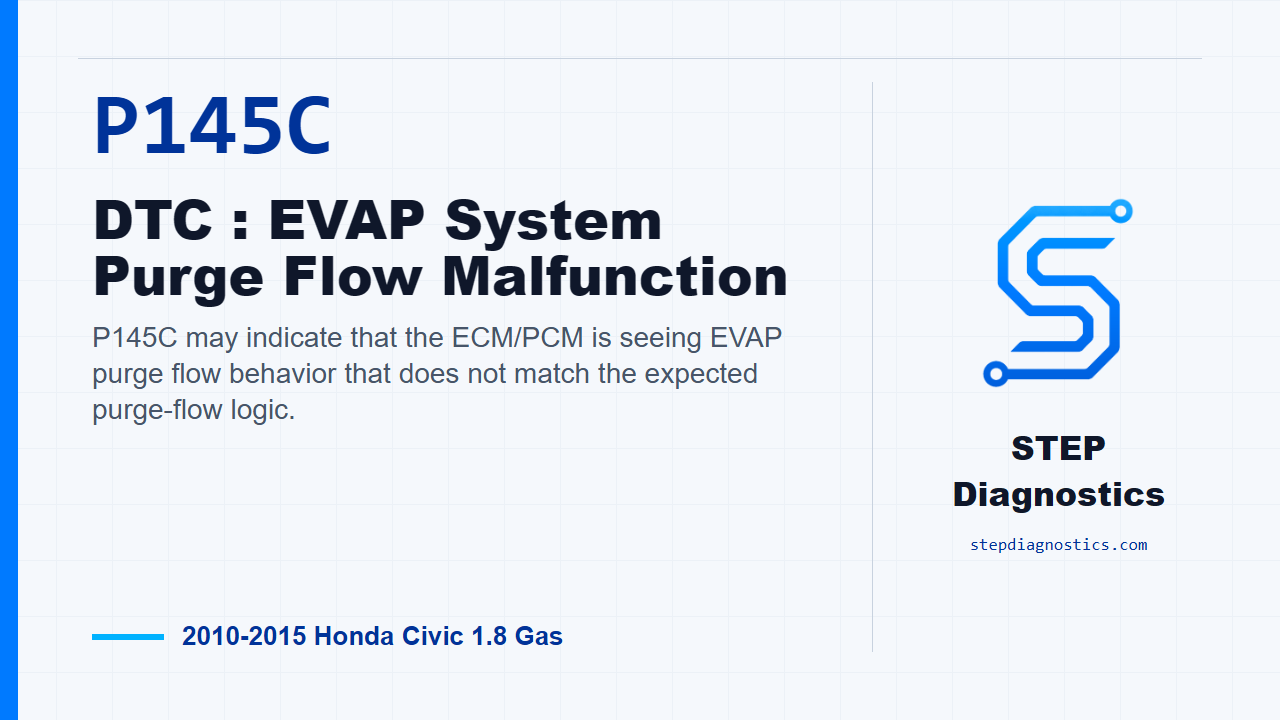
P145C may indicate that the ECM/PCM is seeing EVAP purge flow behavior that does not match the expected purge-flow logic.
What the vehicle may do
- The vehicle may turn on the check engine light.
- The vehicle can often drive normally with no obvious drivability complaint.
- Fuel vapor system readiness or emissions testing may be affected.
Possible fault areas
- Possible purge valve operation concern.
- Possible EVAP purge line poor connection, blockage, or damage.
- Possible canister-side flow restriction or connection issue.
- Possible wiring, connector, or ECM/PCM interpretation concern.
Diagnostic path
Opening context
On this 2010 to 2015 Honda Civic with the 1.8 gas engine, P145C is an EVAP system purge flow malfunction. In plain terms, the ECM/PCM may not be seeing purge flow behave the way it expects. The car may only show a check engine light, and it can often drive normally, but the possible fault areas stay around the purge control side of the EVAP system: purge valve operation, purge line condition, canister-side restrictions or damage, connector condition, and the way the ECM/PCM is interpreting purge flow. The key here is not to treat P145C in isolation until you see what other EVAP purge-flow information is stored with it.
Start with stored data and basic checks
Before getting into the test path, save all freeze data and any on-board snapshot. That captured information matters because if P145C is the only code showing, the related purge-flow diagnostics are run using the freeze data from P145C. Also start with the basic system checks and a structured diagnostic approach before chasing the EVAP components.
Check the code combination
Now turn the ignition switch to ON, position two. With the HDS, check pending and confirmed codes. What you are looking for is whether P145C is stored by itself or stored along with another EVAP purge-flow code. Do not skip this sorting step, because it decides which diagnostic path you follow next.
Choose the diagnostic path
If P145C is stored with another EVAP purge-flow code, diagnose that indicated purge-flow code first, then come back and recheck for P145C. One of those companion purge-flow situations specifically points you to inspect the EVAP canister purge line between the purge valve and the canister for a poor connection, blockage, or damage, and to consider a purge valve stuck closed during that diagnostic path. If P145C is stored alone, use the P145C freeze data and work through the related EVAP purge-flow diagnostic paths rather than guessing at a part.
Verification and takeaway
After the appropriate purge-flow path is completed, verify the repair and confirm P145C stays gone under the captured operating conditions. The takeaway is simple: P145C is a purge-flow logic code, so sort the code combination first, use the freeze data, and let the related EVAP purge-flow path guide the testing. For more diagnostic training, visit stepdiagnostics.com.
Final check
P145C should be approached by first sorting whether it is alone or stored with other EVAP purge-flow information, then using the captured data to guide the correct purge-flow diagnostic path.
For more guided automotive diagnostics, visit STEP Diagnostics.