What this code means
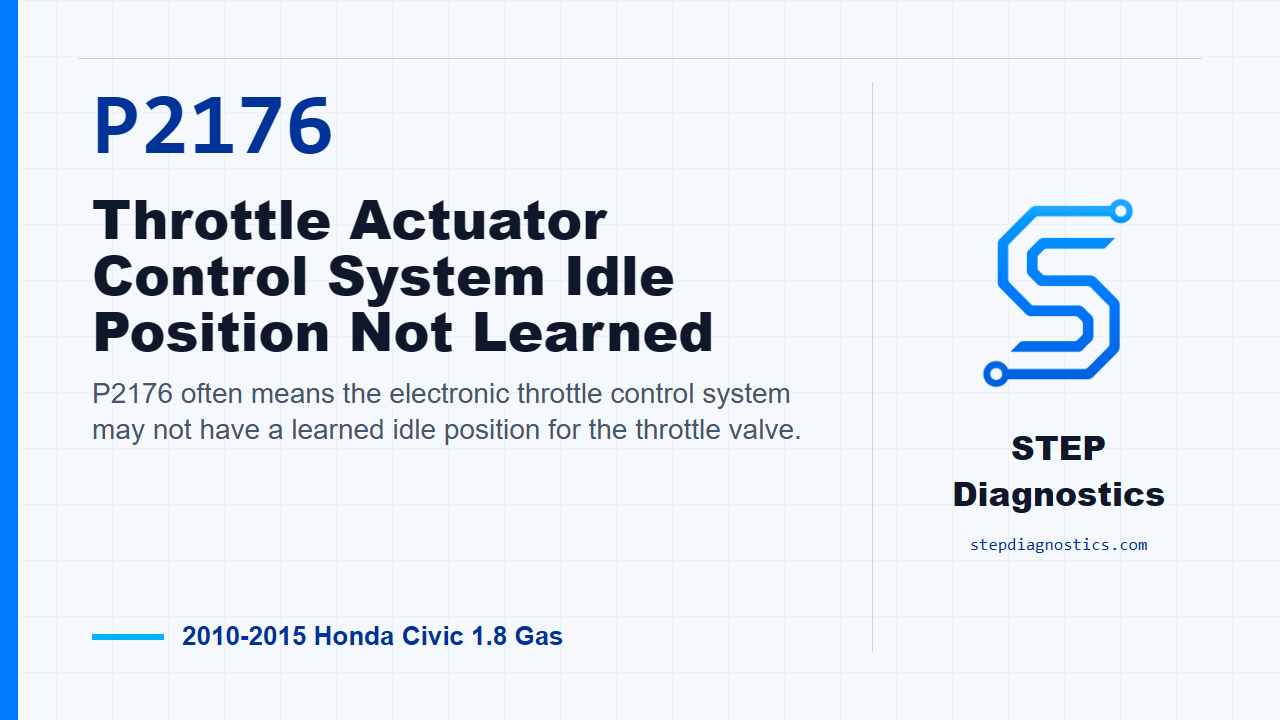
P2176 often means the electronic throttle control system may not have a learned idle position for the throttle valve.
What the vehicle may do
- The vehicle may show warning lights.
- The engine may have idle quality concerns.
- Throttle response may feel limited or abnormal.
Possible fault areas
- Possible throttle body carbon or sludge buildup.
- Possible throttle valve movement issue.
- Possible throttle actuator motor circuit issue.
- Possible connector or terminal concern at the throttle body or PCM.
- Possible PCM software or PCM confirmation issue after circuit checks.
Diagnostic path
Opening context
On this Civic, P2176 means the electronic throttle control system has not learned the throttle idle position. In plain terms, the PCM may not be confident where the throttle should sit at idle. The driver may notice an idle concern, reduced throttle response, or warning lights. The broad areas involved can include throttle body condition, throttle valve movement, the throttle actuator motor circuits, connector condition, or PCM software and PCM confirmation after the circuit checks. Before getting deep into P2176, if another throttle position related code is stored with it, handle that one first, then recheck P2176.
Safety and initial setup
One safety point before commanding the throttle: keep your fingers out of the installed throttle body any time the ignition is ON or the vehicle is in ON mode. If the throttle valve activates, it can seriously injure your fingers. Start with the basic system checks, then move into the P2176 path.
Verify the problem
First, verify whether the fault is present now. Turn the ignition ON, clear the code with the HDS, turn the ignition OFF, then turn it back ON and wait 10 seconds. After that, check pending and confirmed codes with the HDS. If P2176 comes back, the failure is duplicated and you move on to the throttle body operation check. If it does not come back, treat it as intermittent for now. Check for poor connections or loose terminals at the throttle body and the PCM, and if captured operating data is available, try to reproduce those same conditions.
Check throttle valve movement
Next, check whether the throttle valve can move to the fully closed position. Turn the ignition OFF, disconnect the intake air duct from the throttle body, then turn the ignition ON. Clear the code with the HDS, and while running the ETCS test in the HDS inspection menu, visually watch the throttle valve operation. If the valve moves fully closed, continue to the throttle body condition check. If it does not move fully closed, skip ahead to the actuator motor circuit open check.
Inspect the throttle body condition
If the throttle valve did move fully closed, turn the ignition OFF, remove the throttle body, and inspect the throttle valve for sludge or carbon. If sludge or carbon is present, clean the throttle body. If the throttle valve is clean and there is no sludge or carbon, the diagnostic path calls for replacing the throttle body.
Check the actuator motor wires for an open
If the valve did not move fully closed during the command test, check the MTR_1 and MTR_2 lines for an open. With the ignition OFF, jump the SCS line with the HDS. Disconnect PCM connector C, the 51P connector, and disconnect the throttle body 6P connector. At the throttle body connector, jumper terminal No. 1, the YEL/RED wire, to terminal No. 2, the YEL/GRN wire. Then check continuity at the PCM connector side between PCM connector C No. 3, YEL/RED, and PCM connector C No. 4, YEL/GRN. This confirms whether the motor control path is intact through those two wires.
Use the circuit result to choose the next move
If there is continuity, the MTR_1 and MTR_2 wires are considered OK. At that point, update the PCM if it does not have the latest software, or substitute a known-good PCM. If P2176 goes away after the update, the troubleshooting is complete. If it goes away with the substitute PCM, replace the original PCM. If there is no continuity, repair the open in the MTR_1 wire and/or the MTR_2 wire between the PCM at C4 and C3 and the throttle body.
Close and verification
Keep the flow separated: first verify the code is really active, then check throttle movement, then inspect for carbon or sludge, and only go into the motor wiring path if the throttle will not move fully closed. After any repair, verify the repair and confirm P2176 stays gone. The takeaway is simple: do not condemn the throttle body or PCM until the throttle movement and MTR_1 and MTR_2 circuit checks point you there. For more diagnostic training, visit stepdiagnostics.com.
Final check
P2176 diagnosis is built around confirming the code, checking throttle valve closure, inspecting throttle body condition, and then checking the actuator motor wiring path before PCM decisions.
For more guided automotive diagnostics, visit STEP Diagnostics.