What this code means
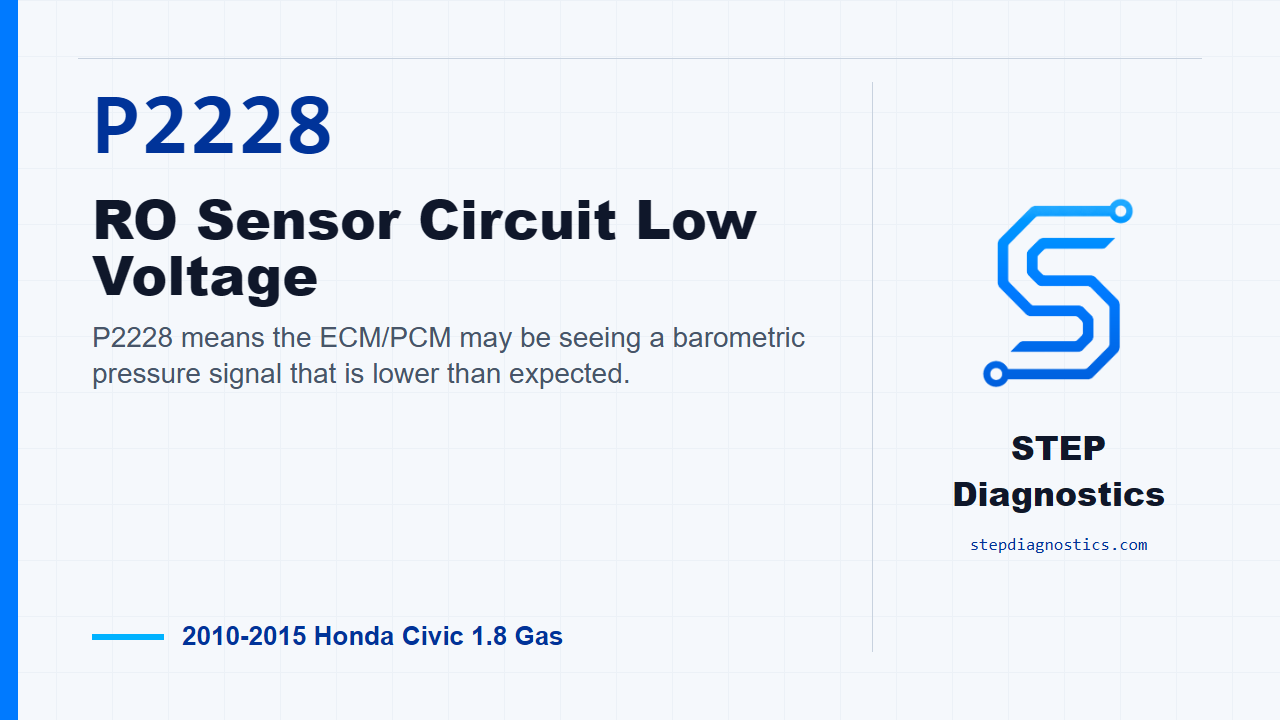
P2228 means the ECM/PCM may be seeing a barometric pressure signal that is lower than expected.
What the vehicle may do
- The vehicle may turn on a warning light.
- The vehicle may feel normal if the condition is intermittent.
- Driveability symptoms can be possible depending on when the BARO information is incorrect.
Possible fault areas
- BARO sensor signal information used by the ECM/PCM
- ECM/PCM connector condition or terminal fit
- ECM/PCM software level
- Possible ECM/PCM fault
Diagnostic path
Opening context
On this 2010 to 2015 Honda Civic with the 1.8 gas engine, P2228 means the ECM/PCM is seeing the barometric pressure signal lower than expected. In plain terms, the computer’s BARO reading may not line up with what it should be seeing. Depending on when it happens, the vehicle may have a warning light, may feel normal, or may have driveability complaints. The broad fault area here can include the BARO sensor circuit information the ECM/PCM is using, the ECM/PCM connections, software level, or the ECM/PCM itself. The key is not to guess. Use the scan data first and see if the fault is actually present right now.
Initial setup
Before troubleshooting P2228, save all captured data and any on-board snapshot. Also do the basic system checks first so you know you are not chasing a symptom caused by a broader vehicle issue.
Duplicate the fault
For problem verification, turn the ignition switch to ON, position II. Then use the HDS and look at BARO SENSOR in the DATA LIST. You are looking for whether the reading is about 53 kPa, 15.6 inHg, 397 mmHg, or whether the signal is 1.31 V or less.
Interpret the BARO reading
If the BARO SENSOR reading is at that low pressure point, or the voltage is 1.31 V or less, the failure is duplicated. At that point, update the ECM/PCM if it does not already have the latest software, or substitute a known-good ECM/PCM, then move on and verify the repair. If the BARO SENSOR reading is not in that range, treat it as an intermittent failure. The system is OK at this time, so do not force a repair that the test did not support.
Verify the repair
After the update or known-good ECM/PCM substitution path, check Pending or Confirmed DTCs with the HDS and see whether P2228 is indicated. Keep this verification separate from the first BARO data check. The first check proves whether the failure is present; this check proves whether the repair path cleared the condition.
If P2228 returns during verification
If P2228 is still indicated, check for poor connections or loose terminals at the ECM/PCM. If the ECM/PCM was updated, substitute a known-good ECM/PCM and recheck. If the ECM/PCM was already substituted, go back to the beginning of the diagnostic path, save the captured information again, and work through the checks in order instead of guessing.
If P2228 does not return
If P2228 is not indicated during verification, troubleshooting is complete. If a known-good ECM/PCM was installed for testing, replace the original ECM/PCM. If other Pending or Confirmed DTCs are present, check what they mean first and follow the appropriate diagnostic path for those codes.
Takeaway
The takeaway on P2228 is simple: confirm the low BARO value with the HDS, follow the ECM/PCM software or known-good module path only if the failure is duplicated, and then verify that P2228 stays gone. For more diagnostic training, visit stepdiagnostics.com.
Final check
Confirm whether the low BARO reading is present, follow the supported ECM/PCM software or known-good module path, and verify that P2228 does not return.
For more guided automotive diagnostics, visit STEP Diagnostics.