What this code means
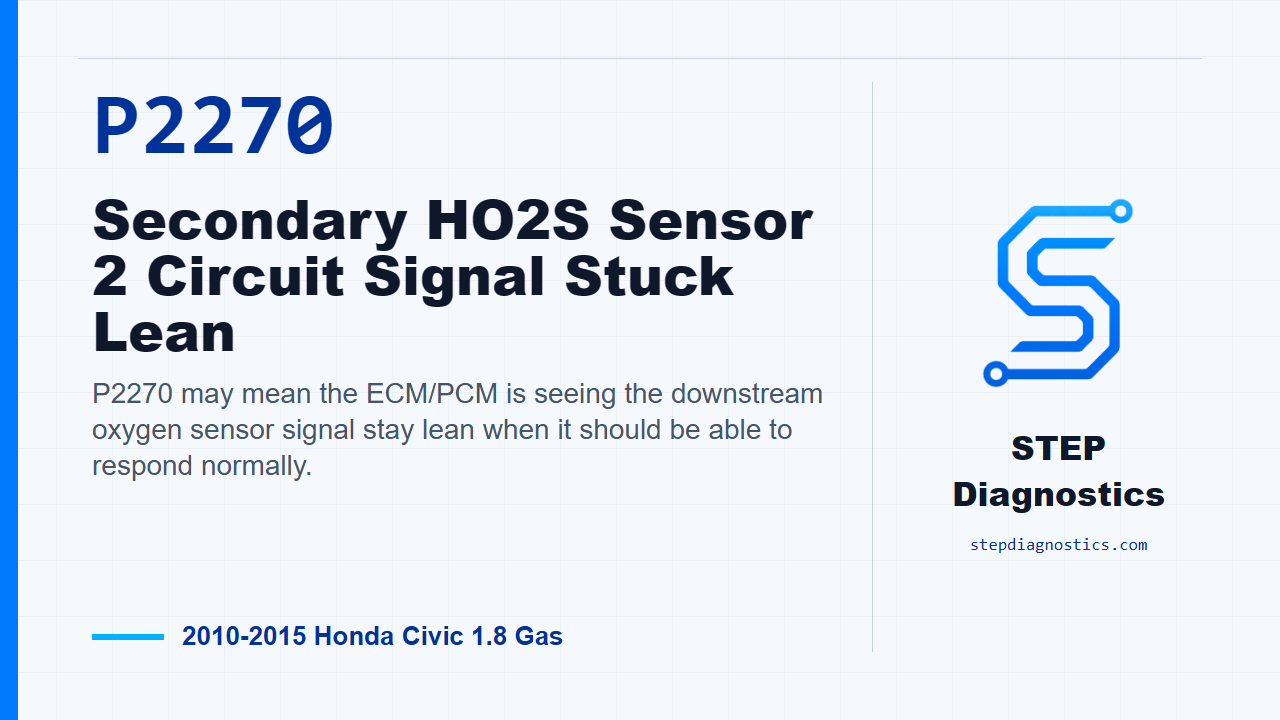
P2270 may mean the ECM/PCM is seeing the downstream oxygen sensor signal stay lean when it should be able to respond normally.
What the vehicle may do
- The vehicle may turn on the check engine light.
- The vehicle can sometimes drive normally with this code present.
- Fuel-control-related symptoms may be possible depending on other conditions.
Possible fault areas
- A possible secondary oxygen sensor signal issue may be involved.
- Connector or terminal problems can be involved.
- ECM/PCM circuit concerns may be possible.
Diagnostic path
Open and initial setup
On this 2010 to 2015 Honda Civic with the 1.8 gas engine, P2270 is for the secondary HO2S, Sensor 2, signal being stuck lean. In plain terms, the ECM/PCM may be seeing the downstream oxygen sensor signal stay lean when it should be able to respond normally. The car may have a check engine light, and it can drive normally or show fuel-control-related symptoms depending on what else is going on. The broad fault areas are possible sensor signal issues, connector or terminal problems, or ECM/PCM circuit concerns. Start clean: before troubleshooting, save the captured operating data and any on-board snapshot, then do the basic system checks so you know what conditions the code set under.
Run the P2270 monitor conditions
For problem verification, turn the ignition switch to ON (II), then clear the code with the HDS. Start the engine and warm it up by holding engine speed at 3,000 rpm with no load, with the automatic in P or N, or the manual in neutral, until the radiator fan comes on. Then let it idle. After that, reproduce the operating conditions for the monitor: coolant temperature at ECT SENSOR 1 above 158 °F (70 °C), automatic in D or manual in 4th, engine speed between 1,500-3,000 rpm, and drive 30 seconds or more. Then watch the OBD STATUS for P2270 on the HDS. At this point, the status is what drives the next move: FAILED, PASSED, or NOT COMPLETED.
Use the HDS result to choose the path
If the HDS shows FAILED during problem verification, replace the secondary HO2S, Sensor 2, then move into repair verification. If it shows PASSED, treat this as an intermittent failure. The system is okay at this time, so check for poor connections or loose terminals at the secondary HO2S, Sensor 2, and at the ECM/PCM. If the HDS shows NOT COMPLETED, the monitor did not finish. Pause, recheck the earlier diagnostic path, meet the test conditions again, and avoid guessing.
Verify the repair separately
Keep verification separate from the first test. For the repair verification, turn the ignition switch to ON (II), reset the ECM/PCM with the HDS, and do the ECM/PCM idle learn procedure. Start the engine again and hold engine speed at 3,000 rpm with no load, with the automatic in P or N, or the manual in neutral, until the radiator fan comes on. Let it idle, then repeat the monitor drive: ECT SENSOR 1 above 158 °F (70 °C), automatic in D or manual in 4th, engine speed between 1,500-3,000 rpm, and drive 30 seconds or more. Now monitor the OBD STATUS for P2270 in the DTCs menu with the HDS.
Final decision and takeaway
If the repair verification shows PASSED, troubleshooting for P2270 is complete. If other pending or confirmed codes are present, check what those codes mean first. If the HDS shows FAILED, go back to the beginning and recheck the diagnostic path. If it shows NOT COMPLETED, meet the test conditions and check OBD STATUS again. The takeaway: make P2270 prove itself under the monitor conditions, do not chase it cold, and let the HDS status drive the next move. For more diagnostic training, visit stepdiagnostics.com.
Final check
P2270 is often handled by reproducing the monitor conditions, checking the scan tool status, and verifying that the code stays gone after the repair path is completed.
For more guided automotive diagnostics, visit STEP Diagnostics.