What this code means
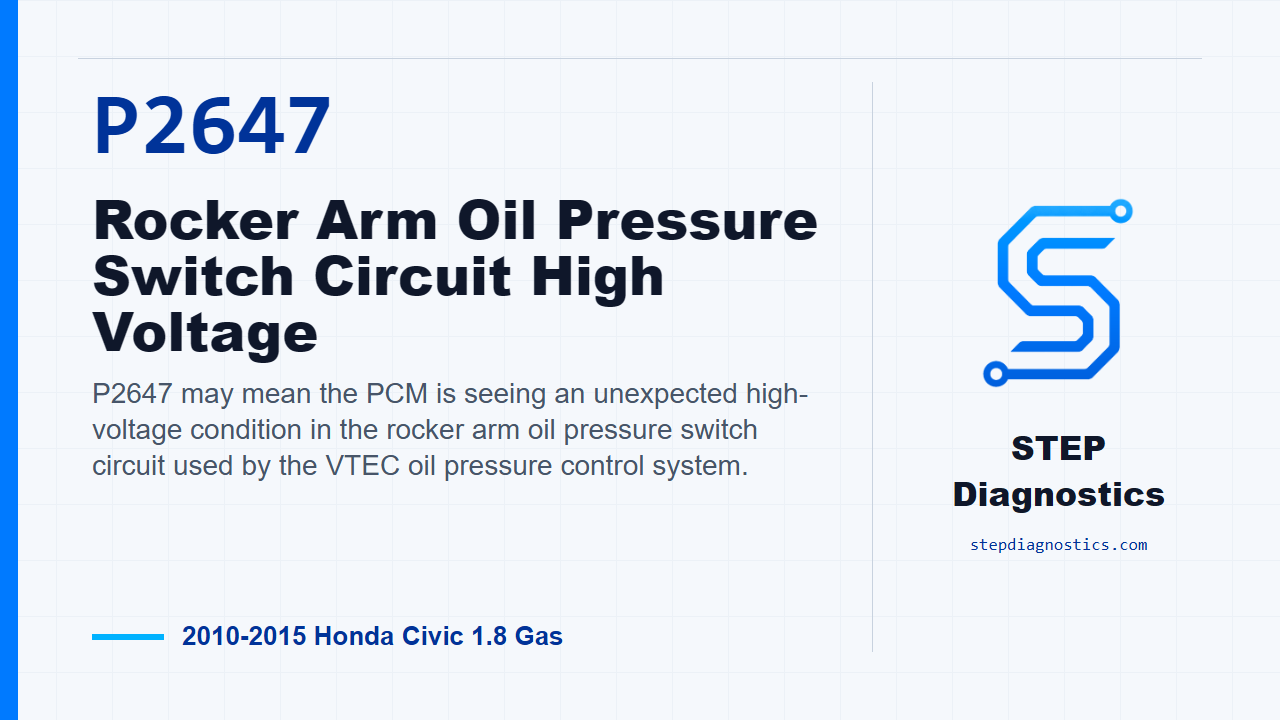
P2647 may mean the PCM is seeing an unexpected high-voltage condition in the rocker arm oil pressure switch circuit used by the VTEC oil pressure control system.
What the vehicle may do
- The vehicle may set a check engine light.
- The engine may have VTEC-related drivability symptoms under certain operating conditions.
- The fault can also be intermittent, depending on connector, wiring, or operating conditions.
Possible fault areas
- Engine oil level may be involved.
- The rocker arm oil pressure switch circuit may be involved.
- Connector condition, loose terminals, wiring opens, or ground-side problems can be possible fault areas.
- The rocker arm oil control solenoid area or PCM involvement may also be possible, depending on test results.
Diagnostic path
Set up the diagnosis
On this 2010 to 2015 Honda Civic with the 1.8 gas engine, P2647 points to a high-voltage fault in the rocker arm oil pressure switch circuit, part of the VTEC oil pressure control side. The car may have a VTEC-related drivability complaint, may feel limited under certain operating conditions, or may simply set the code. Broadly, this can involve engine oil level, the rocker arm oil pressure switch circuit, the rocker arm oil control solenoid area, wiring, grounds, connector condition, or PCM involvement. Before getting deep into circuit testing, start with the basic system checks and follow a structured diagnostic approach. Also, if companion VTEC oil pressure circuit codes are stored with P2647, handle those first, then come back and recheck P2647.
Start with oil level
First, check the engine oil level. If the level is OK, move on to the VTEC test. If the level is not OK, adjust the engine oil to the proper level before going farther. On this fault, don’t skip that first step, because the diagnostic path begins by making sure the oil level is correct.
Run the VTEC test and sort the result
Next, run the VTEC TEST in the inspection menu with the HDS. If P2647 shows up during that test, the path jumps ahead to the VTM line open check. If any other pending or confirmed codes show up, check what those codes mean first instead of forcing this path. If the VTEC test result is OK, treat it as an intermittent failure for now. The system is OK at that moment, so concentrate on poor connections or loose terminals at the rocker arm oil pressure switch, the rocker arm oil control solenoid, and the PCM. If captured operating data is available, try to reproduce the failure under those same conditions. If the VTEC test result is not OK, continue into the failure-area check.
Use the VTEC test result to choose the branch
Now look at the specific VTEC test result. If it indicates a VTEC switch failure, switch open, signal line open, or ground line open, go straight to the rocker arm oil pressure switch continuity check. If it does not indicate one of those switch or switch-circuit results, check for poor connections or loose terminals at the rocker arm oil pressure switch. If that connection check is OK, replace the rocker arm oil control valve.
Check the rocker arm oil pressure switch
For the rocker arm oil pressure switch internal resistance check, turn the ignition switch to LOCK (0), or select OFF mode with the engine start/stop button. Disconnect the rocker arm oil pressure switch 2P connector. On the switch side of that connector, check continuity between terminal No. 1 and terminal No. 2. This is checking the LG and VTM side of the switch. If there is continuity, move to the voltage check. If there is no continuity, replace the rocker arm oil pressure switch.
Check the LG line direction with the VTM voltage
Next is the open-wire check on the LG line. Turn the ignition switch to ON (II), or select ON mode with the engine start/stop button, and leave the rocker arm oil pressure switch 2P connector disconnected. Measure voltage between connector No. 2, the WHT/BLK VTM wire, and body ground. The expected result is about 5.0 V. If you have about 5.0 V, the VTM wire is OK, so repair an open in the LG wire between the rocker arm oil pressure switch and G101. If you do not have about 5.0 V, continue to the VTM line check.
Check the VTM line back to the PCM
For the VTM line open check, turn the ignition switch to LOCK (0), or select OFF mode. Jump the SCS line with the HDS, disconnect PCM connector C, the 51P connector, and keep the rocker arm oil pressure switch 2P connector disconnected. Check continuity between PCM connector C No. 48, the WHT/BLK wire, and rocker arm oil pressure switch connector No. 2, also WHT/BLK. If there is no continuity, repair an open in the VTM wire between the rocker arm oil pressure switch and the PCM at C48. If there is continuity, the VTM wire is OK. At that point, update the PCM if it does not have the latest software, or substitute a known-good PCM.
Verify the repair
Keep verification separate from the circuit checks. After the wiring repair, switch replacement, oil control valve replacement, PCM update, or known-good PCM substitution that matches your branch, verify the repair and confirm P2647 stays gone. If P2647 goes away after a PCM update, troubleshooting is complete. If P2647 goes away only with a known-good PCM substituted, replace the original PCM.
Takeaway
The clean way through P2647 is to prove oil level first, use the HDS VTEC test to choose the right branch, then separate switch, ground-side, VTM wire, and PCM possibilities without guessing. For more diagnostic training, visit stepdiagnostics.com.
Final check
A structured diagnosis can help separate an oil-level issue, an intermittent connection, a switch or circuit fault, an oil control valve path, and possible PCM involvement.
For more guided automotive diagnostics, visit STEP Diagnostics.