What this code means
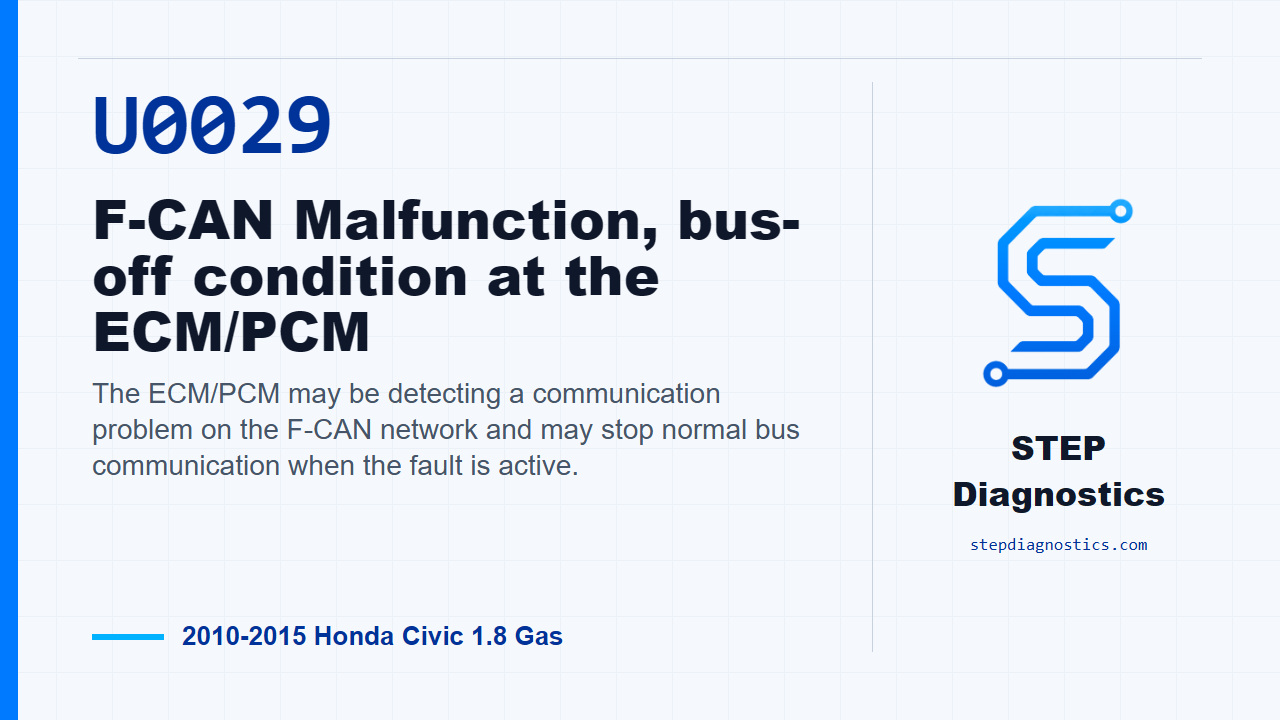
The ECM/PCM may be detecting a communication problem on the F-CAN network and may stop normal bus communication when the fault is active.
What the vehicle may do
- The vehicle may show communication-related warning lights.
- The code may be intermittent and the vehicle may appear normal when the fault is not active.
- Other control modules may also report communication concerns when the network problem is active.
Possible fault areas
- Possible ECM/PCM communication-path concern.
- Possible module software concern.
- Possible power, ground, or ignition-feed issue affecting communication stability.
Diagnostic path
Opening context
This one is for U0029 on a 2010 to 2015 Honda Civic with the 1.8 gas engine. In plain terms, the ECM/PCM may be seeing an F-CAN communication problem severe enough to be treated as a bus-off condition. The vehicle may have communication-related warning lights, may set network-related faults, or may act normally if the fault is intermittent. Broadly, you’re thinking about the control module’s communication path and possible power, ground, or ignition-feed concerns, but this diagnostic path is focused on proving whether U0029 is currently repeatable, then verifying the ECM/PCM software or substitution path.
Save data before clearing anything
Before you start chasing it, save the freeze data and any on-board snapshot, and do your basic preliminaries. That information matters because this code can be intermittent, and once you clear it, you may lose the best clue about the conditions that were present when it set.
Problem verification
Start the problem verification by turning the ignition switch to ON, position II. Then clear the DTC with the HDS. After that, check for Pending or Confirmed DTCs with the HDS. If U0029 is indicated again, the failure is duplicated. If U0029 is not indicated, treat it as an intermittent failure, and the system is OK at this time.
If the code duplicates
When U0029 does duplicate, follow the ECM/PCM path. Update the ECM/PCM if it does not have the latest software. If the update path does not apply, use a known-good ECM/PCM substitution path, then move into repair verification. Keep this as a controlled diagnostic step; don’t treat the substituted module as the final answer until the verification proves it.
Verify the repair and confirm the code stays gone
For repair verification, check again for Pending or Confirmed DTCs with the HDS. If U0029 is still indicated and the ECM/PCM was updated, substitute a known-good ECM/PCM, then recheck. If the ECM/PCM was already substituted, go back to the beginning of the problem verification and repeat the path instead of guessing.
Completion decision
If U0029 is not indicated during verification, troubleshooting for this code is complete. If a known-good ECM/PCM was substituted and the code stays gone, replace the original ECM/PCM. If other Pending or Confirmed DTCs are present, check what they mean next and handle those separately.
Takeaway
The key with U0029 is to separate an intermittent network event from a repeatable ECM/PCM communication failure: save the captured data, clear it, see whether it comes back, and only then follow the software update or known-good module verification path. For more diagnostic training, visit stepdiagnostics.com.
Final check
Confirm whether U0029 is repeatable before treating it as a hard ECM/PCM-side communication fault.
For more guided automotive diagnostics, visit STEP Diagnostics.