What this code means
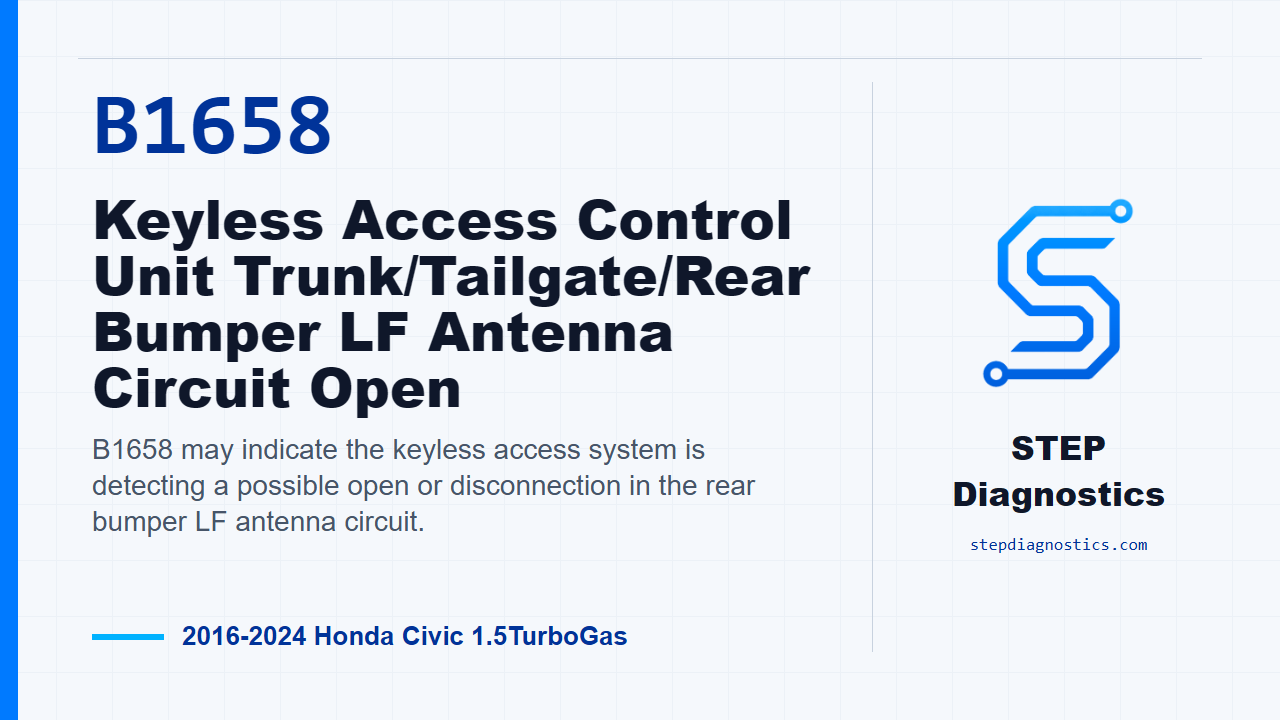
B1658 may indicate the keyless access system is detecting a possible open or disconnection in the rear bumper LF antenna circuit.
What the vehicle may do
- Keyless access functions may act inconsistently.
- Trunk or tailgate-related keyless operation may be affected.
- The vehicle may only store a body control code with no obvious driver complaint.
Possible fault areas
- Possible rear bumper LF antenna concern.
- Possible wiring or connector concern in the antenna circuit.
- Possible body control module-side circuit concern.
Diagnostic path
Opening context
On this Civic, B1658 points to a possible open in the rear bumper LF antenna circuit used by the keyless access system. The body control module can set this code when it detects a disconnection on that antenna line. Depending on the vehicle and the failure, the customer may notice keyless access or trunk-related functions acting up, or they may only have a stored body code. The broad areas to keep in mind are the rear bumper LF antenna, its wiring and connector path, and the body control module side of the circuit. If other body network codes are present, handle that as a network diagnostic first instead of chasing this one in isolation.
Confirm the code with the scan tool
Start by confirming the complaint with the HDS self check. Go into One-Push Start, then Keyless Access Control Unit, and run Self Check. That gives you the control unit’s view of the fault before you start separating the antenna, the wiring, and the module side of the circuit.
Check the antenna circuit for an open
Next, move to the EXT_TR plus and EXT_TR minus open-wire check. Prepare the circuit by disconnecting the rear bumper LF antenna 2-pin connector, then disconnect body control module connector C, the 66-pin connector. With those disconnected, perform the open-wire inspection for both EXT_TR plus and EXT_TR minus according to the connector test points. Normal on each side is less than 1 Ω. If either side is not normal, the problem is in the circuit between the module side and the antenna side, so stay with the wiring and connector path before moving on.
Check the body control module side
Only move into the body control module inspection once the external circuit has checked normal. Disconnect the rear bumper LF antenna 2-pin connector, then perform the module internal circuit inspection. The normal result for this inspection is voltage. This test can be run before the other checks because it includes the inspection items, but if it fails, you still need to continue through the individual checks to identify exactly which item failed. If this module-side inspection is abnormal, the fault area is the body control module.
Isolate the remaining antenna fault
If the open-wire inspection is normal and the body control module side inspection is normal, the remaining suspect in this path is the rear bumper LF antenna. At that point, the diagnostic logic has ruled the circuit and module-side check normal, leaving the antenna as the problem area.
Verification and takeaway
Keep verification separate from the testing. After the fault area has been corrected, use the same HDS self check path to confirm the result. The key point with B1658 is to prove the antenna circuit first, then prove the module side, and only then call the rear bumper LF antenna the remaining fault area. For more diagnostic training, visit stepdiagnostics.com.
Final check
This code is often approached by confirming the self check, checking the antenna circuit for an open, then separating a module-side issue from a remaining antenna issue.
For more guided automotive diagnostics, visit STEP Diagnostics.