What this code means
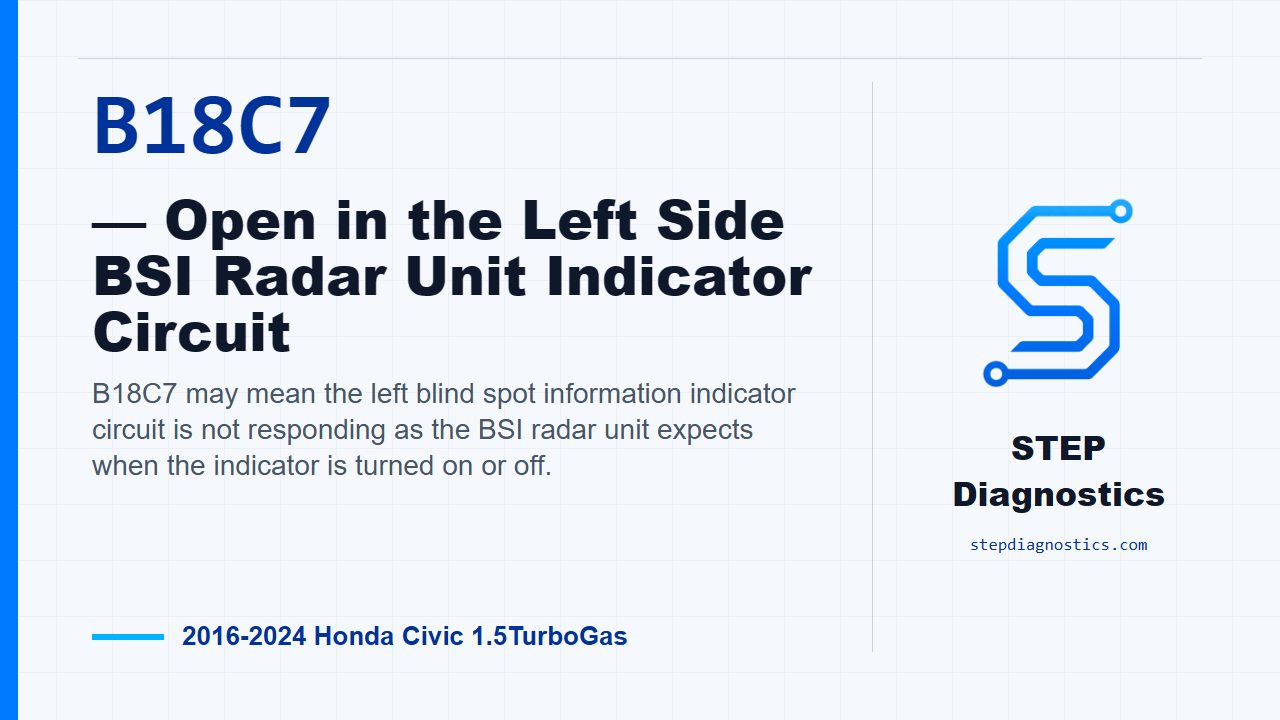
B18C7 may mean the left blind spot information indicator circuit is not responding as the BSI radar unit expects when the indicator is turned on or off.
What the vehicle may do
- The blind spot information system may set a warning or message.
- The left side alert indicator may not operate correctly.
- The system may disable or limit blind spot alert operation.
Possible fault areas
- A possible left BSI alert indicator issue.
- Possible open wiring or poor connector contact in the indicator circuit.
- Possible ground-side circuit concern.
- A possible left side BSI radar unit issue after related checks are normal.
Diagnostic path
Opening context
On this 2016 to 2024 Honda Civic with the 1.5 turbo, B18C7 points to an open in the left side BSI radar unit indicator circuit. In plain terms, the radar unit is not seeing the indicator circuit respond the way it expects when that alert indicator is commanded on or off. The driver may notice a blind spot alert warning, an inoperative left side alert indicator, or a system message, depending on how the vehicle reacts. Broadly, this can involve the left BSI alert indicator, the indicator wiring, ground side of the circuit, connector condition, or the left side BSI radar unit. Start with the basic system checks, and if other codes are present, understand what they mean first so you do not chase the wrong fault.
How the code sets
The logic for B18C7 is command-versus-response. When the BSI alert indicator comes on or goes off, the BSI radar unit watches the indicator circuit voltage. If that voltage is outside the normal range during that change of state, the radar unit flags the circuit as abnormal and stores B18C7. There is not a direct standalone test of the component itself in this path, so the diagnosis works through the related indicator circuit and connected components.
Confirmation gate
First, reproduce the operating condition. Turn the vehicle to the ON mode and wait for at least 5 seconds. That is the confirmation gate before moving into the component and circuit checks.
Left BSI alert indicator check
Next, check the left BSI alert indicator side of the circuit. Disconnect the left BSI alert indicator 2P connector. Then connect a jumper wire between terminals No. 1 and No. 2 of that 2P connector. Turn the vehicle back to the ON mode. The expected response is that B18C7 changes away from the open-circuit fault to the companion indicator response code. If that happens, treat the left BSI alert indicator as the problem area. If it does not happen, move on because the problem is in another related part of the circuit.
Open-wire checks
If the indicator check sends you farther into the circuit, disconnect the left BSI alert indicator 2P connector and the left side BSI radar unit 6P connector. Before probing, confirm the exact terminal identification for the open-wire checks and do not guess at probe locations. Then perform the BSI_L_IND open-wire inspection and the GND open-wire inspection. For each one, the normal result is less than 1 Ω. If either check is not normal, the problem is in the circuit.
Radar unit determination
If the other inspection items are normal, the remaining fault area is the left side BSI radar unit. At that point, do not keep adding guesses. Pause, recheck the earlier diagnostic path, make sure the connector setup and circuit measurements were done correctly, and then make the call based on the completed checks.
Verification and takeaway
For final confirmation, use the same operating gate: turn the vehicle to the ON mode, wait for at least 5 seconds, and confirm B18C7 stays gone. The takeaway is simple: prove whether the indicator can change the circuit response, then prove the BSI_L_IND and ground paths are intact, and only then judge the radar unit. For more diagnostic training, visit stepdiagnostics.com.
Final check
B18C7 is often approached by proving the indicator response first, then checking the indicator and ground circuits, and only then considering the radar unit as the remaining fault area.
For more guided automotive diagnostics, visit STEP Diagnostics.