What this code means
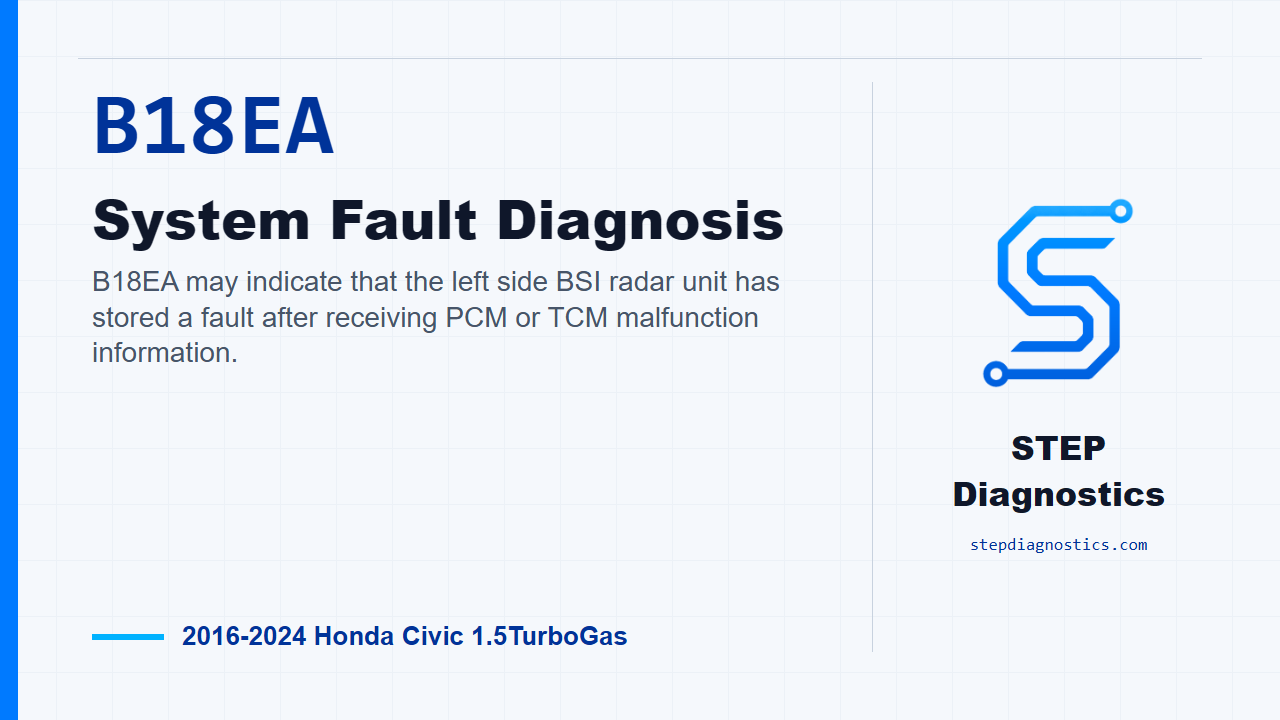
B18EA may indicate that the left side BSI radar unit has stored a fault after receiving PCM or TCM malfunction information.
What the vehicle may do
- Blind spot information features may be limited or disabled.
- Driver-assistance warnings or messages may appear.
- The concern can occur alongside powertrain or transmission-related faults.
Possible fault areas
- Possible PCM or TCM reported malfunction information.
- Possible CVT or automatic transmission system fault stored at the same time.
- Possible communication or shared-status information being received by the left side BSI radar unit.
- Possible BSI radar system involvement, but not a confirmed radar unit failure from this code alone.
Diagnostic path
Opening context
Today we’re focused on B18EA on a 2016 to 2024 Honda Civic with the 1.5 turbo engine. In plain language, this code means the left side BSI radar unit may be storing a fault because it received malfunction information from the PCM or TCM. So the vehicle may have blind spot information warnings, limited driver-assist operation, or related messages, but the fault area is not automatically the radar unit itself. The possible trouble area can include the powertrain or transmission control side, the information being shared to the BSI radar unit, or other related faults stored at the same time.
Start with the basic checks
Before chasing B18EA directly, start with the basic system checks and follow a structured diagnostic approach. That means don’t jump straight to the left side radar unit just because the BSI module stored the code. This DTC is being set from failure information the radar unit received, so the first move is to make sure the overall diagnostic setup is clean and that you understand what other modules are reporting.
Prioritize transmission-related codes first
Next, look for CVT or automatic transmission system codes stored at the same time. If those are present, handle those first and check what those codes mean before continuing with B18EA. That priority matters because B18EA can be a secondary result of the left side BSI radar unit receiving PCM or TCM malfunction information. If the exact follow-up path for those stored transmission codes is not clear, pause, recheck the earlier diagnostic path, and avoid guessing.
Diagnostic boundary
The available path for B18EA does not provide a separate pinpoint test, a numeric threshold, a component test, or a confirmed replacement step for the left side BSI radar unit. So keep the diagnosis disciplined: complete the basic checks, deal with any same-time CVT or automatic transmission faults first, and do not condemn the radar unit from this code alone.
Takeaway
The takeaway is simple: for B18EA, treat the left side BSI radar code as a received-failure-information code. Start with the basic checks, prioritize any same-time CVT or automatic transmission faults, and don’t guess at a radar repair without a complete diagnostic path. For more diagnostic training, visit stepdiagnostics.com.
Final check
B18EA should be approached as a received malfunction information code, with same-time CVT or automatic transmission faults handled first.
For more guided automotive diagnostics, visit STEP Diagnostics.