What this code means
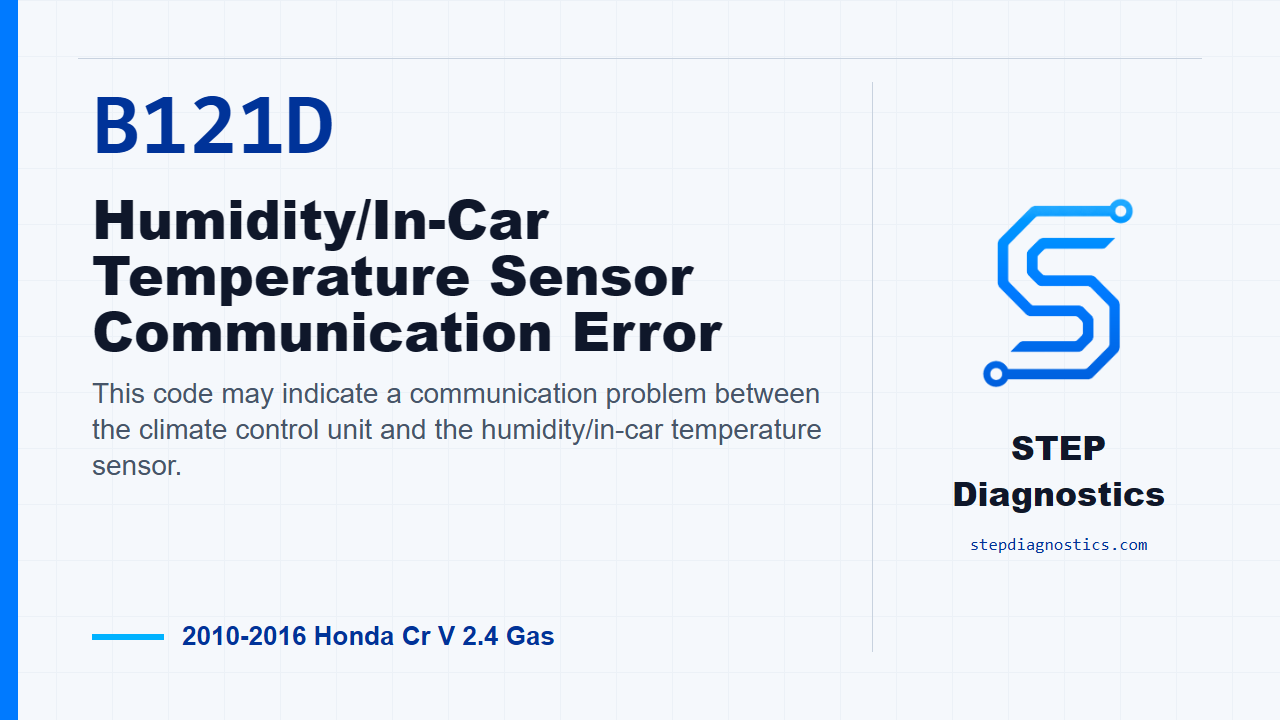
This code may indicate a communication problem between the climate control unit and the humidity/in-car temperature sensor.
What the vehicle may do
- Automatic climate control operation may seem inaccurate or inconsistent.
- Cabin temperature or humidity-based control decisions can be affected.
Possible fault areas
- Possible wiring or connector issues in the humidity/in-car temperature sensor circuit.
- Possible power feed, SENSOR COM, HUM DATA, or HUM CLK circuit fault.
- Possible humidity/in-car temperature sensor concern.
- Possible climate control unit concern.
Diagnostic path
Opening context
On this Honda CR-V, B121D points to a communication problem between the climate control unit and the humidity/in-car temperature sensor. In plain terms, the control unit may not be getting a clean signal from that sensor circuit. The customer may notice automatic climate control behavior that seems inaccurate or inconsistent. The possible fault areas often include the sensor circuit wiring, connector condition, the shared power feed, the communication lines, the sensor itself, or the climate control unit. Treat this like a guided electrical diagnosis: verify the code first, then separate power, communication wiring, shorts, opens, and finally the control-side decision.
Start with code verification
Start by clearing the DTC with the HDS. Turn the vehicle OFF, then back ON, and run the climate control self-diagnostic. Now check whether the fault returns. If it does, continue with the circuit checks. If it does not return, treat it as intermittent and inspect for loose wires or poor connections in the humidity/in-car temperature sensor circuit.
Power-side caution before testing
Before you narrow this to only the sensor branch, look at the bigger fault picture. If other short-circuit faults are present at the same time, there may be an open or a short to body ground in the power (5 V) circuit. That matters because a shared power-side problem can make this code show up along with other faults.
5 V feed check at the sensor
Next, check the sensor 5 V line. Turn the vehicle OFF, disconnect the humidity/in-car temperature sensor 4P connector, then turn the vehicle ON. Measure voltage from connector No. 1 to body ground. You are looking for about 5 V. If about 5 V is present, the power feed is good enough to move on to the sensor communication return checks. If about 5 V is not present, go straight to the power-feed open-circuit check later in the path.
SENSOR COM line open check
With the vehicle OFF, disconnect the climate control unit 32P connector as well. Now check continuity from climate control unit connector No. 23 to humidity/in-car temperature sensor connector No. 3. If continuity is present, the SENSOR COM wire is OK and you can continue. If there is no continuity, repair the open in that wire between the climate control unit and the humidity/in-car temperature sensor.
Check the HUM DATA and HUM CLK paths together
Now use a jumper at the disconnected sensor connector between No. 2 and No. 4. With both the climate control unit 32P connector and the sensor 4P connector disconnected, check continuity between climate control unit connector No. 4 and No. 5. If continuity is present, continue to the next check. If it is not present, the path branches to identify which of the two communication wires is open.
Check for ground involvement with the jumper installed
Leave the jumper installed between sensor connector No. 2 and No. 4. Check continuity from climate control unit connector No. 4 to body ground. If continuity is present, the next step separates which communication wire is shorted to ground. If there is no continuity, move to the check for a short between the HUM CLK and HUM DATA wires.
If the communication pair is shorted to ground
If the previous check showed continuity to ground, remove the jumper and check continuity from climate control unit connector No. 4 to body ground. If continuity is still present, repair a short to ground in the HUM DATA wire between the climate control unit and the humidity/in-car temperature sensor. If continuity is not present, repair a short to ground in the HUM CLK wire between those same two components.
If the power feed was missing
If the earlier voltage check failed, turn the vehicle OFF, disconnect the climate control unit 32P connector, and check continuity from climate control unit connector No. 17 to humidity/in-car temperature sensor connector No. 1. If continuity is present, replace the climate control unit. If continuity is not present, repair the open in the wire between the climate control unit and the humidity/in-car temperature sensor.
If the jumped communication pair did not show continuity
If the check across the jumped HUM DATA and HUM CLK pair did not show continuity, remove the jumper. Then check continuity from climate control unit connector No. 4 to humidity/in-car temperature sensor connector No. 2. If continuity is present, repair an open in the HUM CLK wire. If continuity is not present, repair an open in the HUM DATA wire.
Check for a short between HUM DATA and HUM CLK
If the earlier ground check did not show continuity, remove the jumper and check continuity between climate control unit connector No. 4 and No. 5. If continuity is present, repair the short between the HUM DATA and HUM CLK wires. If there is no continuity, continue to the final control unit check.
Final control-side check
For the final check, reconnect the climate control unit 32P connector. At the disconnected humidity/in-car temperature sensor connector, jumper No. 2 to No. 4. Turn the vehicle ON, then press and hold the AUTO and ON/OFF buttons. If the mode indicator turns on, replace the humidity/in-car temperature sensor. If the mode indicator does not turn on, replace the climate control unit.
Verification and close
After any wiring repair or supported component replacement, verify the repair by going back to the first check: clear the DTC, cycle the vehicle OFF and ON, run the climate control self-diagnostic, and confirm the fault does not return. The key is to let the circuit tests tell you whether the problem is power feed, SENSOR COM, HUM DATA, HUM CLK, the sensor, or the climate control unit. For more diagnostic training, visit stepdiagnostics.com.
Final check
This fault is best handled as a methodical electrical circuit diagnosis, starting with verification and then separating power, continuity, shorts, sensor response, and control unit response.
For more guided automotive diagnostics, visit STEP Diagnostics.