What this code means
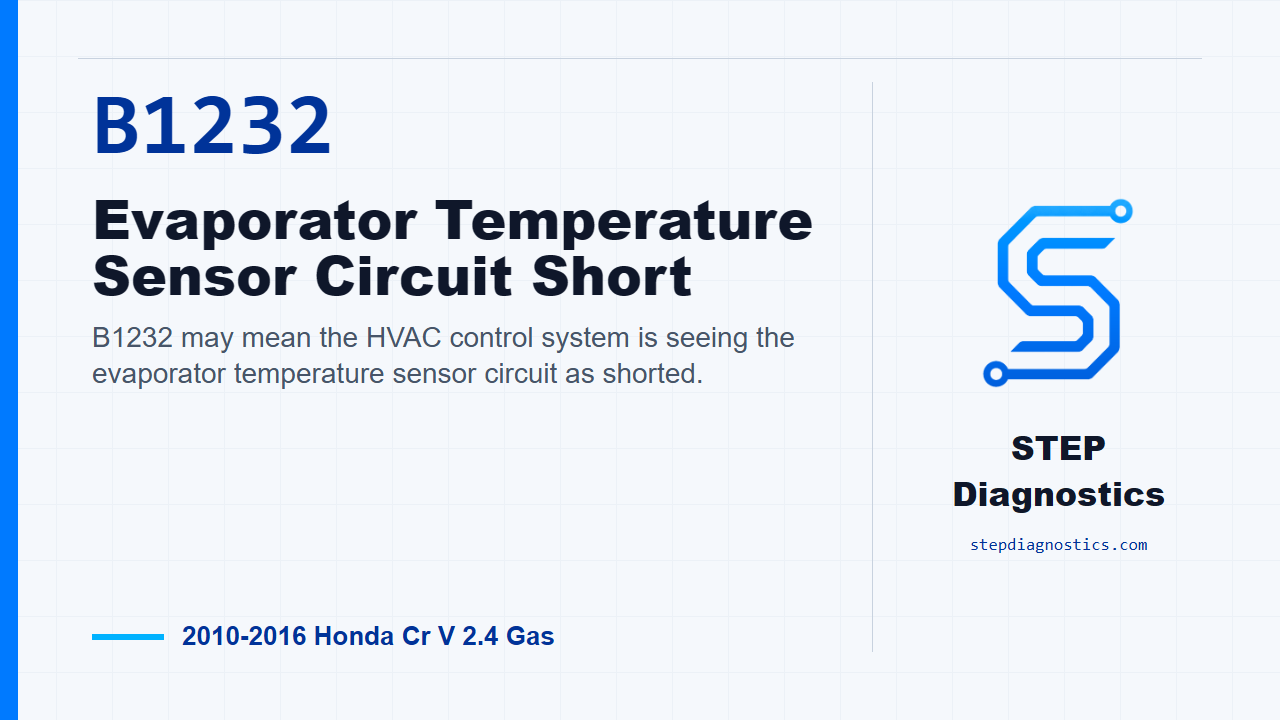
B1232 may mean the HVAC control system is seeing the evaporator temperature sensor circuit as shorted.
What the vehicle may do
- The A/C temperature control may behave abnormally.
- Cooling may be inconsistent.
- The climate system can store the code even when the driver complaint is subtle.
Possible fault areas
- Possible shorted wiring in the evaporator temperature sensor circuit.
- Possible loose or poor connector contact at the sensor or climate control unit.
- Possible evaporator temperature sensor fault.
- Possible climate control unit fault after wiring and sensor checks pass.
Diagnostic path
Code overview and problem verification
For this 2010 to 2016 Honda CR-V, B1232 points to an evaporator temperature sensor circuit short in the HVAC control system. In plain terms, the climate control unit may be seeing that sensor circuit pulled where it should not be. The driver may notice abnormal A/C temperature control, inconsistent cooling behavior, or the climate system may simply store the body code without an obvious complaint. The broad fault areas are possible shorted wiring, poor connections at the evaporator temperature sensor circuit, the sensor itself, or, after the circuit and sensor check out, the climate control unit. Start by clearing the code with the HDS. Turn the vehicle OFF, then back ON. Run the self-diagnostic with the HDS or through the climate control unit, then check codes again. If B1232, or 0A on the climate display, comes back, continue with the circuit checks. If it does not come back, treat it as an intermittent failure and inspect for loose wires or poor connections in the evaporator temperature sensor circuit.
Check the TEVA wire for a short to ground
Next, power the vehicle down to OFF. Disconnect the climate control unit 32P connector and disconnect the evaporator temperature sensor 2P connector. With both connectors unplugged, check continuity from the climate control unit 32P connector No. 18 to body ground. This is the TEVA line. If there is continuity, repair the short to ground in the wire between the climate control unit and the evaporator temperature sensor. If there is no continuity, the TEVA wire is not shorted to ground, so move on to the next short check.
Check for a short between TEVA and sensor common
Keep the same test setup: vehicle OFF, the climate control unit 32P connector disconnected, and the evaporator temperature sensor 2P connector disconnected. Now check continuity between the climate control unit 32P connector No. 18 and the climate control unit 32P connector No. 23. This checks whether the TEVA line is shorted to the SENSOR COM, or SENS-COM, line. If there is continuity, repair the short in the wires between the climate control unit and the evaporator temperature sensor. If there is no continuity, that short is not present, and the next decision point is the evaporator temperature sensor itself.
Sensor decision point
Now test the evaporator temperature sensor. Do not guess at this point; the sensor has to be tested correctly before condemning either the sensor or the control unit. If the evaporator temperature sensor tests OK, replace the climate control unit. If the evaporator temperature sensor does not test OK, replace the evaporator temperature sensor.
Verify the repair and close
After the repair, verify the repair and confirm the code stays gone. Clear the code, cycle the vehicle OFF and then ON, run the self-diagnostic again, and confirm B1232, or 0A, does not return. The key on this one is to prove whether the TEVA circuit is shorted first, then only make the sensor or control unit call after the wiring checks are clean. For more diagnostic training, visit stepdiagnostics.com.
Final check
This diagnosis is mainly about proving whether the sensor signal circuit is shorted before making a sensor or control unit decision.
For more guided automotive diagnostics, visit STEP Diagnostics.