What this code means
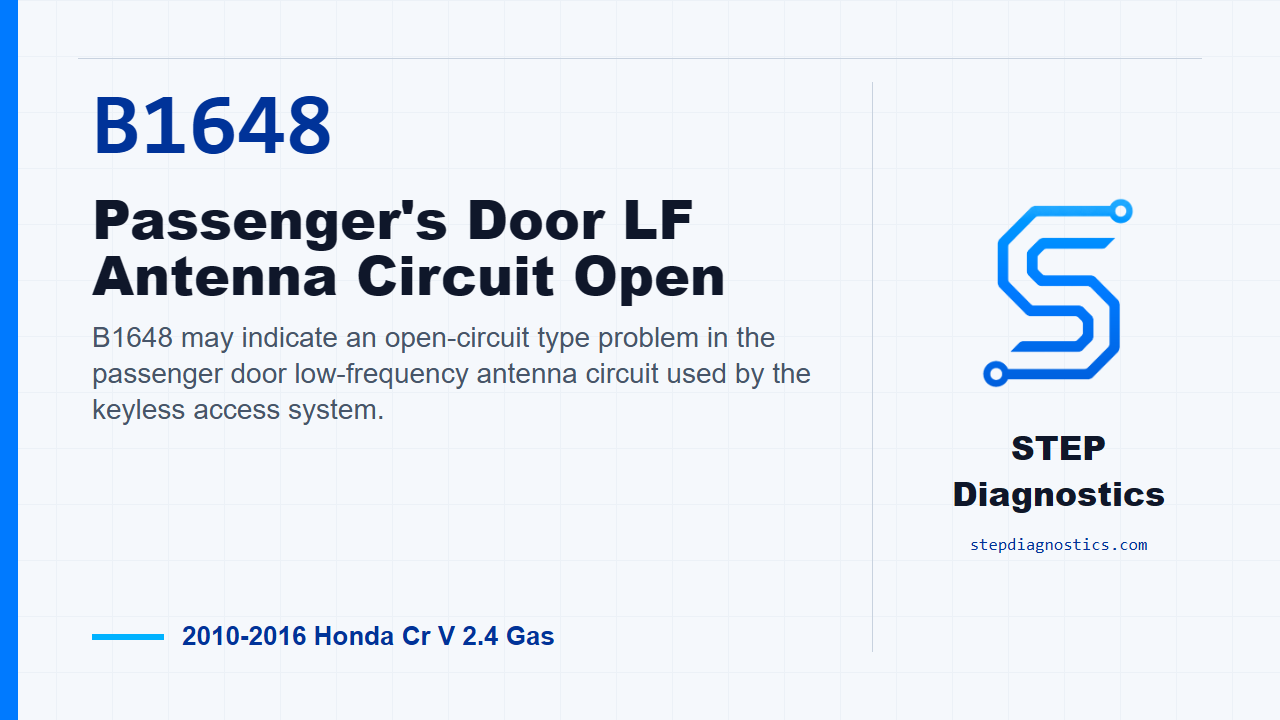
B1648 may indicate an open-circuit type problem in the passenger door low-frequency antenna circuit used by the keyless access system.
What the vehicle may do
- The vehicle may not reliably detect the key at the front passenger door.
- Passive entry from the passenger door can be intermittent or inoperative.
- The keyless access system may otherwise appear normal depending on where the key is used.
Possible fault areas
- Possible front passenger door LF antenna or outer handle issue.
- Possible open or high resistance in the antenna plus or minus circuit.
- Possible loose, poor, or disconnected terminals at the related connectors.
- Possible keyless access control unit fault after the circuit checks pass.
Diagnostic path
Opening context
On this 2010 to 2016 Honda CR-V, B1648 points to an open circuit concern for the passenger’s door LF antenna in the keyless access system. In plain terms, the car may not reliably see the key at the front passenger door, so passive entry at that door can be weak, intermittent, or inoperative. The fault area can include the antenna built into the passenger door outer handle, the EXT FR AS plus and minus circuits, connector fit or terminal condition, or the keyless access control unit. If other codes are present, check what they mean first so you do not chase this circuit out of order.
Confirm the code first
Start by proving the complaint. Clear the DTCs with the HDS. From the mode menu, enter the self check, run the self check, and then check for DTCs again with the HDS. If B1648 comes right back, continue into the circuit test. If B1648 is not indicated, treat it as an intermittent failure. The system is OK at this time, so concentrate on loose or poor connections instead of replacing parts.
Check antenna line output at the passenger door handle
Next, check whether the keyless access control unit is producing output on the front passenger door antenna lines. Turn the vehicle to OFF, lock mode. Disconnect the front passenger’s door outer handle 8P connector. Then turn the vehicle to ON mode. On the HDS, select Keyless Access Control from the one-push start system menu, enter Functional Tests, and set up the voltmeter between the front passenger’s door outer handle 8P connector No. 2 and No. 6. Select Front Passenger Door Antenna with the HDS. At this point, you are only deciding whether voltage is present or not.
Use the voltage result to split the path
If there is voltage at that connector during the test, the path points to a faulty front passenger’s door LF antenna, and the repair is to replace the front passenger’s door outer handle. If there is no voltage, do not condemn the handle yet. Move on and check the two antenna wires for an open or high resistance condition.
Check the EXT FR AS plus and minus wires for continuity
For the open-wire check, turn the vehicle back to OFF, lock mode. Disconnect keyless access control unit connector A, 32P. Leave the front passenger’s door outer handle 8P connector disconnected. Now check continuity on both antenna lines. First, check between keyless access control unit connector A, 32P, No. 22 and the front passenger’s door outer handle 8P connector No. 2. Then check between keyless access control unit connector A, 32P, No. 6 and the front passenger’s door outer handle 8P connector No. 6.
Make the call from the continuity result
If both continuity checks pass, the EXT FR AS plus and minus wires are OK, and the next call is to replace the keyless access control unit. If continuity is missing, repair the open or high resistance in the wire. Keep this decision clean: voltage at the handle points toward the door handle antenna, no voltage sends you to the wire check, and good wires after that point toward the control unit.
Verify and close
After the repair, verify the repair and confirm the code stays gone by using the same HDS self check approach used at the start: clear the DTCs, run the self check, and make sure B1648 is not indicated. The takeaway is simple: confirm the code, check for output at the passenger door handle connector, then separate a handle antenna fault from an open circuit or a control unit fault. For more diagnostic training, visit stepdiagnostics.com.
Final check
B1648 is best handled by confirming the code, checking antenna line output at the passenger door handle, and then using continuity checks to separate a handle antenna fault from wiring or control unit
For more guided automotive diagnostics, visit STEP Diagnostics.