What this code means
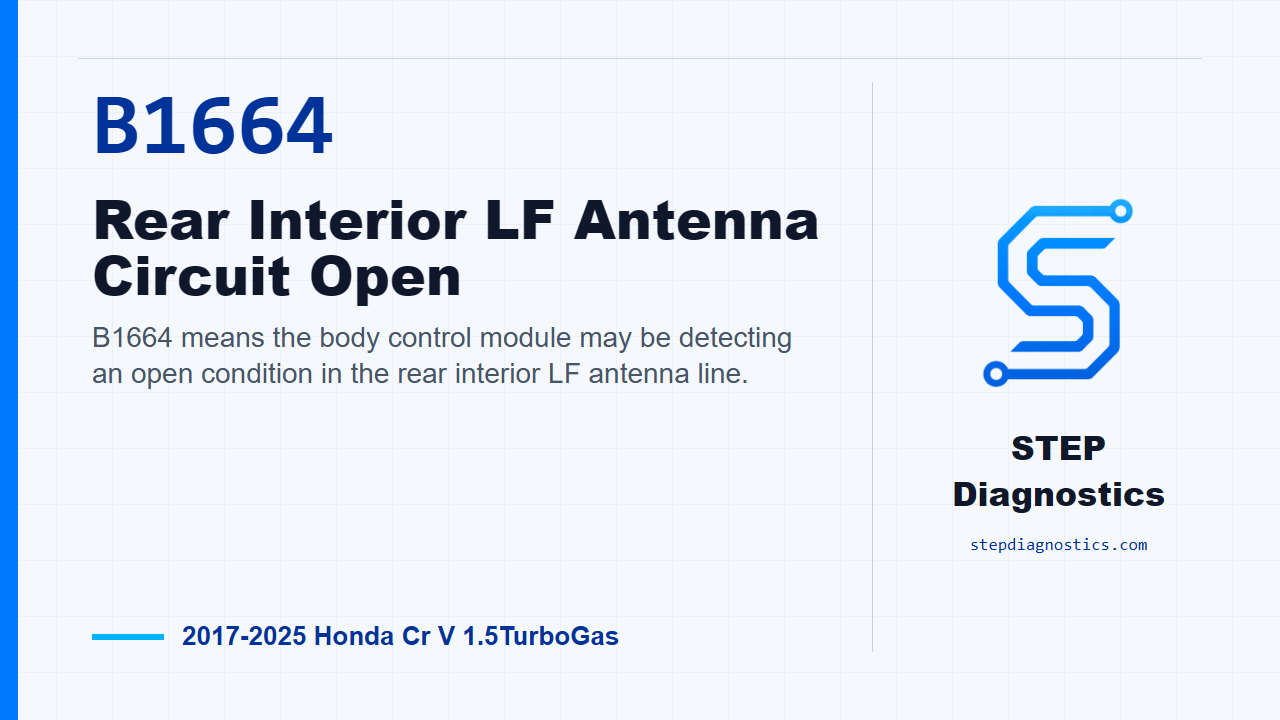
B1664 means the body control module may be detecting an open condition in the rear interior LF antenna line.
What the vehicle may do
- Keyless access operation may be affected.
- The vehicle may have trouble detecting the key from the rear interior antenna area.
- Symptoms can be intermittent depending on circuit condition and connector contact.
Possible fault areas
- Possible open condition in the EXT_M plus or EXT_M minus antenna circuit.
- Possible connector or wiring issue between the rear interior LF antenna and body control module.
- Possible body control module circuit issue.
- Possible rear interior LF antenna issue after the circuit and module checks are normal.
Diagnostic path
Opening context
Today we’re looking at B1664 on a 2017 to 2025 Honda CR-V with the 1.5 turbo. In plain terms, this code means the body control module may be seeing an open in the rear interior LF antenna line. When that happens, keyless access operation may be affected because the vehicle can have trouble using that antenna area to detect the key. The likely fault areas are the antenna circuit wiring, the body control module side of the circuit, or the rear interior LF antenna itself. Start with the basic system checks, and if other codes are present, handle the multiple-code path first so this diagnosis stays clean.
Initial scan check
Next, run the HDS self check. That gives you the current fault picture before you start unplugging connectors or loading the circuit. Don’t skip this step, because this code is being judged by the body control module, and the scan result is what keeps the rest of the testing pointed in the right direction.
Check the EXT_M circuit for an open
Now move to the open-wire inspection for the EXT_M plus and EXT_M minus lines. Prepare the circuit with the rear interior LF antenna 2-pin connector disconnected and body control module connector C, the 66-pin connector, disconnected. The terminal-position details for these connector checks are not available here, so pause and confirm the exact terminals before probing. With IG Mode OFF, check the EXT_M plus and EXT_M minus paths. A normal result is less than 1 Ω on the EXT_M plus open-wire inspection, and less than 1 Ω on the EXT_M minus open-wire inspection. If either side is abnormal, call the fault in the circuit and stay on that circuit problem instead of moving on to the module or antenna.
Check the body control module side
If the external circuit checks normal, then move to the body control module inspection. The precondition here is important: the external circuit needs to be normal before you use this result to judge the module. Set up with the rear interior LF antenna 2-pin connector disconnected. Again, confirm the exact measurement points before probing, because the connector terminal detail is not available here. With IG Mode ON, perform the module internal circuit inspection at the disconnected rear interior LF antenna connector male terminals and look for voltage. If that inspection is abnormal, the problem is with the body control module side. There is also a note that this module check can be run before the other inspections, but if it fails, you still have to continue with the individual checks to identify which item actually failed.
Call the remaining fault area
If the open-wire inspection is normal and the body control module inspection is normal, then the remaining fault area is the rear interior LF antenna. The key is the order: prove the two EXT_M lines first, then prove the module side, and only then blame the antenna as the remaining cause.
Takeaway
The takeaway: keep B1664 simple. Confirm the scan result, prove the EXT_M plus and EXT_M minus circuit integrity, check the body control module side only after the external circuit is normal, and call the rear interior LF antenna only after the other checks pass. For more diagnostic training, visit stepdiagnostics.com.
Final check
Prove the antenna circuit first, then the module side, and only identify the rear interior LF antenna as the remaining cause after the other inspections pass.
For more guided automotive diagnostics, visit STEP Diagnostics.