What this code means
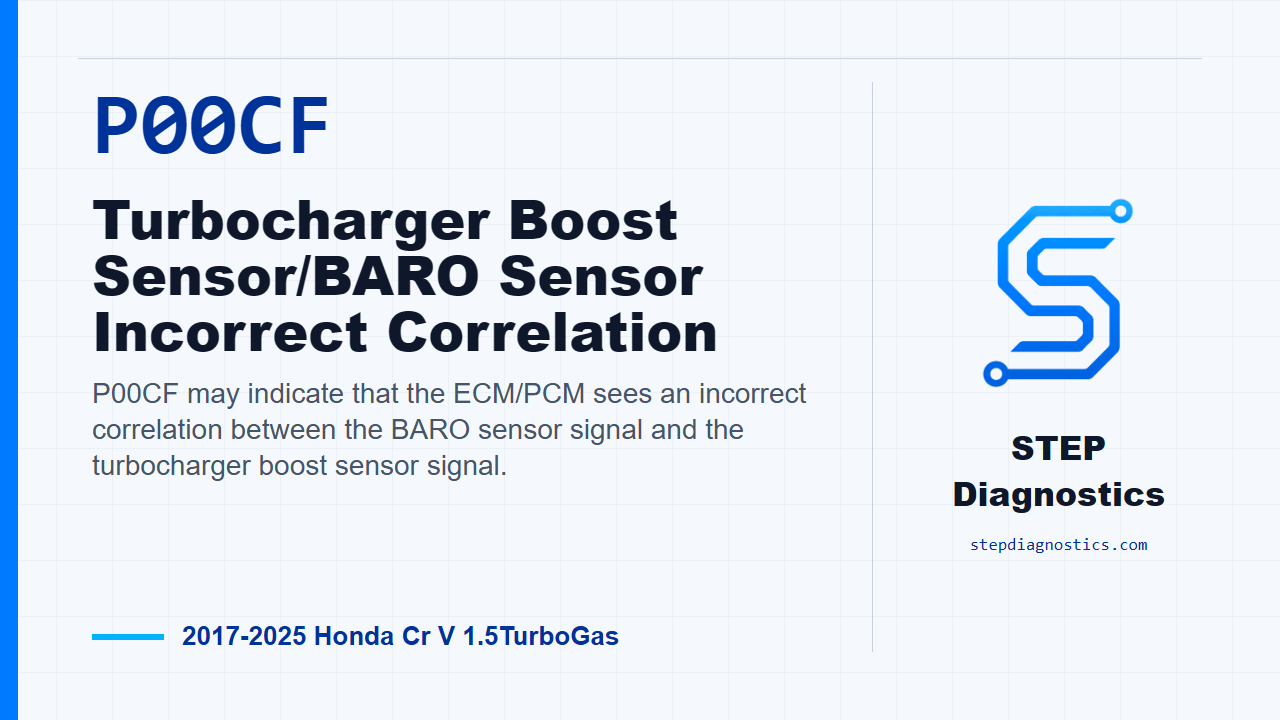
P00CF may indicate that the ECM/PCM sees an incorrect correlation between the BARO sensor signal and the turbocharger boost sensor signal.
What the vehicle may do
- The vehicle may illuminate a warning light.
- The vehicle can have reduced boost response or drivability complaints.
- The vehicle may sometimes appear to drive normally while the code is stored.
Possible fault areas
- Possible BARO sensor signal concern.
- Possible turbocharger boost sensor signal concern.
- Possible connector or wiring concern in the pressure sensor circuits.
- Possible pressure readings that do not agree under the captured operating conditions.
Diagnostic path
Open on what P00CF is watching
On this Honda CR-V 1.5 turbo, P00CF is a correlation fault between the BARO sensor reading and the turbocharger boost sensor reading. In plain language, the PCM is seeing those two pressure signals disagree when they should line up. The vehicle may drive normally, or it can have reduced boost response, warning lights, or drivability complaints depending on when the fault sets. Broadly, this can involve a possible BARO sensor signal issue, a possible boost sensor signal issue, connector or wiring concerns, or a pressure reading that does not make sense under the captured operating conditions.
Start with the basic checks
Before getting deep into this code, start with the basic troubleshooting routine. Do not jump straight to parts. Make sure the vehicle is being diagnosed in a structured way before following the P00CF path.
Handle companion pressure-sensor codes first
If a BARO sensor code is stored at the same time as P00CF, diagnose that BARO sensor code first. If a turbocharger boost sensor code is stored at the same time, diagnose that boost sensor code first. For P00CF, those related faults are context, not the main story, but they can point you toward which pressure signal is already being flagged.
If P00CF is by itself
If P00CF is the only code indicated, the path is to work through both the BARO sensor diagnostic direction and the turbocharger boost sensor diagnostic direction, using the captured conditions for P00CF. That matters because this code is about correlation. You are not just checking one sensor in isolation; you are checking whether the two pressure readings make sense together under the conditions where the PCM saw the fault.
Understand the setting logic
The setting logic is straightforward. When the vehicle is at idle, the PCM compares the BARO sensor output value to the turbocharger boost sensor output value. If a certain difference occurs between those two values, the PCM decides the relationship is abnormal and stores P00CF. So keep the diagnosis focused on why those two signals do not agree at idle, instead of treating this like a normal boost control performance fault.
Wrap up
The takeaway: P00CF is a pressure-signal correlation code. Check companion BARO or boost sensor faults first, and if P00CF stands alone, compare the BARO and boost sensor diagnostic paths using the captured P00CF conditions. For more diagnostic training, visit stepdiagnostics.com.
Final check
P00CF is best approached as a pressure-signal agreement problem between BARO and turbocharger boost sensor readings.
For more guided automotive diagnostics, visit STEP Diagnostics.