What this code means
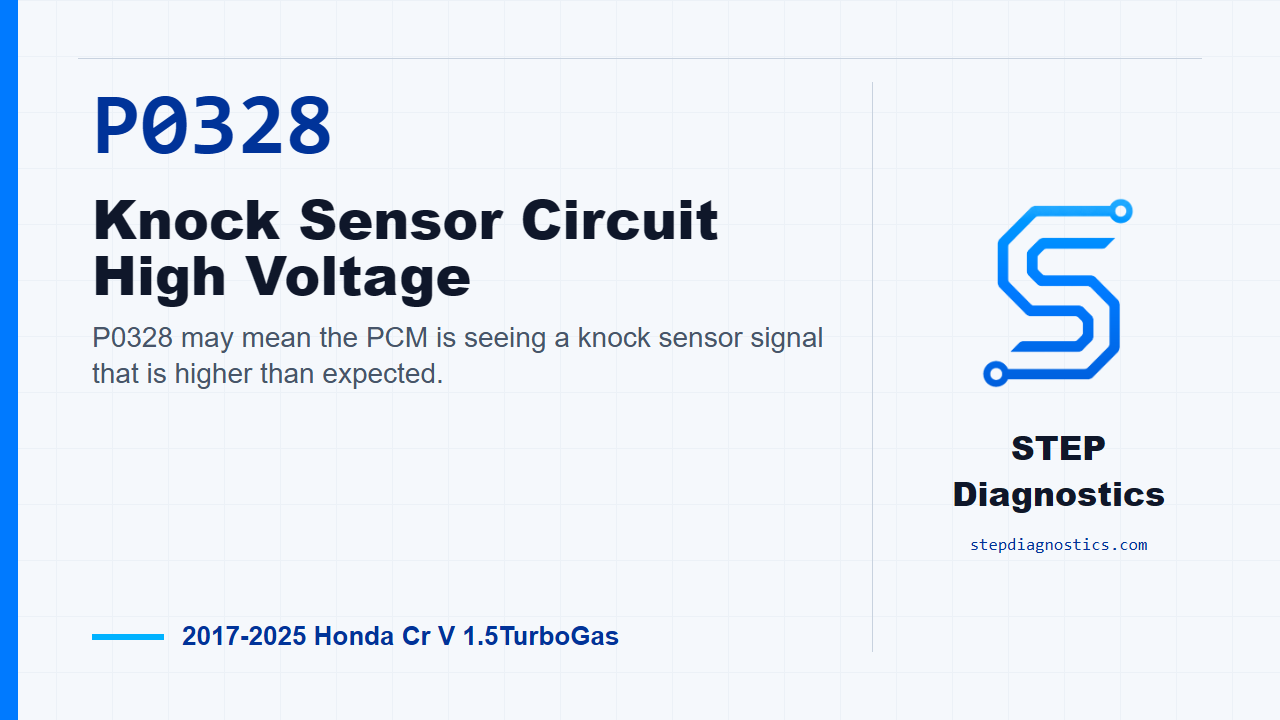
P0328 may mean the PCM is seeing a knock sensor signal that is higher than expected.
What the vehicle may do
- The warning light may be on.
- The engine may run normally.
- The vehicle can feel weak or less responsive if timing control is affected.
Possible fault areas
- A possible issue in the knock sensor signal path.
- A possible issue with the sensor connection or wiring.
- A possible issue at the PCM input.
Diagnostic path
Open on what P0328 means
On this Honda CR-V, P0328 means the PCM is seeing a knock sensor signal that is higher than expected. The vehicle may only show a warning light, but it can also feel weak or less responsive if timing control is being affected. Think in broad areas first: the knock sensor signal path, the sensor connection and wiring, and the PCM input. This is a plausibility-style fault, so do not condemn a part from the code alone.
Start with the basic checks and confirm the condition
Start with the basic system checks and follow a structured diagnostic approach. If other codes are present, check what they mean first. For P0328, the PCM sets the fault when the knock sensor output voltage is higher than a specified value. Begin the confirmation by turning the vehicle to the ON mode.
Check the knock sensor connector voltage
There is no direct method called out to test the knock sensor element by itself, so this path checks the related pieces around it. Disconnect the knock sensor connector, the 2P connector, then test at the disconnected female terminals with IG Mode ON. The normal unit output voltage is About 5.0 V. Before probing, make sure the terminal identification and meter-lead placement are confirmed; if you cannot verify the cavity locations, pause and avoid guessing. If this inspection is normal, the fault path points back to the knock sensor. If it is abnormal, continue looking at the related circuit or component side of the diagnosis.
Protect the PCM before circuit testing
Before disconnecting the PCM connector, jump the SCS line with the HDS and wait more than 1 minute. After that, disconnect the knock sensor connector, the 2P connector, and disconnect PCM connector E, the 80P connector.
Check the KS and KSGND wires
With IG Mode OFF, check the KS and KSGND open-wire paths between the disconnected knock sensor connector and disconnected PCM connector E. The normal condition for the KS open-wire inspection is less than 1 Ω, and the normal condition for the KSGND open-wire inspection is less than 1 Ω. Again, do not guess on connector cavities or meter-lead locations. If either inspection is abnormal, the problem is in the circuit.
Make the PCM call last
If the other inspection items all show normal conditions, the remaining call in this diagnostic path is a problem with the PCM. That decision comes last, after the sensor connector voltage check and the KS and KSGND open-wire checks have been worked in order.
Takeaway
The takeaway: P0328 is a high knock-sensor signal diagnosis. Work it in order: confirm the condition, check the sensor connector voltage, protect the PCM before disconnecting it, prove the KS and KSGND wiring, and only then consider the PCM. For more diagnostic training, visit stepdiagnostics.com.
Final check
P0328 often needs an orderly circuit and signal-path diagnosis rather than a code-only parts decision.
For more guided automotive diagnostics, visit STEP Diagnostics.