What this code means
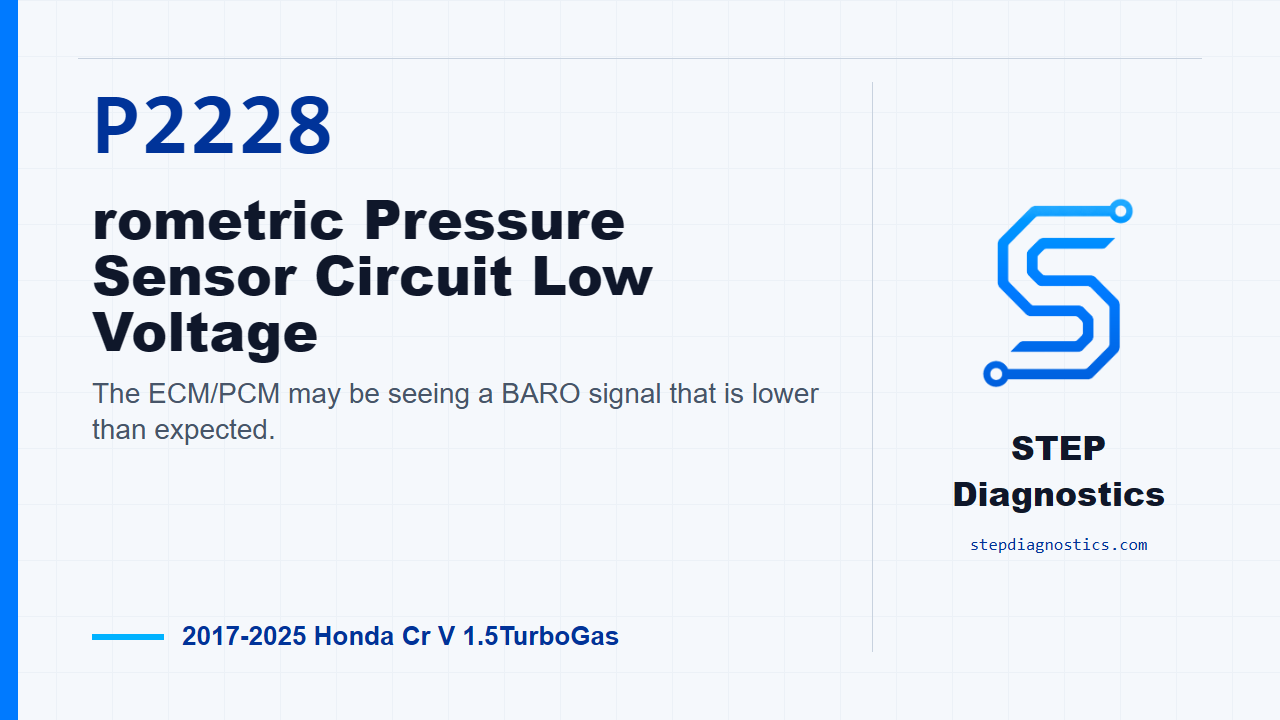
The ECM/PCM may be seeing a BARO signal that is lower than expected.
What the vehicle may do
- The vehicle may set a warning light.
- Engine load and air-density calculations can be affected.
Possible fault areas
- Possible BARO signal path issue.
- Possible connector or wiring condition.
- Possible ECM/PCM input-side concern.
Diagnostic path
Opening context
On this Honda CR-V, P2228 is a barometric pressure sensor circuit low voltage code in the ECM/PCM. In plain language, the module may be seeing a BARO signal that is lower than expected. The vehicle may set a warning light, and because BARO information can affect air-density and load calculations, the broad possible fault areas are the BARO signal path, the connector and wiring, or the ECM/PCM input side. Before getting into the code-specific check, start with the basic system checks and follow a structured diagnostic approach.
Code-specific check
For the P2228 check, turn the vehicle to the ON mode. Then look at the HDS Baro Sensor data. If the HDS Baro Sensor value is less than 336 mmHg, the failure is duplicated. That is the important decision point here: when the BARO sensor output is lower than the specified value, the PCM determines there is an abnormality and stores the code.
Testing boundary
This path is a confirmation check for whether the low BARO reading is present. Do not jump to a parts decision from the code name alone. Keep the scan data result tied to the actual duplicated condition, and if the diagnostic path does not clearly tell you the next move, pause, recheck the earlier steps, and avoid guessing.
Close
Takeaway: for P2228, power the vehicle ON, check the HDS Baro Sensor value, and use less than 336 mmHg as the failure-duplication point. Keep verification separate from the category-specific test, and confirm the code stays gone only after the actual fault path has been handled. For more diagnostic training, visit stepdiagnostics.com.
Final check
P2228 is handled by confirming whether the BARO sensor reading is low enough to duplicate the fault, then keeping any verification separate from the code-specific check.
For more guided automotive diagnostics, visit STEP Diagnostics.