What this code means
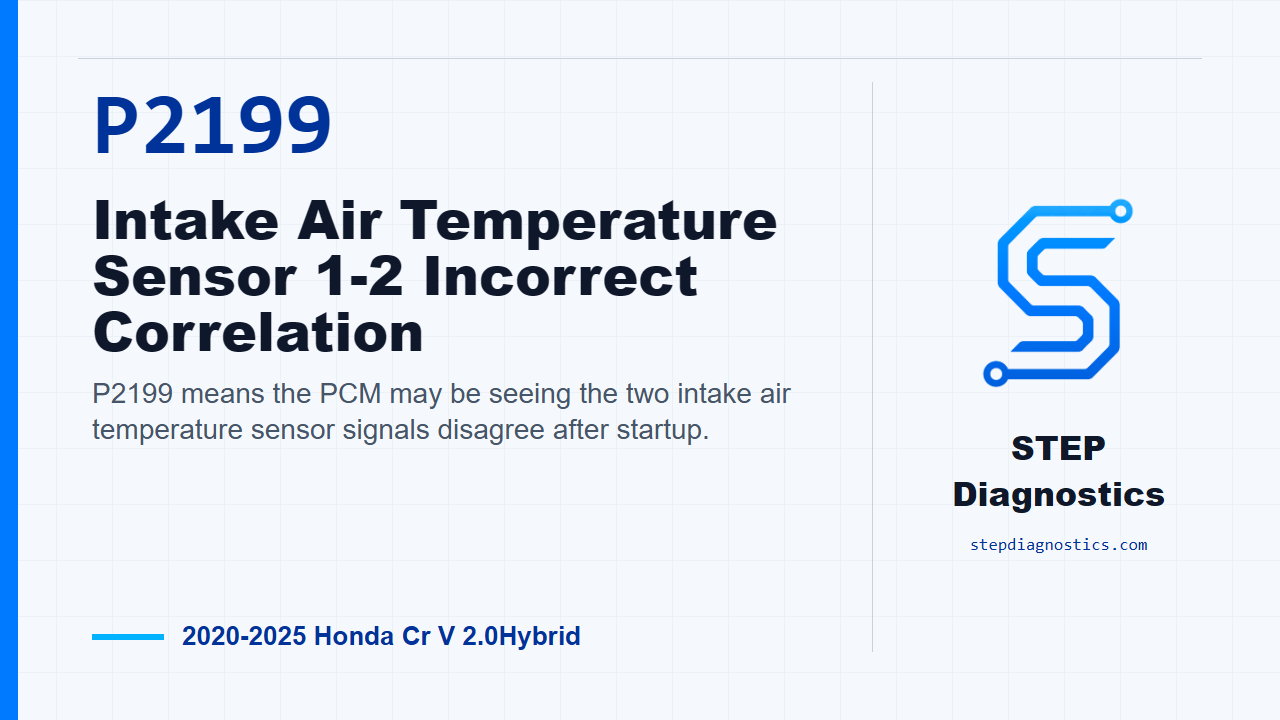
P2199 means the PCM may be seeing the two intake air temperature sensor signals disagree after startup.
What the vehicle may do
- The vehicle may only show a warning light.
- Drivability can be subtle or may seem normal.
- Engine operation may be affected if the PCM is working with air temperature information that does not agree.
Possible fault areas
- Possible connector or terminal concerns at related temperature sensors.
- Possible mismatch between the IAT sensor 1 and IAT sensor 2 signals.
- Possible IAT sensor 2 concern if the connector and terminal checks are normal.
Diagnostic path
Opening context
On this 2020 to 2025 Honda CR-V Hybrid, P2199 is an intake air temperature correlation code. In plain language, the PCM may be seeing IAT sensor 1 and IAT sensor 2 disagree after the engine starts. The vehicle may only show a warning light, and drivability can be subtle or may seem normal. Possible fault areas often include the air temperature sensor inputs, their connectors and terminals, or an IAT signal that is not matching the other one. Before narrowing this down, start with the basic system checks and follow a structured diagnostic approach.
Reproduce the operating conditions
This code depends on reproducing the operating conditions. First, turn the vehicle to OFF, LOCK mode, and leave it for at least 6 hours. After that, enter maintenance mode, start the engine, and let it idle for at least 10 seconds. The diagnostic logic here is built around comparing the two intake air temperature signals after startup.
Check the sensor connections
Once the operating conditions have been reproduced, move to the connection checks. Inspect the connectors for a secure fit and look for loose terminals at ECT sensor 1, ECT sensor 2, the MAF Sensor with IAT Sensor 1, and IAT Sensor 2. At this point, the goal is not to guess at a part. The goal is to confirm the related temperature inputs are connected properly before making the decision call.
Decision point
If anything is abnormal at those connectors or terminals, the problem is in the connections or terminals. Correct that area, then pause and recheck the earlier diagnostic path instead of guessing. If the connector and terminal checks are normal, this path points to a problem with IAT sensor 2.
Verify and close
Keep verification separate from the connection checks. After the issue found by this path is handled, repeat the same operating-condition check and confirm P2199 stays gone. The key takeaway is simple: do not skip the long OFF time, because this code is about how the two IAT readings compare right after startup. For more diagnostic training, visit stepdiagnostics.com.
Final check
P2199 is a correlation diagnosis, so the setup time and the connector checks matter before drawing a conclusion.
For more guided automotive diagnostics, visit STEP Diagnostics.