What this code means
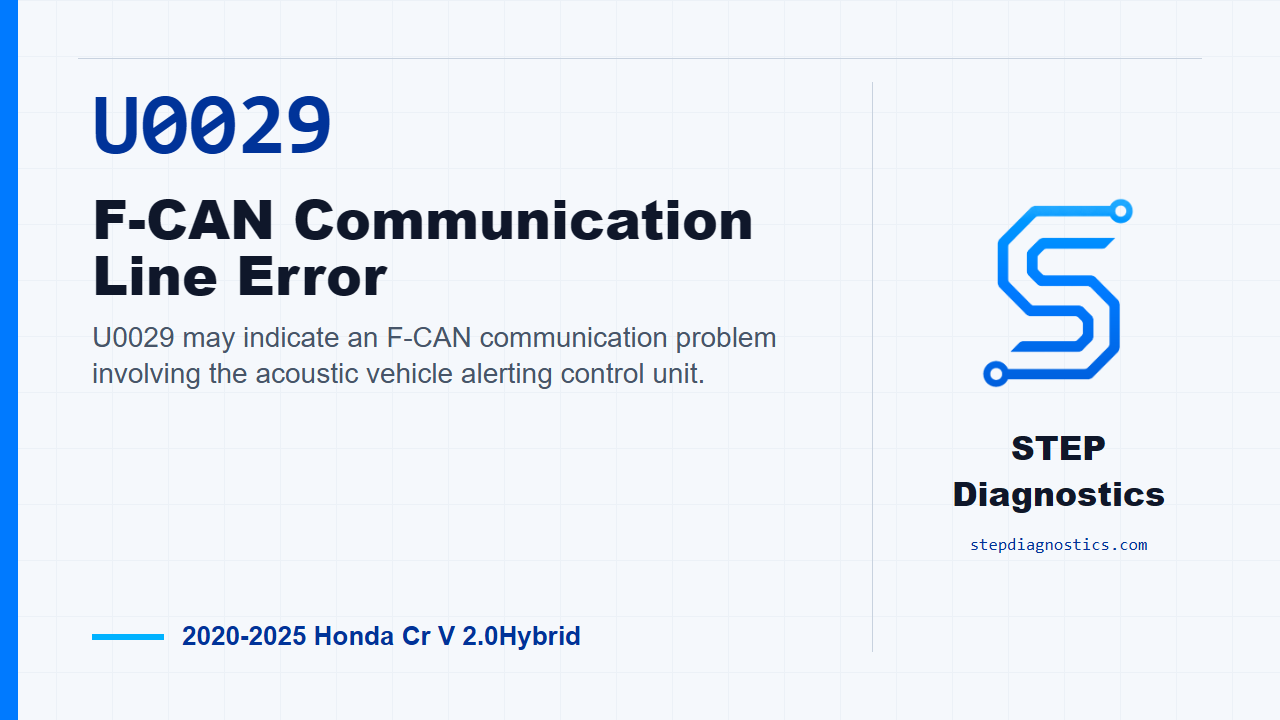
U0029 may indicate an F-CAN communication problem involving the acoustic vehicle alerting control unit.
What the vehicle may do
- The vehicle may show warning indicators.
- A scan tool may show communication-related faults or limited module communication.
- Symptoms may be related to the acoustic vehicle alerting system or broader network communication behavior.
Possible fault areas
- Possible F-CAN communication line concern.
- Possible network wiring or connector issue.
- Possible acoustic vehicle alerting control unit communication path concern.
- Possible gateway-side or broader network communication concern.
Diagnostic path
Opening context
On this 2020 to 2025 Honda CR-V Hybrid, U0029 points to an F-CAN communication problem seen by the acoustic vehicle alerting control unit. In plain language, that module may be losing normal network communication. The vehicle may have warning lights, communication-related scan tool issues, or symptoms tied to the acoustic vehicle alerting system. Possible fault areas can include the F-CAN communication line, network wiring or connector issues, the alerting control unit’s communication path, or another network fault affecting the gateway side of the vehicle.
How the code sets
For U0029, the control logic is looking for a BUS-OFF condition on the F-CAN. If the acoustic vehicle alerting control unit detects that BUS-OFF condition continuously for a set number of times, it determines there is an abnormality and stores the code. So treat this as a network communication diagnosis, not as a simple component-performance code.
Start with the basic path
Before chasing U0029, start with the basic system checks and follow a structured diagnostic approach. Make sure the scan tool data and code status make sense, and don’t skip the normal network-code groundwork. With communication faults, jumping straight to a part call can waste a lot of time.
Handle code priority first
Next, check whether the related gateway-side network communication code is stored at the same time. If it is, diagnose that gateway communication fault first before continuing with U0029. That priority matters because a gateway-side network problem can affect what the acoustic vehicle alerting control unit is able to see on the F-CAN.
Multiple-code logic
If you are dealing with multiple communication DTCs, don’t isolate U0029 too early. Use the appropriate multiple-code network diagnostic path so the fault is sorted in the right order. The goal is to find whether U0029 is the main failure or a result of a broader network communication problem.
Limits of this path
The available path for U0029 gives the setup, the code-setting logic, and the priority check, but it does not provide pinpoint measurements, connector checks, repair actions, or a final verification routine for this code. At that point, pause, recheck the earlier diagnostic path, and avoid guessing. Continue with the correct network diagnostic workflow for the codes that are actually present.
Close
Takeaway: U0029 is an F-CAN BUS-OFF communication fault seen by the acoustic vehicle alerting control unit, and the key move is to handle any higher-priority gateway or multi-code network issue first before treating U0029 as a standalone fault. For more diagnostic training, visit stepdiagnostics.com.
Final check
U0029 should often be approached as a network communication fault, with priority given to related gateway or multiple-code communication issues before isolating this code.
For more guided automotive diagnostics, visit STEP Diagnostics.