What this code means
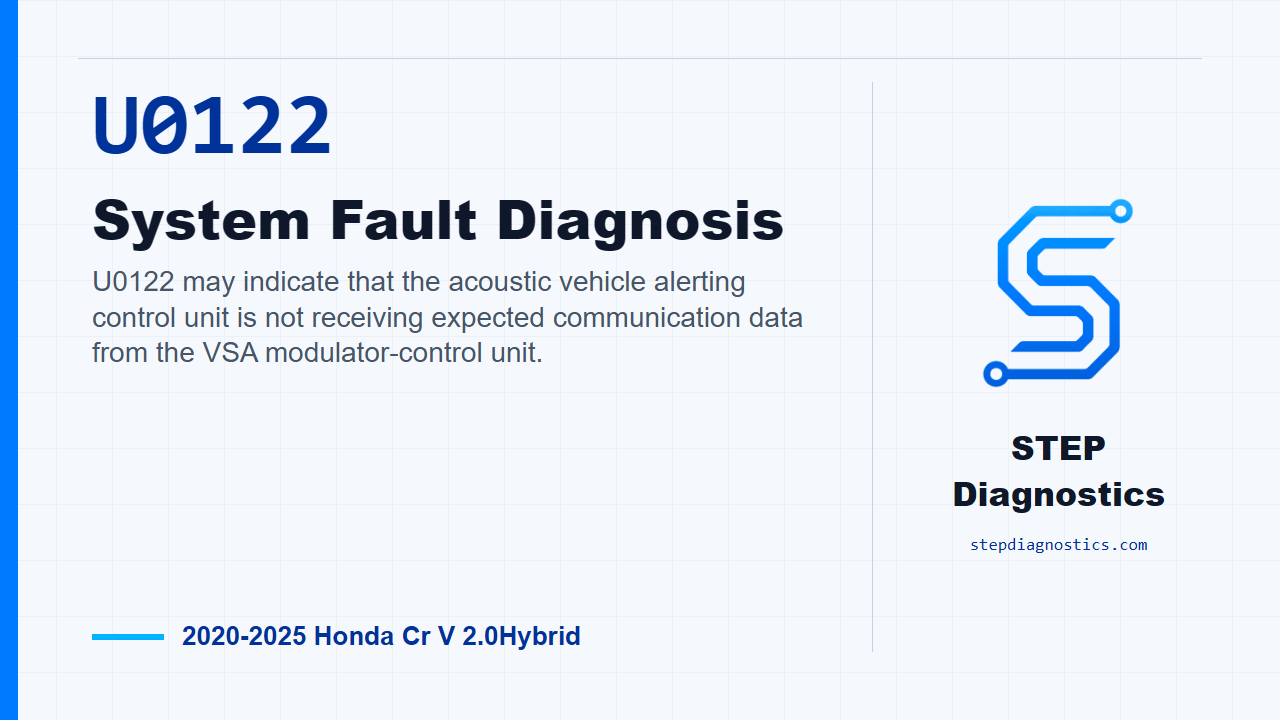
U0122 may indicate that the acoustic vehicle alerting control unit is not receiving expected communication data from the VSA modulator-control unit.
What the vehicle may do
- The vehicle may set a warning related to the acoustic vehicle alerting system.
- The pedestrian alert sound system may not have the data it expects.
- Other network or stability-control related symptoms may also be present depending on the vehicle condition.
Possible fault areas
- Possible VSA modulator-control unit startup issue.
- Possible VSA modulator-control unit power or ground issue.
- Possible communication issue between the acoustic vehicle alerting control unit, VSA modulator-control unit, and network gateway.
Diagnostic path
Opening context
Today we’re looking at U0122 on a 2020 to 2025 Honda CR-V Hybrid, in the acoustic vehicle alerting system. In plain terms, this code means the acoustic vehicle alerting control unit may not be getting the expected data from the VSA modulator-control unit. The vehicle may set a warning, and the pedestrian alert sound system may not have the information it expects. The broad fault areas can include VSA module startup, VSA power or ground, and the communication path between the modules. So don’t treat this as a speaker problem first. Treat it as a communication and module-support problem.
Start with the basic checks
Before getting deep into the code, start with the basic system checks and follow a structured diagnostic approach. If there are multiple codes stored, handle the multiple-code process first instead of chasing this one code in isolation. That helps keep you from blaming the acoustic vehicle alerting control unit for a network problem that started somewhere else.
Check the VSA module support first
The first targeted check is the VSA modulator-control unit power and ground. Do that before continuing with U0122. This matters because this code may store if the VSA modulator-control unit does not start normally, and it may also store from a failure in the VSA power or ground circuit. In other words, prove the VSA unit is being supported correctly before you spend time on deeper communication diagnosis.
Power the vehicle and look at the data path
Next, turn the vehicle to the ON mode. With the vehicle awake, work from the acoustic vehicle alerting system data list on the HDS. The logic behind the code is simple: if the acoustic vehicle alerting control unit cannot receive the specified data from the VSA modulator-control unit, it sees that as abnormal and stores U0122.
Network diagnosis boundary
From here, the diagnostic direction moves into the F-CAN lost-communication path through the CAN gateway. The detailed branch steps for that network path are not present in this episode, so don’t invent a pass-fail point or jump to a module replacement. Pause, recheck the earlier diagnostic path, confirm the VSA power and ground checks were done correctly, and avoid guessing.
Verification and takeaway
Keep verification separate from the testing. After any correction, make sure the original communication concern is actually gone before calling the job done. The takeaway is this: for U0122, support the VSA modulator-control unit first, then follow the communication path logically. For more diagnostic training, visit stepdiagnostics.com.
Final check
U0122 is often approached as a communication-support diagnosis: confirm the VSA unit is powered, grounded, and awake before moving deeper into network testing.
For more guided automotive diagnostics, visit STEP Diagnostics.