What this code means
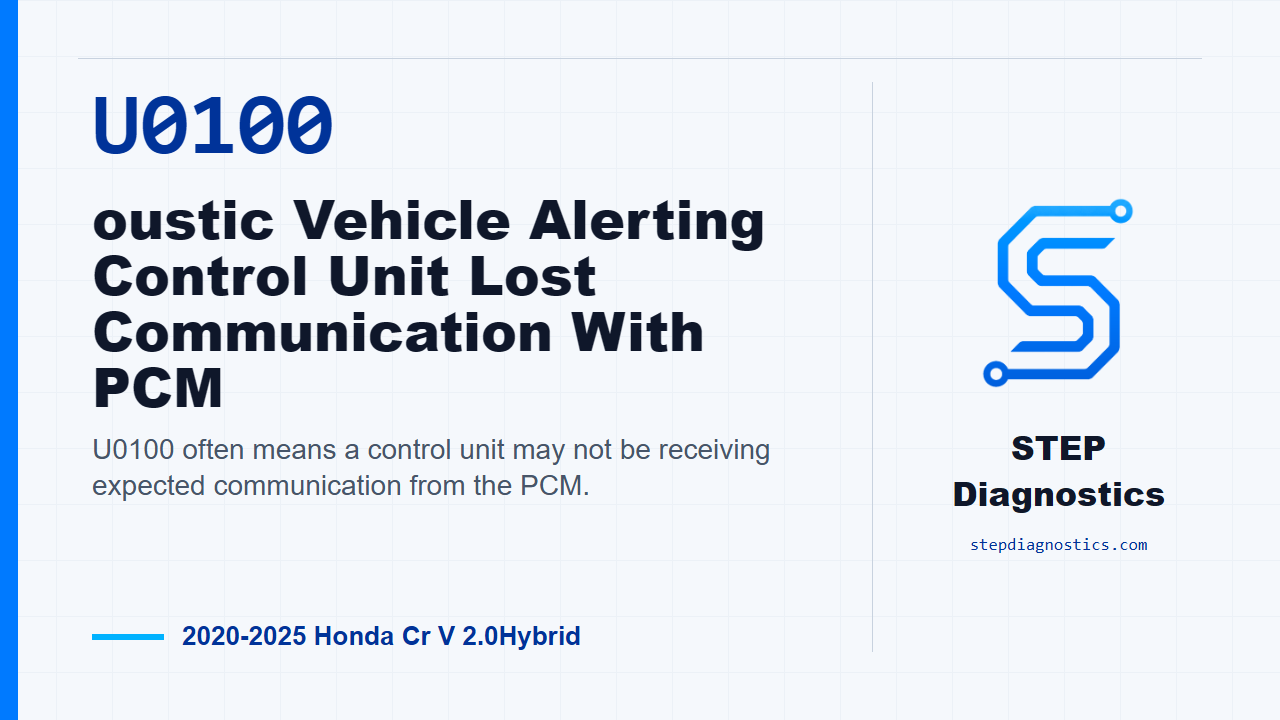
U0100 often means a control unit may not be receiving expected communication from the PCM.
What the vehicle may do
- The vehicle may store a communication fault.
- Some functions may be affected if PCM communication is not available to the receiving control unit.
- The fault can appear with other network or power-related concerns.
Possible fault areas
- Possible PCM power or ground concern.
- Possible PCM startup concern.
- Possible CAN communication or gateway-related concern.
- Possible control-unit communication issue.
Diagnostic path
Opening and code meaning
This episode is for U0100 on a 2020 to 2025 Honda CR-V Hybrid, where the acoustic vehicle alerting control unit has lost communication with the PCM. In plain terms, the alerting control unit may not be getting the PCM data it expects. The vehicle may set a communication fault, and the behavior can point toward a network communication issue, a PCM power or ground problem, or a PCM that is not starting up normally. Keep this one disciplined: don’t jump straight into module replacement. Start by proving the basics that can make the PCM unavailable on the network.
Start with the basic checks
Before you dig into the code path, start with the basic system checks and use a structured diagnostic approach. If other faults are present, especially communication or power-related faults, check what they mean first so you are not chasing a symptom of another problem.
Check PCM power and ground first
The first real priority on this code is the PCM power and ground circuit. The reason is simple: this code may store if the PCM does not start normally, and it may also store from a PCM power or ground circuit failure. If the PCM is not awake and stable, the acoustic vehicle alerting control unit can lose the data it needs and set U0100.
Move into the communication path
After the PCM power and ground side has been checked, continue with the F-CAN lost-communication diagnostic path for the CAN bus connection through the gateway. The logic for U0100 is that the acoustic vehicle alerting control unit sets the code when it cannot receive the specified data from the PCM. So the testing direction is communication integrity between those modules, not a guess at the alerting control unit itself.
Multiple-code handling
If you are troubleshooting multiple faults at the same time, use the body CAN system diagnosis test mode path for multiple-code handling before narrowing the job back down to this code. That keeps the network diagnosis organized and helps avoid treating one module’s complaint as the root cause without checking the wider communication picture.
Key-on check and verification
Turn the vehicle to ON mode as part of the diagnostic process. Once the checks and any needed corrections are complete, keep verification separate from testing: turn the vehicle back to the required operating state, verify communication behavior, and confirm U0100 stays gone instead of just clearing the code and calling it fixed.
Closing takeaway
Bottom line: for U0100 here, prove the PCM can power up correctly, prove its power and ground are sound, then follow the F-CAN communication path through the gateway. Don’t replace modules just because one module reports missing PCM data. For more diagnostic training, visit stepdiagnostics.com.
Final check
This diagnosis should stay focused on proving PCM power, ground, startup, and network communication before considering any module-level conclusion.
For more guided automotive diagnostics, visit STEP Diagnostics.