What this code means
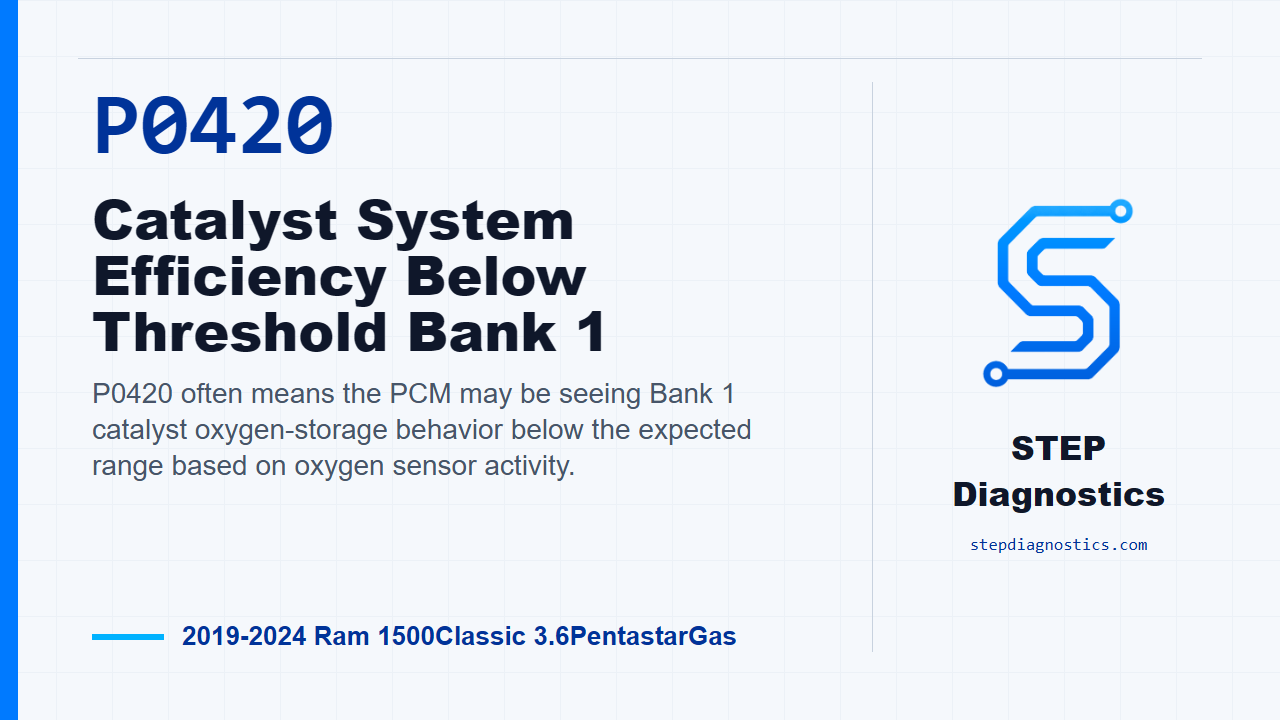
P0420 often means the PCM may be seeing Bank 1 catalyst oxygen-storage behavior below the expected range based on oxygen sensor activity.
What the vehicle may do
- The MIL may illuminate.
- The driver may not notice a drivability complaint.
Possible fault areas
- Possible exhaust leak.
- Possible engine mechanical condition that can contaminate the sensor or catalyst.
- Possible aging or fouled upstream oxygen sensor.
- Possible oxygen sensor replacement-history mismatch.
- Possible catalytic converter concern.
Diagnostic path
Open on what P0420 is really telling you
On this Ram 1500 Classic with the 3.6 Pentastar, P0420 is a Bank 1 catalyst efficiency code. In plain terms, the PCM may be seeing the downstream oxygen sensor pattern look too much like the upstream oxygen sensor pattern, which can point to the catalyst not storing oxygen the way it should. The customer may only notice the MIL, but the diagnostic path still needs to stay disciplined. Possible fault areas can include an exhaust leak, an engine mechanical condition that contaminates the sensor or catalyst, an aging or fouled upstream oxygen sensor, a recent downstream sensor replacement paired with an older upstream sensor, or the catalytic converter itself.
Understand the monitor before testing
Before chasing parts, understand what the PCM is comparing. With a healthy catalyst, the downstream oxygen sensor trace should be much flatter than the upstream trace; the downstream line would measure approximately 20% of the upstream line. If the downstream-to-upstream signal ratio is more than approximately 0.6/1, or 60%, the PCM determines the catalyst is failing. For the best chance to reproduce the catalyst monitor, the engine temperature needs to be above 70°C (158°F), engine speed between approximately 1000 rpm and 3000 rpm, and vehicle speed between 20 mph and 85 mph under moderate engine load. Also, the monitor expects no active oxygen sensor circuit faults, so do not skip the basics.
Confirm the code is current
Start with the basic system checks. Use the scan tool to read DTCs in all ECUs, record them, and save the vehicle scan report with the related recorded data. Then erase all DTCs, turn the ignition off for a minimum of 10.0 seconds, turn the ignition back on, and operate the vehicle under the same type of conditions that set the code. After that, read DTCs again. If P0420 does not return, handle it as an intermittent condition. If it does return, continue with this diagnostic path.
Do not ignore oxygen sensor faults
Next, look back at the recorded codes. If there are upstream or downstream oxygen sensor signal or heater circuit faults present, diagnose those oxygen sensor faults before continuing with P0420. A catalyst efficiency decision depends on those sensor signals, so a sensor circuit problem can mislead the catalyst monitor. If those faults are not present, move on to the converter inspection.
Inspect the catalytic converter first
Visually inspect the catalytic converter inlet and outlet. Look for physical damage like dents or holes, leakage, signs that the converter is internally broken, or severe discoloration from overheating. If any of those problems are found, repair the condition that may have caused the failure, replace the catalytic converter, and then verify the repair and confirm the code stays gone. If the converter passes the visual inspection, continue to the exhaust leak check.
Check the exhaust for leaks
Now check the exhaust system for leaks. Pay close attention to leaks ahead of the catalytic converter. Even a very small leak, depending on location, can pull the upstream oxygen sensor out of range or keep it from switching correctly, and that can fail the catalyst monitor. If an exhaust leak is found, repair or replace the leaking exhaust components as needed, then verify the repair. If no leak is found, keep going.
Rule out engine mechanical contamination
Next, check for an engine mechanical issue. An engine problem that causes oil consumption, coolant consumption, or excessive fuel can foul the upstream oxygen sensor because that sensor is not protected by the catalyst. Check the exhaust for excessive smoke from an internal engine problem, and verify the upstream oxygen sensor is not fouled from a mechanical engine failure. If an engine mechanical condition is present, repair that condition and verify the repair. If it is not present, continue.
Check repair history for a sensor mismatch
Review the vehicle repair history. A new downstream oxygen sensor paired with an aging upstream oxygen sensor may cause this DTC to set. If the downstream oxygen sensor was replaced recently without replacing the upstream oxygen sensor, replace the upstream oxygen sensor and then verify the repair. If that repair-history pattern is not present, the diagnostic path has no remaining listed causes before the converter decision.
Final decision and verification
If P0420 returned, oxygen sensor circuit faults were not present, the converter had no external damage found, there were no exhaust leaks, no engine mechanical condition was found, and the repair history does not point to the downstream-new and upstream-aging sensor combination, replace the catalytic converter. Keep the verification separate from the testing: after any repair in this path, verify the repair and confirm P0420 stays gone. The takeaway is simple: prove the monitor is valid, eliminate sensor and exhaust causes first, then make the converter call only after the earlier checks are clear. For more diagnostic training, visit stepdiagnostics.com.
Final check
P0420 can be a catalyst problem, but the diagnostic path should first confirm the code returns and rule out oxygen sensor faults, exhaust leaks, engine mechanical issues, and relevant sensor repair-mư
For more guided automotive diagnostics, visit STEP Diagnostics.