What this code means
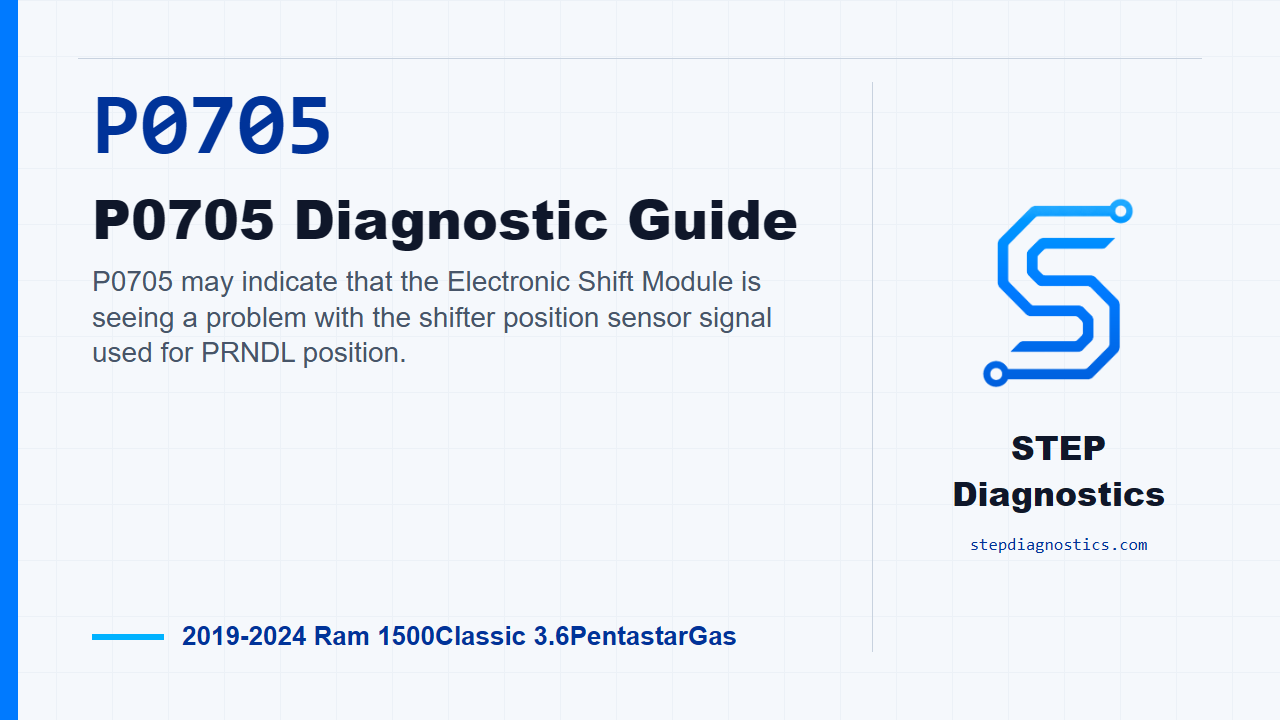
P0705 may indicate that the Electronic Shift Module is seeing a problem with the shifter position sensor signal used for PRNDL position.
What the vehicle may do
- ESM indicators and backlighting may be turned off when the fault is active.
- Gear selection may not be available when the fault is active.
Possible fault areas
- Possible ESM circuitry concern.
- Possible ESM internal processor concern.
- Possible related wiring concern for shifter and BTSI operation.
Diagnostic path
Opening context
On this 2019-2024 Ram 1500 Classic with the 3.6 L engine, P0705 is a shifter range input fault in the Electronic Shift Module. In plain terms, the module is seeing a problem with the shifter position sensor signal it uses for PRNDL position. When this fault is active, the vehicle may turn off the ESM indicators and backlighting, and gear selection may not be available. Broadly, the issue can involve ESM circuitry, the module’s internal processor, or related wiring involved in the shifter and BTSI operation. Before chasing the code, start with the basic system checks so you are not diagnosing around a power, communication, or setup issue.
Confirm whether P0705 is active
Start by checking the ESM with the scan tool. Read the ESM DTCs and record what is present, then record the environmental data. Clear the codes, then try to reproduce the same operating conditions using the captured data and the monitor and set conditions for this fault. After that drive or operating cycle, read the ESM codes again. If P0705 does not return, do not jump to a module. Treat it as an intermittent condition and diagnose it that way. If P0705 does return, continue into the connection and harness checks.
Inspect the related connections
With the code confirmed active, move to the related harness connections. Disconnect the ESM harness connectors, any related in-line connectors if equipped, and the related component connectors. Inspect the connectors and the male and female terminals carefully. You are looking for poor connector seating, damaged locks, corrosion, water intrusion, damaged weather seals if equipped, bent terminals, heat discoloration from a poor connection, or terminals pushed back in the connector cavity. Then perform a terminal drag test on each connector terminal to confirm terminal tension. Repair any condition you find before moving on.
Reconnect and rerun the fault check
After the inspection and any needed connection repair, reconnect the ESM harness connectors, any in-line connectors if equipped, and the related component connectors. Make sure every connector is fully seated and every connector lock is fully engaged. Clear the DTCs again, operate the vehicle under the captured event and environmental conditions that set the fault, and then read the ESM DTCs again.
Decision after testing
Now make the decision based on whether P0705 returned. If the code is gone, keep verification separate from the connection testing and run the ESM verification test to confirm the repair. If the code returns after the connection checks and any repairs, the diagnostic path calls for replacing the ESM, followed by the ESM verification test.
Closing takeaway
The key with P0705 is to prove whether the fault is repeatable, check the ESM and related connector integrity before condemning the module, and then verify the repair with a clean final check. For more diagnostic training, visit stepdiagnostics.com.
Final check
P0705 is often approached by confirming the fault, checking connector and terminal integrity, and then verifying whether the code stays gone.
For more guided automotive diagnostics, visit STEP Diagnostics.