What this code means
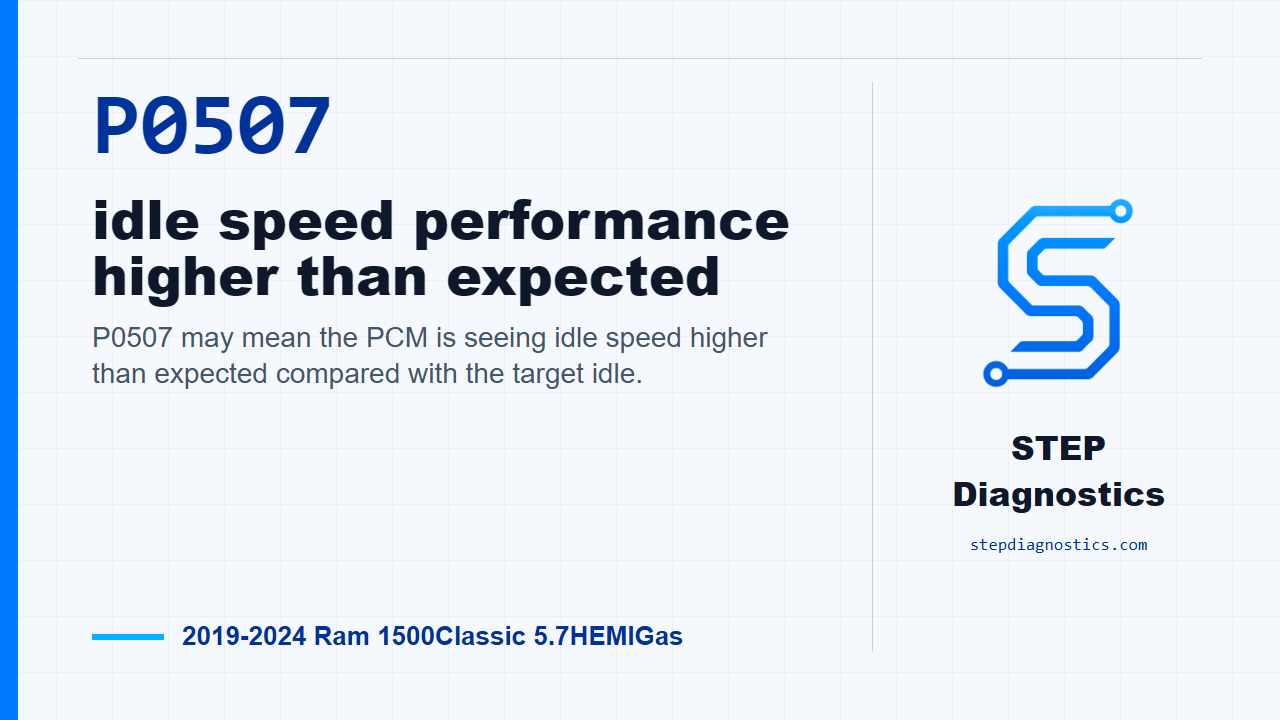
P0507 may mean the PCM is seeing idle speed higher than expected compared with the target idle.
What the vehicle may do
- The engine may idle higher than normal.
- The check engine light can illuminate.
- Stop/start may be disabled when the code is active on vehicles equipped with that feature.
Possible fault areas
- Possible extra air entering through the PCV system or a vacuum leak.
- Possible throttle body operation or connector concern.
- Possible ABS communication or implausible data concern affecting the idle rationality check.
- Possible PCM concern after the earlier checks are completed.
Diagnostic path
Opening context
On this Ram 1500 Classic with the 5.7 HEMI, P0507 means the PCM is seeing idle speed higher than expected. In plain language, the actual idle may be staying too far above the target idle. The driver may notice a high idle, a check engine light, or stop/start may be disabled when the code is active. The broad fault areas can include extra air getting into the engine through the PCV system or a vacuum leak, a throttle body concern, ABS communication or speed data that can confuse the idle rationality test, or, farther down the path, a possible PCM concern. The logic here is commanded-versus-actual idle performance: the PCM is trying to control idle, and the engine is not matching what it expects.
How the code runs and sets
Before testing, keep the monitor logic in mind. This diagnostic runs at idle, with no throttle input requested, vehicle speed at zero, and engine run time of more than 30.0 seconds. The code sets when engine speed is more than 200 rpm above idle speed for 30.0 seconds. So when you try to duplicate it, reproduce those operating conditions instead of chasing the fault under the wrong conditions.
Start the diagnostic path
Start with the basic pre-diagnostic checks completed. Then start the engine, test drive or operate the vehicle under the same conditions that run and set this fault, and read and record the DTCs with the scan tool. If P0507 is active or pending, continue with this path. If it is not active or pending, treat it as an intermittent concern instead of forcing the active-code routine.
Check other code context
Next, look at the other recorded codes before condemning anything. If there are active or pending throttle body codes, or ABS communication or implausible ABS data concerns, deal with those first. A loss of communication with the ABS module can make the PCM default vehicle speed to zero while driving, and that can falsely fail the idle speed rationality check. If none of those related concerns are active or pending, move on to the air and throttle checks.
Inspect the PCV system
Turn the ignition off and inspect the PCV system for proper operation. Look for cracked or damaged hoses or tubes, poor hose or tube connections, and a PCV valve stuck open. Any of those can add unmetered air and raise idle. If you find a PCV problem, repair it as necessary, then verify the repair and confirm the code stays gone. If the PCV system checks out, continue to the vacuum leak inspection.
Check for vacuum leaks
Start the engine and inspect for vacuum leaks. Before working around a running engine, stay out of the fan path, keep your hands away from pulleys, belts, and the fan, and do not wear loose clothing. Check for internal leaks and check external areas that can create a vacuum leak, including vacuum supply lines, the brake booster, purge solenoid, and engine seals. If you find a vacuum leak, repair it as necessary, then verify the repair and confirm the code stays gone. If no vacuum leak is found, continue to the throttle body checks.
Check throttle body operation
Now inspect the throttle body for proper operation. Look for carbon buildup, other restrictions, and use a straight edge to check for a bent throttle plate. If the plate does not close entirely, it may be bent and needs to be replaced. With the vehicle running, perform a wiggle test on the ETC motor wiring and connections while listening for the idle to rise. Use the same running-engine safety precautions here: stay clear of the fan, belts, and pulleys, and keep loose clothing away from moving parts.
Throttle body decision point
If you find a throttle body problem, or the idle fluctuates during the wiggle test, first verify good pin-to-terminal contact at the throttle body and PCM connectors. If the connectors check good and no connector problem is found, replace the throttle body assembly. Disconnect the battery when replacing the throttle body assembly. After installation, use the scan tool and run the Throttle Body Self Learn, then verify the repair and confirm the code stays gone. If no throttle body problem is found and the idle does not fluctuate during the wiggle test, continue to the harness connection checks.
Check related harness connections
Next, inspect the related harness connections. Disconnect all PCM harness connectors, any related in-line harness connections if equipped, and the related component connectors. Inspect the harness connectors, component connectors, and male and female terminals for proper installation, damaged connector locks, corrosion, water intrusion, weather seal damage if equipped, bent terminals, discoloration from overheating due to poor connection, terminals pushed back into the connector cavity, spread terminals, and proper terminal tension. Repair any conditions you find. Then reconnect the PCM connectors, in-line connectors if equipped, and related component connectors, making sure everything is fully seated and locked.
Final decision and verification
After the connector work, erase the DTCs with the scan tool. Test drive or operate the vehicle under the same operating conditions, then read the DTCs again. If P0507 returns, the path calls for replacing and programming the PCM, followed by repair verification. If the code does not return, the wiring or poor connection problem has been repaired. Keep verification separate from the individual checks: after any repair, operate the vehicle under the proper conditions and confirm the code stays gone.
Takeaway
The key with P0507 is not to jump straight to a throttle body. Prove the code is active, clear any code context that can mislead the idle rationality test, check for extra air through the PCV and vacuum system, then work through throttle body operation and connector integrity in order. For more diagnostic training, visit stepdiagnostics.com.
Final check
P0507 is often a commanded-versus-actual idle control fault, so the diagnosis should prove the operating conditions, eliminate misleading code context, check for extra air, and then follow the ordered
For more guided automotive diagnostics, visit STEP Diagnostics.