What this code means
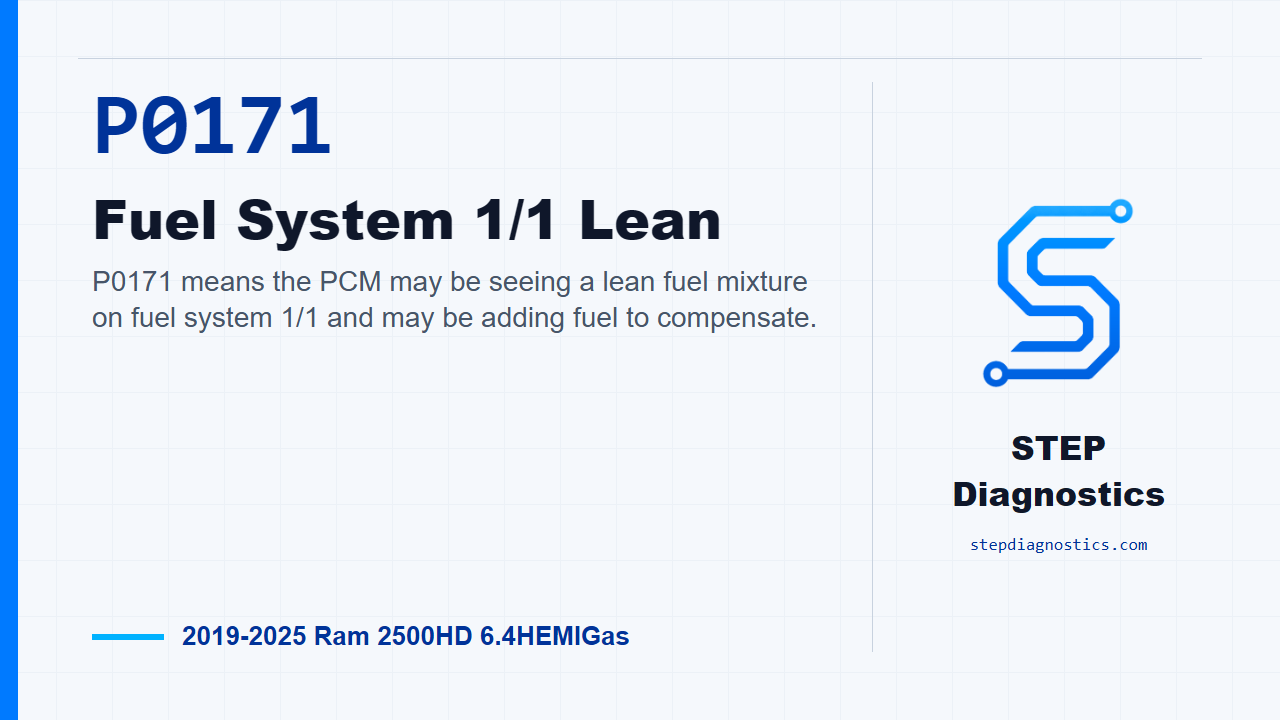
P0171 means the PCM may be seeing a lean fuel mixture on fuel system 1/1 and may be adding fuel to compensate.
What the vehicle may do
- The MIL may be illuminated.
- The vehicle may have fuel system or driveability symptoms.
- If equipped, stop/start may be disabled while the code is active.
Possible fault areas
- Possible fuel delivery or injector restriction concerns.
- Possible unmetered air, vacuum leak, or engine mechanical concerns.
- Possible purge flow or exhaust leak concerns.
- Possible MAP sensor input, upstream O2 sensor wiring, upstream O2 sensor, or PCM concerns.
Diagnostic path
Opening context
P0171 on this Ram 2500HD with the 6.4 HEMI gas engine means the PCM is seeing Fuel System 1/1 lean. In plain language, the controller may be adding fuel because the bank one upstream feedback shows the mixture trending lean. The driver may see the MIL, and if the truck has stop/start, that system may be disabled while the code is active. This can come from possible fuel delivery issues, unmetered air or vacuum leaks, purge flow problems, exhaust leaks ahead of the sensor, MAP input concerns, O2 sensor wiring, the O2 sensor itself, or, at the end of the path, the PCM. But don’t start with the O2 sensor. This code is often more likely to be caused by a mechanical, fuel, or air handling issue, so work the path in order.
Confirm the fault under the right conditions
Start with the basic system checks. From an emissions standpoint, this monitor is aimed at a fault severe enough to exceed 1.5 times any of the standards. Then read and record the DTCs from all ECUs, save the scan report and related data, erase the codes, turn the ignition off for a minimum of 10.0 seconds, turn the ignition back on, and operate the truck under the captured conditions that set P0171. Treat the enable conditions as monitor gates: the engine is running in closed loop fuel control, battery voltage is above 11.0 volts, barometric pressure is greater than 75 kPa, ambient temperature is above -7°C (20°F), fuel level is greater than 12%, and altitude is below 2590.8 m (8500 ft.). The diagnostic fails when the sum of short term and long term fuel corrections is greater than a calibrated threshold, generally 133% (100% is nominal), for approximately 30 seconds of fail time. After the drive, read the codes again. If P0171 does not return, handle it as an intermittent condition instead of forcing a hard-fault diagnosis.
Handle related fuel and air faults first
Next, look back at the recorded codes. If any fuel or air handling system codes are active or pending, diagnose those first. If not, move through the checks in order: verify MAP sensor operation, then verify the fuel delivery system, then check the ethanol content in the gasoline. If any of those checks finds a problem, make the appropriate repair and verify the repair before continuing. If they pass, keep moving down the path without inventing limits or outcomes.
Check mechanical, vacuum, injector, and purge conditions
If MAP operation, fuel delivery, and ethanol content check out, turn the ignition off and inspect for mechanical conditions that can make the mixture look lean. The air induction system needs to be free from leaks. Check the engine and vacuum lines or hoses for leaks. Check the power brake booster for an internal vacuum leak by monitoring engine speed and vacuum while pinching the booster vacuum hose. If a restricted or plugged fuel injector is suspected, remove the fuel rail with the injectors intact, energize the fuel pump to maintain fuel pressure in the rail, actuate the suspect injector or injectors with the scan tool, and compare the spray pattern to the others. Also confirm the purge flow system flows freely with no leaks or restrictions, including the hose and connections between the purge solenoid and the intake manifold. Engine compression must be within specifications. If a mechanical problem is found, repair it and verify the repair.
Check for exhaust leakage
After the mechanical and purge checks, test the exhaust system for leaks. A leak in the wrong location can skew upstream oxygen sensor feedback and keep the PCM chasing a lean condition. If the exhaust leak test finds a problem, repair it and verify that P0171 stays gone before moving deeper into the circuit path.
Check the bank one upstream O2 wiring
If the exhaust check passes, move to the 1/1 upstream O2 sensor wiring. Disconnect the upstream O2 sensor harness connector and the PCM C2 harness connector. If you need to test at a PCM connector terminal, use the GPEC Diagnostic Adapter 10436. Do not probe the PCM harness connectors directly; that can damage the PCM terminals and create a poor terminal-to-pin connection. Check the upstream O2 sensor circuits between the O2 sensor connector and PCM C2 for a short to ground, and for an open or high resistance. If you find a wiring problem, repair it and verify the repair.
Replace the upstream O2 sensor only after the earlier checks pass
Only after the wiring checks pass does this path call for replacing the Bank 1 upstream O2 sensor. Connect the Bank 1 upstream O2 sensor and PCM harness connectors, turn the ignition on, erase the codes, and operate the vehicle under the captured conditions or monitor conditions that set P0171. If the code does not return, the sensor replacement repaired the fault, and you still finish by verifying the repair. If P0171 returns, continue to the connector and harness connection checks.
Final connector inspection and PCM endpoint
At the final stage, disconnect the PCM harness connectors, any related in-line harness connections if equipped, and the related component connectors. Inspect the harness connectors, component connectors, and male and female terminals for proper seating, damaged locks, corrosion, signs of water intrusion, weather seal damage if equipped, bent terminals, overheating or discoloration from a poor connection, and terminals pushed back in the cavities. Check for spread terminals and verify terminal tension. Repair anything you find, then reconnect every PCM, in-line, and component connector fully seated with the locks engaged. Erase the codes, operate the vehicle under the monitor conditions, and read the codes again. If P0171 does not return, the wiring or poor connection problem has been repaired. If it does return after this final connector check, the path ends with replacing and programming the PCM, then verifying the repair.
Takeaway
The clean way through P0171 is to confirm the code first, handle fuel and air handling faults before chasing the oxygen sensor, check mechanical and exhaust causes, then prove the O2 circuit before replacing the sensor or condemning the PCM. For more diagnostic training, visit stepdiagnostics.com.
Final check
P0171 is often best approached by proving the basic fuel, air, mechanical, exhaust, and circuit conditions before blaming the sensor or PCM.
For more guided automotive diagnostics, visit STEP Diagnostics.