What this code means
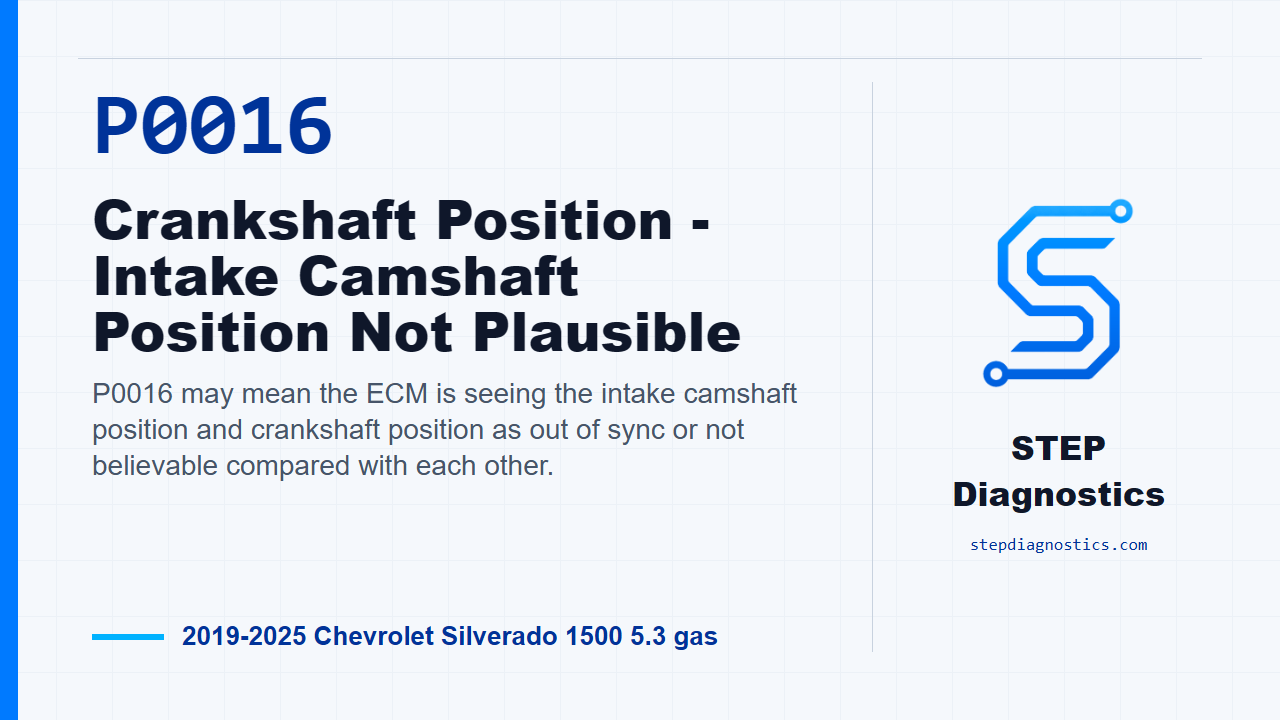
P0016 may mean the ECM is seeing the intake camshaft position and crankshaft position as out of sync or not believable compared with each other.
What the vehicle may do
- The vehicle may have a check engine light.
- It may crank longer than normal.
- It can run rough or feel down on power.
- In some cases, symptoms may be intermittent.
Possible fault areas
- Possible camshaft or crankshaft position sensor installation issues.
- Possible connector or signal-related concerns.
- Possible camshaft actuator solenoid issue.
- Possible crankshaft reluctor alignment issue.
- Possible timing belt, timing chain, or tensioner concern.
Diagnostic path
Open on what P0016 means
On this 2019-2025 Chevrolet Silverado 1500 with the V8-5.3L gas engine, P0016 means the ECM sees the crankshaft position and intake camshaft position as not plausible to each other. In plain language, the computer may be seeing the cam and crank signals out of sync. The truck may crank longer, run rough, feel down on power, or turn the check engine light on. Possible fault areas can include cam or crank sensor fitment, signal or connector concerns, the cam actuator solenoid, crank reluctor alignment, or timing-drive play. The diagnostic path here is about proving whether P0016 is really active, then checking the mechanical and installation-related causes that can make the cam and crank relationship look wrong.
Start with the basic checks
Before chasing P0016 directly, start with the basic system checks and follow a structured diagnostic approach. Make sure the diagnostic categories are being applied correctly. Then, with the ignition on and the vehicle in service mode, check for other related crank, cam, actuator, or reference-type codes. If those are present, check what they mean first, because they can affect whether this P0016 test is valid.
Run the P0016 check
If the related codes are not set, run the engine at idle with the engine at normal operating temperature. Then check whether P0016 is set. The monitor is allowed to run with the engine cranking or running, the crankshaft and camshaft signals synchronized, the camshaft actuator solenoid valve in the park position, and Time since diagnostic ran last = For greater than 1 s. Once those monitor gates are met, it runs continuously.
Understand the setting logic
The setting logic is a cam-to-crank correlation error. P0016 sets when the relative camshaft position deviation is greater than −11° in one direction, or greater than 11° in the other direction, measured in degrees of the crankshaft. So if the scan result shows the code active under the right conditions, think in terms of sync, sensor fitment, actuator position, reluctor alignment, and timing-drive movement rather than jumping straight to a part.
If P0016 is set, inspect the listed fault areas
If P0016 is set, turn the ignition and vehicle off. Now check the listed mechanical fault areas in one pass: cam and crank sensor fitment, the camshaft position actuator solenoid valve for fitment or stuck-open or stuck-closed behavior, crankshaft reluctor alignment, and timing-drive or tensioner play or fitment. If one of those conditions is found, repair or replace as necessary.
If nothing obvious is found
If none of those conditions exists, do not guess at a repair. Pause, recheck the earlier diagnostic path, and make sure the code was evaluated under the correct conditions before moving on.
If P0016 is not set, reproduce the conditions
If P0016 is not set during the initial check, operate the vehicle within the conditions that allow the diagnostic to run. You can also reproduce the captured operating conditions from when the code was recorded. Then verify the DTC does not set. If it sets during that final operation, one of the earlier conditions is still present. If it does not set, the check is okay at that time.
Verify the repair
After any repair is completed, keep verification separate from the testing. Verify the repair and confirm P0016 stays gone under the proper operating conditions. The takeaway is simple: prove the monitor is valid, confirm whether the cam and crank correlation fault is active, inspect the listed sync-related fault areas, and then verify the code does not return. For more diagnostic training, visit stepdiagnostics.com.
Final check
P0016 is often a correlation diagnosis: confirm the monitor conditions, check whether the code is active, inspect the listed sync-related fault areas, and verify the code stays gone.
For more guided automotive diagnostics, visit STEP Diagnostics.