What this code means
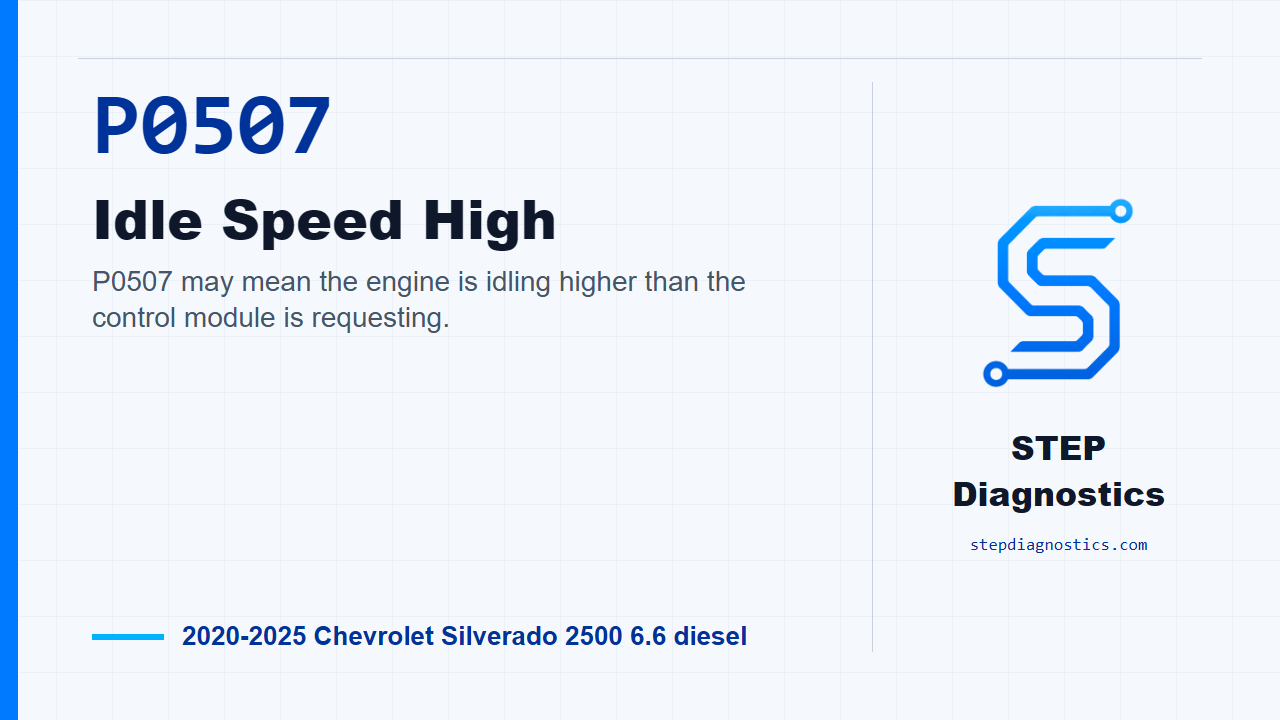
P0507 may mean the engine is idling higher than the control module is requesting.
What the vehicle may do
- The vehicle may have a fast idle or idle flare.
- The driver may notice little change other than a warning light.
- Idle behavior can vary depending on operating conditions.
Possible fault areas
- Fueling concerns may be involved.
- Fuel contamination of the engine oil can be a possible area to consider.
- Aftermarket fuel-system equipment or accessories may affect the idle check.
- Commanded idle and actual engine speed may not be lining up.
Diagnostic path
Opening context
On this Silverado 2500 with the 6.6 diesel, P0507 may mean the engine is idling higher than the control module is requesting. The driver may notice a fast idle, an idle flare, or the truck may simply set the light with very little drivability complaint. Treat this as a command-versus-response check: desired idle on one side, actual engine speed on the other. Possible areas can include fueling concerns, fuel contamination in the oil, aftermarket fuel-system equipment, or operating conditions that make the idle check invalid. Before you get deep into it, start with the basic system checks and follow a structured diagnostic approach so you do not jump straight to parts.
Initial check
Turn the ignition on with the vehicle in Service Mode. Before you focus on the idle-high fault, verify that no other codes are set. If other codes are present, check what they mean first. If no other codes are set, continue with the idle check.
Compare actual idle to desired idle
Idle the engine at normal operating temperature. On the scan tool, compare Engine Speed to Desired Idle Speed. The expected window is Engine Speed = −100 to +200 RPM of the Desired Idle Speed. If actual engine speed is outside that window, move into the P0507 testing. If it is inside that window, reproduce the operating conditions, or reproduce the captured conditions from when the fault stored.
Monitor gates and setting point
For this check to be meaningful, make sure the monitor gates line up. The required operating points include Barometric Pressure = Greater than 70 kPa (10 PSI), Engine = Idling — For greater than 5 s, Engine = Running — For greater than 1 min, Engine Coolant Temperature = Greater than 60°C (140°F), Engine speed varies less than +/-25 RPM, Ignition Voltage = 11 to 32 V, Intake Air Temperature Sensor = Greater than −20°C (−4°F), and Vehicle Speed = Less than 2 km/h (1.2 MPH). Once the running conditions are met, Frequency the DTC runs = Continuously — After the running conditions are met — For greater than 10 s. The scan tool control function should be inactive, the torque converter clutch inactive, and the transmission not shifting. For P0507, the actual setting point is Engine Speed = 182 RPM Greater than desired — For greater than 10 s.
Decision after reproducing the condition
After you reproduce those operating conditions, verify the fault does not reset. If it does not reset, this check is OK at that time. If it does reset, go into the testing path instead of guessing.
Testing context before the P0507 branch
There is a companion idle-low testing branch in this same idle-speed family that looks for a restricted exhaust, a mechanical condition limiting engine speed, or parasitic engine load. That is useful context, but it is not the P0507 branch. For this episode, stay focused on the idle-high path unless the earlier checks point you somewhere else.
P0507 testing
For the P0507 side, verify that these conditions do not exist: a leaking fuel injector, fuel contamination in the engine oil, or aftermarket fuel-system equipment or accessories affecting the system. If one of those conditions is present, repair as necessary. If none of them are present, the diagnostic path does not support guessing at parts; pause, recheck the earlier checks and operating conditions, and avoid forcing a repair that the test path did not prove.
Verify the repair
After the repair is complete, verify the repair and confirm the fault stays gone. The takeaway is simple: prove the idle-high condition against desired idle first, make sure the monitor gates are valid, then check the P0507-specific fuel and contamination concerns only when the path points you there. For more diagnostic training, visit stepdiagnostics.com.
Final check
P0507 is often best approached by comparing actual idle to desired idle, then checking the specific possible fault areas only when the diagnostic path points there.
For more guided automotive diagnostics, visit STEP Diagnostics.