What this code means
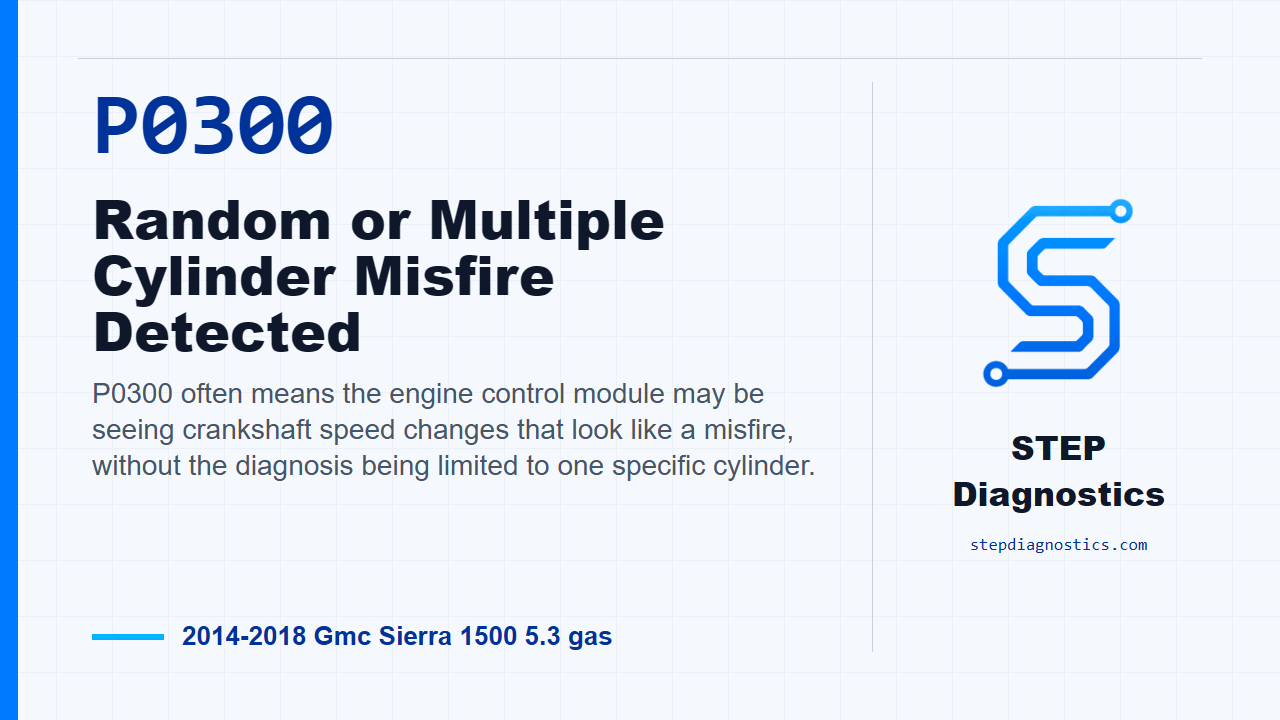
P0300 often means the engine control module may be seeing crankshaft speed changes that look like a misfire, without the diagnosis being limited to one specific cylinder.
What the vehicle may do
- The vehicle may run rough, shake, hesitate, or feel down on power.
- The malfunction light may turn on, and it can flash during a severe catalyst-damaging misfire condition.
- The concern may be intermittent and may only appear under certain driving conditions.
Possible fault areas
- Possible ignition faults can include spark delivery issues, plug wire concerns, spark plug condition, or ignition control problems.
- Possible fuel faults can include injector operation, injector circuit resistance, fuel quality, fuel level, or fuel pressure concerns.
- Possible air and exhaust faults can include vacuum leaks, PCV issues, vacuum hose problems, exhaust leaks, or exhaust restriction.
- Possible mechanical faults can include compression concerns, valve train concerns, or other engine mechanical conditions.
- Possible signal or wiring faults can include crankshaft or camshaft signal interpretation, connector movement, harness issues, or related sensor circuit concerns.
Diagnostic path
Open: what P0300 is telling us
On this GMC Sierra with the 5.3 gas engine, P0300 means the control module is seeing crankshaft speed changes that look like an engine misfire, but it is not limited to one named cylinder in the way a cylinder-specific misfire code would be. The truck may run rough, hesitate, shake, or turn the malfunction light on. Under catalyst-damaging misfire conditions, the light can flash, so do not treat this like a minor nuisance. Broadly, the fault area may be ignition, fuel delivery, air or vacuum issues, exhaust restriction, wiring or connector problems, crank and cam signal interpretation, or an engine mechanical problem. The diagnostic path is to prove where the misfire is coming from before replacing anything.
Start with verification, not parts
Start with the basic system checks, then follow a structured diagnostic approach. With the engine running, listen first. If there is abnormal engine noise, stop and deal with the engine mechanical concern before chasing ignition or fuel. If the engine sounds normal, perform the crankshaft position variation learn before continuing. Next, if other codes are present for the camshaft position sensor, crankshaft position sensor, oxygen sensor, injector, ignition coil, fuel system, ignition system, or mechanical condition, check what those codes mean first. Do not let a related system fault hide behind P0300.
Use the misfire data and power balance
Now watch the Cylinder 1–8 Current Misfire Counter. The expected result is that it does not increment. If it increments, move into deeper testing. If it does not increment, enable Cylinder Power Balance and compare the engine speed or sound as each fuel injector is turned off. Every cylinder should affect the engine the same way. If one or more cylinders do not change the sound the same way, continue into testing. If they all respond evenly, wiggle the harnesses and connectors at the engine control module, fuel injectors, and ignition coils, and also wiggle the vacuum hoses while watching the misfire counter. If the counter increments during that movement, repair or replace as necessary in the area that reacted.
Reproduce the monitor conditions
If the misfire is not active in the bay, reproduce the operating conditions that allow the monitor to run, or reproduce the captured conditions from the stored data. Treat these as monitor gates, not as a component test: Engine Coolant Temperature = −7 to 127°C (19.4 to 261°F), Engine Load = Greater than 30%, Engine Speed = Greater than 1,800 RPM, Fuel level = Greater than 11%, and System Voltage = 9 to 32 V. If P0300 sets again, continue into testing. If it does not set, the check is OK at that time.
Begin deeper testing with compression and basic conditions
For deeper testing, ignition off, confirm the CH-51450-A Oscilloscope Diagnostic Kit and CH-51450-LEAD-A Oscilloscope Basic Lead Kit are available. If they are not available, do not jump ahead; pause, recheck the earlier diagnostic path, and avoid guessing. If the tools are available, perform a Relative Engine Compression Test. If that test does not pass, the path is engine mechanical. If it passes, check for the basics that can create a random misfire: vacuum leaks, exhaust leaks, missing exhaust parts, exhaust restriction, contaminated or dirty fuel, low fuel level, fuel pressure that is high or low, PCV leakage or incorrect connection, and vacuum hoses that are kinked, leaking, incorrectly connected, or restricted. If one of those conditions exists, repair or replace as necessary. Also keep in mind that vibration inputs can mislead the misfire monitor. Loose or damaged accessory drive parts, belt-driven devices, brake rotor or driveline runout, rough road input, tire and wheel runout, and transmission operation can all create noise in the crankshaft speed signal. Even balanced tire and wheel assemblies can vibrate if runout is excessive.
Check spark delivery before condemning the plug
With the ignition off, disconnect the spark plug wire at the spark plug for the cylinder being evaluated. Inspect the spark plug boot for carbon tracking, fluid intrusion, or visible damage. If that condition is present, repair or replace as necessary. If the boot looks good, install J-26792 Ignition Spark Tester at the spark plug wire and ground. Run the engine and verify spark at the tester. An erratic or weak spark counts as a no-spark condition. If there is no spark, swap the original spark plug wire with another known good wire from the vehicle. Run the engine again and watch whether the Cylinder 1–8 Current Misfire Counter increments at the original location. If it no longer increments there, replace the original spark plug wire. If it still increments at that original location, continue with electronic ignition diagnosis.
If spark is present, move to the plug, injector, and mechanical checks
If spark is present at the tester, shut the vehicle off and remove the spark plug. Verify the plug gap, heat range, and torque are correct for this application; do not guess those values. Then inspect the plug for carbon tracking, fouling, or visible damage. If the specification or condition check fails, repair or replace as necessary. If it passes, swap the original spark plug with another known good plug from the vehicle. Run the engine and watch the Cylinder 1–8 Current Misfire Counter at the original location. If it no longer increments there, replace the original spark plug. If it still increments at the original location, perform Fuel Injector Balance testing. If that test does not pass, replace the fuel injector that failed the test. If injector balance passes, verify that no engine mechanical condition exists. If a mechanical condition is found, repair or replace as necessary. If no condition is found, the result is OK.
Verify the repair and close
After completing the repair, verify the repair and confirm P0300 stays gone. After any repair, also operate the vehicle under the required catalyst performance conditions to confirm the catalytic converter is performing correctly. The takeaway is simple: on P0300, prove the misfire path first, separate ignition, fuel, air, exhaust, wiring, and mechanical causes, and only replace a part after the test result points to it. For more diagnostic training, visit stepdiagnostics.com.
Final check
P0300 should be diagnosed by proving the active misfire path first, then separating ignition, fuel, air, exhaust, wiring, and mechanical causes before any part replacement.
For more guided automotive diagnostics, visit STEP Diagnostics.