What this code means
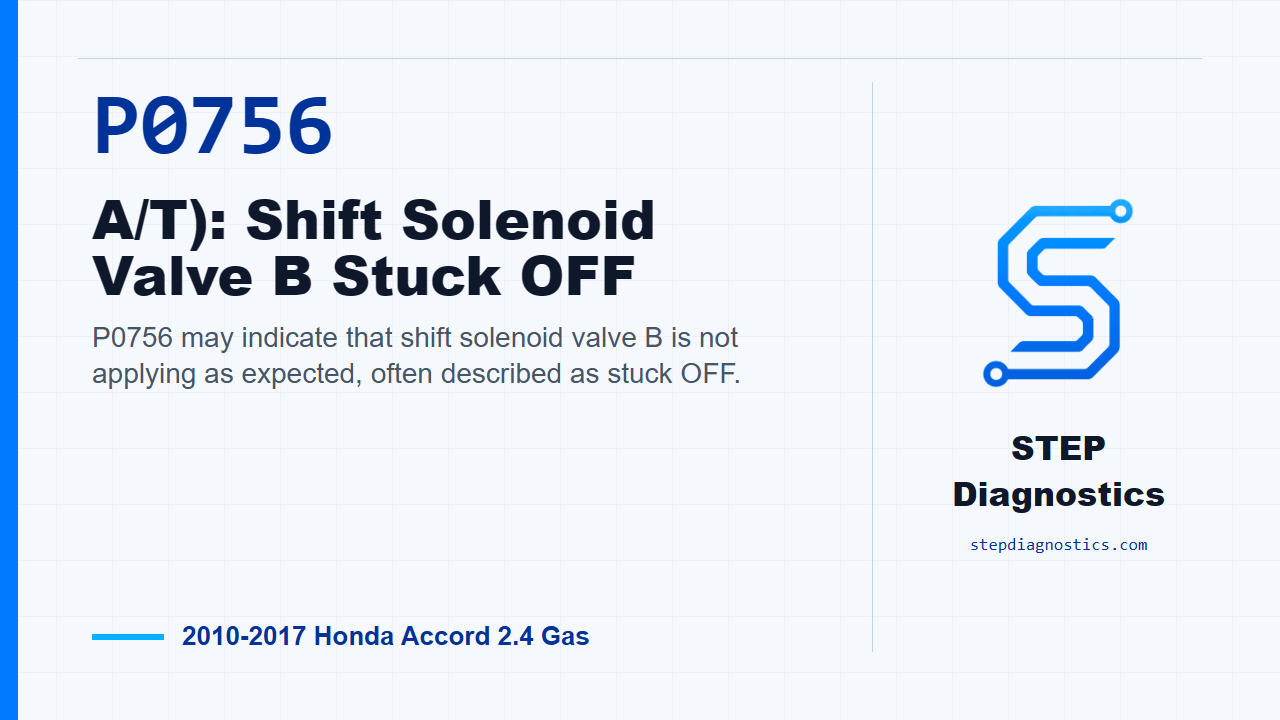
P0756 may indicate that shift solenoid valve B is not applying as expected, often described as stuck OFF.
What the vehicle may do
- The transmission may enter a fail-safe strategy and limit normal shifting.
- The driver may notice harsh, limited, or abnormal shift behavior.
Possible fault areas
- Possible ATF contamination or internal clutch material
- Possible shift solenoid valve B issue
- Possible hydraulic shift valve issue
- Possible internal mechanical transmission fault
Diagnostic path
Opening context
On this 2010 to 2017 Honda Accord with the 2.4 gas engine, P0756 points to shift solenoid valve B being stuck OFF. In plain terms, the PCM is seeing a shift control problem that may involve the hydraulic side of the transmission, the solenoid, the shift valves, fluid contamination, or an internal mechanical fault. The driver may notice the transmission going into fail-safe operation; when this code is stored, it does not shift to any gear other than 2nd or 5th gear. Before getting deep into the test path, start with the basic system checks and make sure there are no obvious issues being missed.
Start with ATF condition and debris
First, get the engine up to normal operating temperature. Confirm the transmission is filled to the proper level, check for fluid leaks, then drain the ATF through a strainer. What you are looking for is metal debris or excessive clutch material. If the strainer has that kind of debris in it, the path calls for transmission replacement. If it does not, replace the ATF and move on to the scan tool checks.
Use scan data to separate solenoid behavior from other faults
Next, turn the vehicle to ON mode, clear the code with the HDS, start the engine, hold the brake pedal, and shift to D position or D mode. Watch A/T Shift Solenoid Valve B, Input Shaft, or Mainshaft, Speed, and Shift Control on the HDS. The key comparison is this: Input Shaft Speed should be 0 rpm when A/T Shift Solenoid Valve B is OFF, and about the same as engine speed when A/T Shift Solenoid Valve B is ON. If it matches that pattern, shift back to P and go check shift solenoid valve B operation. If it does not match, shift back to P and run the problem verification step.
Verify whether the failure is duplicated
For the problem verification, clear the code again with the HDS. With the brake pedal pressed, shift to D position or D mode and watch A/T Shift Solenoid Valve B, Input Shaft Speed, and Shift Control. This time, you are checking whether Input Shaft Speed stays steady when the solenoid is OFF and when it is ON. If it does, the failure is duplicated. The fault callout is the 1st gear one-way clutch. The repair path is to replace the countershaft 1st gear, which is the 1st gear one-way clutch, or replace the transmission. If the countershaft 1st gear is replaced, clean metal debris or excessive clutch material from the transmission, ATF cooler, ATF pipes, and hydraulic circuit, then replace the countershaft 1st gear and the torque converter. If the failure does not duplicate, treat it as intermittent and OK at this time. If snapshot data for this code is available, try to reproduce the failure using the captured conditions.
Command shift solenoid valve B
If the earlier scan data points you toward the solenoid check, select Shift Solenoid Valve B in the miscellaneous test menu and operate it with the HDS. Listen for the click. If you hear the clicking sound, shift solenoid valve B is OK and you continue to the shift valve test. If there is no click, the fault callout is shift solenoid valve B, and the repair path is replacement of the secondary valve body for shift solenoid valve B.
Check shift valve operation under the controlled gear test
For the shift valve B check, turn the vehicle OFF, raise it on a lift, make sure it is securely supported, and make sure all four wheels can rotate freely. Turn the vehicle ON, clear the code with the HDS, start the engine, and disable VSA with the VSA OFF button. If the vehicle speed will be above 31 mph (50 km/h), use VSA maintenance mode. Then perform the test-drive portion, shift the transmission to 2nd gear and then to 3rd gear, and watch the 3rd Pressure Switch, 6th Pressure Switch, and Shift Control on the HDS. In 3rd gear, if the 3rd Pressure Switch is OFF and the 6th Pressure Switch is ON, the fault callout is shift valve B. The repair path is replacement of the secondary valve body for shift valve B, or replacement of the transmission. If that pressure switch pattern is not present, shift valve B is OK and the fault callout is shift valve C. The repair path is replacement of the main valve body for shift valve C, or replacement of the transmission. If the main valve body is replaced, clean any metal debris or excessive clutch material from inside the transmission, the ATF cooler, the ATF hoses, the ATF pipes, and the hydraulic circuit, then replace the main valve body and the torque converter. After the test, slow down and stop the wheels.
Takeaway and CTA
The clean way through P0756 is to start with fluid contamination, then use scan data to separate solenoid command behavior from a duplicated internal fault, then finish with the solenoid click test and the controlled shift valve pressure switch check. Do not jump straight to parts; let the branch you land on make the call. For more diagnostic training, visit stepdiagnostics.com.
Final check
Use the ordered test path to separate fluid contamination, solenoid operation, hydraulic valve behavior, and possible internal transmission faults.
For more guided automotive diagnostics, visit STEP Diagnostics.